


Key takeaways
- Employee benefits are the non-monetary compensation you provide your workers.
- Popular employee benefits include health insurance, retirement savings, and paid leave, while uncommon benefits include child care, pet insurance, and mental health support.
- Thorough cost analysis, industry standards research, and staff surveys are important to determine the best benefits to offer your employees.
Contributing experts
- Cheri Wheeler: Vice President and Senior Consultant at Kelly Benefits Strategies.
- Cyndi Wenninghoff, PHR SHRM-CP: Director of Employee Success at Quantum Workplace.
Update notes
- Oct. 13, 2025: Hanna Sillo updated the article’s formatting for better readability, revised section headers, refreshed key elements, and added new FAQs to improve clarity and coverage.
- Jul. 17, 2024: Jessica Dennis reviewed and rewrote the article for freshness and accuracy. She also rearranged elements on the page and updated the formatting to improve the flow of information.
What are employee benefits?
Employee benefits are the non-monetary compensation employers provide alongside regular pay, like health insurance, retirement plans, and paid time off. In most U.S. workplaces, both employers and employees share the cost of these programs.
Think of benefits as the essentials that keep work and life running smoothly, such as water, power, and heat in a house. By contrast, perks are the nice extras: free lunches, gym memberships, or learning stipends.
Beyond what’s required by law, companies can tailor their benefits to fit their workforce and budget. For example:
- Increase paid time off (PTO) with tenure to reward loyalty.
- Offer flexible insurance options for full- and part-time staff.
However you design your package, keep equity and consistency in mind. Ideally, employees in similar roles and circumstances should have access to the same benefits.
Advantages of offering employee benefits
Employee benefits are a net good for your organization despite the increased labor costs. This is because employee benefits help you:
- Comply with labor laws: You’ll avoid fines and penalties from laws like the Affordable Care Act (ACA), Employee Retirement Income Security Act (ERISA), and Federal Insurance Contributions Act (FICA).
- Attract top talent: Offering top-tier benefits as part of your recruitment strategy can encourage qualified candidates to apply since they help you stand out from competitors.
- Retain talent longer: Employees are more likely to stay long-term if you offer great benefits since they improve employee morale, satisfaction, and well-being.
- Support a diverse workforce: Benefits can support diversity, equity, and inclusion (DEI) through comprehensive PTO to support religious and cultural observations, more affordable healthcare, and flexible work for employee caregivers.
- Align with company values: The benefits you offer can demonstrate your commitment to values like inclusion, teamwork, and community, plus strengthen your company’s brand image.
Global benefits
Compared to other countries, employee benefits in the U.S. are far more employer-driven. This gives companies flexibility to tailor plans, but it also means U.S. workers depend on their employers for benefits that are guaranteed by law elsewhere.
For example:
- Japan and the U.K. offer universal healthcare, so employees don’t rely on their jobs for coverage.
- Many countries require paid parental leave and medical leave by law.
- In 2023, Spain introduced paid menstrual leave, giving women up to three days off for severe pain.
If you employ people in multiple countries, being mindful of these global standards helps you create fair and culturally relevant benefits.
For instance, if your team includes both U.S. and U.K. employees, you could offer free health insurance to U.S. staff to match the U.K.’s public coverage. Moves like this show your commitment to equity and consistency—ensuring all employees have access to comparable benefits, no matter where they work.
Learn more about how to create an equitable global benefits strategy: An Employer Guide to Global Employee Benefits
Examples of employee benefits
The table below breaks down the most common employee benefits in the U.S., including those mandated by law and popular fringe (voluntary) benefits:
Legally mandated benefits
Health and wellness
| Benefit | Description |
|---|---|
| Workers’ compensation | Provides employees with medical care and partial wage replacement following a work-related injury or illness. |
| Affordable Care Act (ACA)-qualifying health insurance | Requires employers with 50 or more full-time employees to offer affordable health insurance to employees. |
| Medicare | Provides health insurance to employees 65 or older; employees and employers fund this through Federal Insurance Contributions Act (FICA) payroll tax. |
Financial security
| Benefit | Description |
|---|---|
| Social Security | Provides a percentage of income to employees after reaching age 65 or older; employees and employers fund this through FICA payroll tax. |
| Unemployment insurance (UI) | Issues partial wages to employees following a qualifying termination, such as a layoff; employers fund this through Federal Unemployment Tax Act (FUTA) and State Unemployment Tax Act (SUTA) payroll taxes. |
Work and life balance
| Benefit | Description |
|---|---|
| Family and Medical Leave (FMLA) | Mandates qualifying employers to provide up to 12 weeks of unpaid, job-protected leave to eligible employees for specific medical and family reasons. |
Fringe benefits
Health and wellness
| Benefit | Description |
|---|---|
| Medical or health insurance | Pays for some or all of employees’ medical care; employees and employers usually pay for this through pre-tax payroll deductions; plans include Preferred Provider Organization (PPO), Health Maintenance Organization (HMO), or High Deductible Health Plan (HDHP). |
| Dental insurance | Pays for some or all of employees’ dental care; employees and employers usually pay for this through pre-tax payroll deductions. |
| Vision insurance | Pays for some or all of employees’ vision care; employees and employers usually pay for this through pre-tax payroll deductions. |
| Prescription or pharmacy insurance | Pays for some or all of employees’ drug prescriptions; employees and employers usually pay for this through pre-tax payroll deductions. |
| Wellness programs | Promotes health, well-being, and exercise through workplace offerings, like gym memberships, health screenings, and fitness and mental health stipends. |
Financial security
| Benefit | Description |
|---|---|
| Short-term (STD) and long-term (LTD) disability insurance | Replaces a portion of an employee’s income following a serious injury or illness; employees and employers usually pay for this through payroll deductions. |
| Financial wellness | Provides financial literacy tools, such as money managing courses and earned wage access (EWA), to decrease employees’ financial stress. |
| Retirement and pension plans | Ensures employees receive a portion of income replacement following retirement; employees and employers pay for these through pre-tax payroll contributions. |
| Annuities | Provides employees with a set income regularly at a later date; qualified employee annuities allow workers to fund it through pre-tax contributions. |
| Life insurance and death benefits | Issues employee beneficiaries a sum of money following an employee’s death; either employees, employers, or both may fund it. |
| Health savings accounts (HSAs) or flexible spending accounts (FSAs) | Pays for qualified medical expenses from an account that employees contribute pre-tax gross pay; HSAs roll over year after year and FSAs are use-it-or-lose-it accounts. |
| Relocation assistance | Pays wholly or partially for expenses around work relocation, like travel, moving, food, and temporary lodging. |
| Tuition assistance | Assists employees in paying for their education, usually in exchange for taking specific courses or maintaining a certain GPA. |
| Equity | Allows employees to buy in and own stock shares of their company in exchange for a portion of its profits. |
Work and life balance
| Benefit | Description |
|---|---|
| Paid time off (PTO) | Provides pay to employees even if they did not work; companies can offer different kinds like paid sick, vacation, personal, bereavement, and jury duty leave. |
| Holiday pay | Provides pay time off to employees during holidays recognized by the company, such as Independence Day in the U.S. |
| Premium pay | Provides income over an employee’s straight-time pay rate to incentivize working undesirable shifts or hours; overtime pay and shift differentials are examples. |
| Employee assistance programs (EAPs) | Assists employees in finding solutions to personal problems affecting their work, such as financial, legal, health, and relationship issues. |
| Commuter benefits | Lowers the gas, parking, and public transport costs employees pay to get to and from work; employees and employers pay for this through pre-tax payroll deductions. |
| Flexible work | Allows employees to vary their work location or start and stop times but maintain the number of hours they work each week to accommodate personal needs, like child care and doctor visits. |
Types of employee benefits
The benefits you can offer employees fall into two categories: legally mandated or fringe.
Core benefits every employer should offer (legally required)
Legally-mandated benefits are benefits you must offer your employees by law. In the U.S., federal law requires employers to provide and pay in whole or in part the following employee benefits:
Workers’ compensation
Workers’ compensation (WC) is insurance that pays 100% of the medical costs associated with an employee’s work-related injury or illness. It also replaces some of the employee’s wages once they have missed work for a specified period.
All states, except Texas, require employers to purchase and maintain WC insurance through a state fund or a private insurance carrier. Some states also allow you to self-insure, allowing you to pay for WC claims directly without going through an insurance carrier.
WC is essential for employees, especially those in high-risk industries like logging, fishing, construction, and roofing. Besides providing a financial safety net for them following a workplace accident, it also incentivizes employers to develop comprehensive safety programs to protect their employees and reduce the chance of expensive claims that raise their insurance premiums.
Want to learn more?
Check out Navigating Injuries in the Workplace, which discusses the various U.S. laws that come into play at the onset of a workplace injury.
ACA-qualifying healthcare
The Affordable Care Act requires applicable large employers (ALEs) — or those with 50 or more full-time employees — to offer affordable health insurance to employees or risk a federal penalty. If you are an ALE, generally you will work alongside your insurance broker or carrier to find a plan that aligns with your benefits strategy and does not exceed a certain percentage of employees’ household income.
You should also consider your employee population when deciding on healthcare plans. A plan may be affordable by ACA standards, but your employees may still spend a significant proportion of their income on healthcare relative to their location and socioeconomic class.
For instance, employees may spend most of their income on transportation to and from work and groceries, especially if they live in food deserts. As a result, you may want to absorb more of the premium costs so employees retain most of their take-home pay.
Even if you are not an ALE, you may offer ACA-qualifying insurance as a part of your overall employee attraction and retention strategy. After all, according to SHRM’s 2023 Employee Benefits Survey, health insurance ranks as the most important benefit to employees. Plus, if you’re a small business and offer ACA-qualifying insurance, you may be eligible for a small business tax credit from the Internal Revenue Service (IRS).
Don’t forget COBRA!
If you have 20 or more employees and offer health insurance, you must comply with the federal Consolidated Omnibus Reconciliation Act (COBRA). COBRA allows terminated employees to continue their employer-sponsored health insurance coverage for up to 18 months. Employees are responsible for paying the total cost of benefit premiums to continue on the plan.
COBRA also requires you to send paperwork notifying employees of their rights upon benefits enrollment, plus an election notice for any COBRA qualifying event. You can read the Department of Labor’s An Employer’s Guide To Group Health Continuation Coverage Under COBRA for more information.
Social Security and Medicare
Under the Federal Insurance Contribution Act (FICA), employers and employees are responsible for funding the federal Social Security and Medicare programs. 7.65% of your employees’ taxable wages each paycheck goes to these programs, which you match.
Social Security is a type of wage replacement available to people with disabilities or those 65 or older. Similarly, Medicare is a federal health insurance that covers the same demographic. Both ensure income and affordable healthcare once people reach retirement age.
Despite these federal social programs, most employers offer retirement and health insurance plans to fill in the gaps of these programs, especially for employees who want to maintain a certain standard of living.
Family and Medical Leave
The Family and Medical Leave Act (FMLA) requires employers with 50 or more employees within a 75-mile radius to provide at least 12 weeks of unpaid, job-protected leave for a qualifying family or medical reason. Typical reasons include childbirth, a serious health condition, caregiving responsibilities, or reasons involving a family member’s military service.
Because FMLA is a job-protected leave, you are responsible for maintaining benefits, like health insurance, during an eligible employee’s leave. You also must place them in the same or similar position upon their return to work.
While FMLA is unpaid, remember that some states mandate paid family leave. Even if your employees reside in states without these laws, offering paid family and medical leave is a great way to attract employees and showcase your dedication to their personal well-being.
Unemployment insurance
Unemployment insurance (UI) provides partial income replacement to employees following termination for an eligible reason, usually a layoff. In most states, you pay for 100% of this benefit through the Federal Unemployment Tax Act (FUTA) and state equivalent acts (SUTA).
Although the FUTA rate is a flat 6% for most employers, some states impose experience ratings, meaning employers with more frequent unemployment claims pay higher UI taxes. As a result, businesses in seasonal or high-turnover industries usually have higher UI costs.
If this is you, remember to be upfront with your employees about their unemployment benefits. Many states require posters with instructions on filing for UI benefits upon termination; you may even have to provide them with your unemployment account numbers.
These benefits are important for employees who have just lost their income, and employers who are forthright about the process are more likely to develop loyal employees.
Federally-mandated vs. state-mandated benefits
For simplicity, we’ll only discuss federally mandated employee benefits here. However, most states and municipalities require employers to offer additional benefits to employees or more employee-favorable versions of federal benefits.
For example, California, New York, Chicago, Philadelphia, Michigan, and Washington require employers to provide employees with paid sick leave benefits. Some states, like Massachusetts, Colorado, and Rhode Island, even mandate paid family leave, which exceeds FMLA requirements.
Because of this, double-check the laws for your employees’ countries, states, and municipalities to ensure you’re meeting minimum provisions.
Voluntary (fringe) benefits that attract talent
Fringe benefits are benefits you offer employees outside of those required by law. Because of this, you can also think of fringe benefits as voluntary or discretionary benefits.
There are several types of fringe benefits, but you can sort most into the following categories:
- Health and wellness
- Financial security
- Work and life balance
Fringe benefits and the IRS
The IRS defines fringe benefits as “a form of pay for the performance of services.” It offers examples like providing a company car to commute to and from work, tickets to entertainment events, and discounted services. As a result, the IRS definition of fringe benefits includes both voluntary benefits and employee perks.
The main takeaway is that most fringe benefits and perks are taxable. You should factor their cost into employees’ gross pay for income tax withholding. Exceptions include most health insurance and retirement and pension plans.
Health and wellness
Health and wellness fringe benefits comprise any non-compensation benefit related to an employee’s physical, mental, and emotional well-being. The most common include the following:
- Medical insurance.
- Dental insurance.
- Vision insurance.
- Prescription and pharmacy insurance.
- Wellness programs.
Most of these benefits aim to cover the costs of various health-related services, from doctor and hospital visits to dental cleanings and gym classes. Usually you’ll partner with an insurance carrier that manages, pays for, or reimburses employees on eligible health claims.
Considering health insurance benefits account for about 6.9% of an employee’s total compensation package, according to September 2023 Bureau of Labor Statistics data, many employers are finding low-cost health benefit alternatives. This may include access to onsite nurses, therapists, and wellness classes.
Financial security
Financial security fringe benefits are any benefits that help employees manage their finances for future expenditures and retirement.
Most financial security benefits revolve around wage replacement following an injury, illness, retirement, or death. Others help to pay for life expenses, including education and moving. Below are some of the most common:
- Short-term and long-term disability insurance.
- Retirement plans, like 401(k) or Roth 401(k).
- Pension plans.
- Annuities.
- Life insurance or death benefits.
- Employee savings plans, like health savings accounts (HSAs) and flexible savings accounts (FSAs).
- Relocation assistance.
- Tuition assistance.
- Equity.
What is financial wellness?
Financial wellness refers to the ability of someone to manage their money in a way that provides them peace of mind. As an employer, financial wellness benefits typically refer to a variety of tools you can offer employees to ease financial stress, such as:
- Financial literacy classes.
- Discount programs.
- Budgeting and saving tools.
- Earned wage access (EWA).
According to a 2023 TransAmerica Institute Report, only 28% of employers offer financial wellness programs compared to 77% of employees who consider them important. This is surprising since most financial wellness tools are free or low-cost. Many human resources (HR) platforms even include financial wellness tools with their subscription.
Gusto, for example, gives employees access to Gusto Wallet, which allows them to track and add money to multiple savings goals within their mobile app. Meanwhile, Paycor offers on-demand pay, financial coaching, and self-paced learning courses to educate employees and provide a financial cushion for unforeseen expenses.

Wallet lets employees budget their spending into different categories to maximize each paycheck. Source: Gusto 
With Paycor, employees can get free advice, schedule a financial counseling appointment, and take financial learning courses directly from their mobile phones. Source: Paycor
Work and life balance
Fringe benefits that balance work and life make it easier for employees to be successful in both their professional and personal lives. The most popular work and life balance benefit is job-protected paid leave that allows employees to miss work for various personal reasons without fear of termination.
Other standard work and life balance benefits include:
- Paid time off (PTO).
- Holiday pay.
- Premium pay.
- Employee assistance programs.
- Commuter benefits.
- Flexible work.
Since the COVID-19 pandemic, employees have placed greater importance on these benefits. Flexible work options, for example, are attractive to groups like single parents, caregivers, and people with disabilities, where traditional nine-to-five work is incompatible with their day-to-day realities.
SHRM’s 2023 Benefits Survey notices this shift, with 62% of employers now offering hybrid work opportunities and 59% subsidizing at-home office equipment. These benefits significantly open up your candidate pool, allowing you to source talent from a wider array of backgrounds.
Emerging and uncommon employee benefits
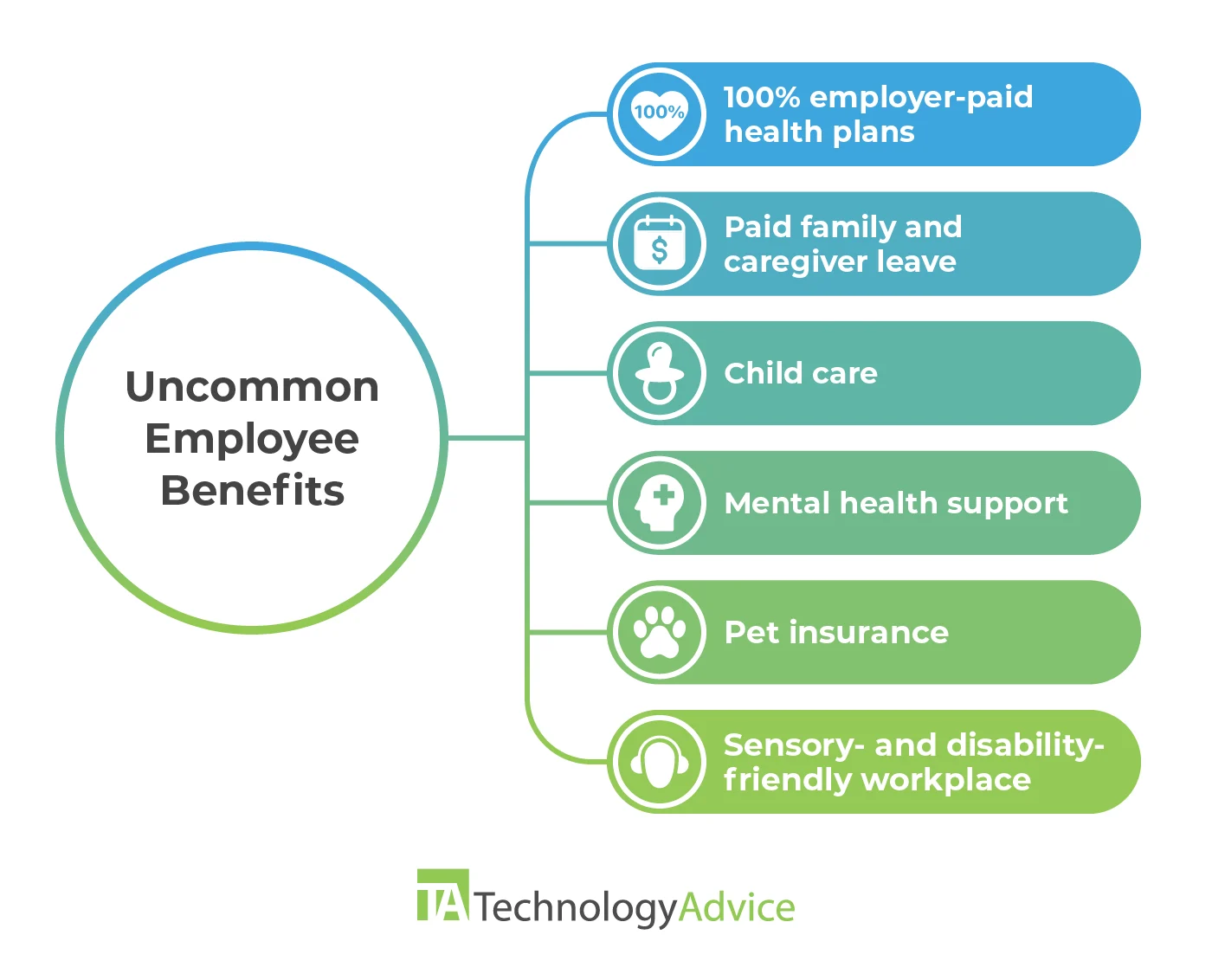
If you already offer most of the above benefits in your total compensation package, many lesser-known benefits are growing in popularity. Adding these unique benefits can modernize your employee benefits and make your workplace stand out.
1. 100% employer-paid health plans
Under the ACA, most employers with 50 or more full-time employees must offer health insurance. But coverage quality and costs still vary widely, and many employees have limited provider options—especially with low-cost, high-deductible plans.
Fully covering health insurance for employees (and their dependents) removes those barriers. It reduces financial stress, supports workers with ongoing medical needs, and promotes equity by giving everyone the same access to quality care—without extra out-of-pocket costs.
Did you know?
According to a 2023 Deloitte study, women pay $15 billion more than men in out-of-pocket healthcare costs annually. In addition to paying 100% of premiums, consider shopping for insurance plans with robust coverage options for women, including menstrual, menopause, and reproductive support.
You may also want to pay particular attention to each plan’s out-of-state coverage, especially if your employees live in rural areas with limited access to in-network providers. Other things to look out for are each health plan’s support for mental health, telemedicine, and gender-affirming care.
2. Paid family and caregiver leave
The federal FMLA only guarantees unpaid leave, so offering a paid family and caregiver program immediately sets your company apart. It’s especially valuable for employees managing medical conditions or starting families who can’t afford lost wages.
Paid caregiver benefits also boost productivity and engagement. As Cheri Wheeler, VP and Senior Consultant at Kelly Benefits Strategies, explains: “Caregiving benefits can help improve employee productivity, as employees who are able to manage their caregiving responsibilities effectively are more likely to be focused and engaged at work.” These programs reduce stress, burnout, and financial insecurity—while strengthening company culture.
The U.S. remains one of just six countries without national paid parental leave. Offering it voluntarily shows you care about employees’ well-being, supports retention, and positions your business to compete globally when the time comes.
Build your family and caregiver leave policy
Providing paid family leave is fantastic, but pay close attention when crafting your leave policy. A comprehensive family leave program should also cover lactation support, elder care assistance, and family planning. A good leave program also offers ways for employees to negotiate flexible working arrangements, extended leave, and a gradual return to work.
If you’re curious, you can learn more about leave management and parental policy building in our resources below:
- The Employer’s Guide to Parental Leave Policies
- Policies & Benefits That Support Working Parents
- Leave Management Tools and Best Practices
3. Child care
Childcare benefits can take on a variety of forms, such as:
- Stipends to lower costs for child care services.
- Dependent Care Flexible Spending Accounts (DCFSA).
- Discounts at local child care facilities.
- In-office child care centers.
The goal is to help working parents reduce child care costs while continuing to work. If you’re a small business with a limited budget, assisting employees with finding or paying for child care can be more affordable than an employee missing work due to unreliable or unaffordable child care.
4. Family-building and reproductive assistance
Family-building and reproductive assistance benefits help employees who want to start a family but face obstacles. It includes employer-sponsored offerings like:
- Fertility assistance, such as in vitro fertilization (IVF)
- Adoption
- Egg or sperm donors
- Surrogacy
While some health care plans and EAPs cover these, carving out family-building benefits can be especially attractive to employees who are:
- Single by choice
- LGBTQ+
- Struggling with fertility
One advantage of offering family-building and reproductive assistance is that it can be unique to your company’s culture and budget.
For example, Cyndi Wenninghoff, the Director of Employee Success at Quantum Workplace, explains that they reimburse employees up to $10,000 per family per year for fertility and adoption services. Such reimbursement programs allow employees to choose the services they want without the limitations of insurance plans.
5. Mental health support
Mental health benefits help employees manage stress, anxiety, and other emotional challenges—and they’re now a core part of any modern benefits package.
Most health insurance plans include coverage for:
- Counseling and therapy
- Medication and psychiatric treatment
- Substance abuse programs
If your plan doesn’t cover these—or you want to do more—consider:
- Mental health days built into PTO for recovery or crisis support
- Onsite or virtual counseling options
- Wellness apps like Calm or Headspace for daily stress management
Even small investments in mental health support can reduce burnout, boost focus, and strengthen workplace culture.
Mental health awareness in the workplace
Despite the strides mental health awareness has made in recent years, there is still a lot of stigma and shame surrounding mental healthcare. Minority groups, like people of color, who want to take advantage of mental healthcare services may have difficulty finding care from providers with knowledge and backgrounds similar to them.
One way to support these groups as an employer is to foster a workplace culture of acceptance through company-wide allyship training and crisis management training for managers. Creating and providing access to employee resource groups (ERGs) is another way for employees to find support in a shared community, even if they are uncomfortable with traditional mental healthcare options.
6. Pet insurance
Pet insurance is becoming a popular employee perk and for good reason. According to 2023 Pew research, 62% of Americans own a pet, and 97% consider them family. Routine care, vaccinations, and vet visits can quickly add up, making this benefit both practical and appreciated.
More employers are catching on: SHRM’s 2023 Benefits Survey found that 19% of companies now offer pet insurance, up from 14% in 2022.
Most plans reimburse employees for eligible vet expenses and fall into two types:
- Illness plans: Cover major issues like injuries or diseases.
- Wellness plans: Cover preventive care such as checkups, vaccines, and lab work.
If you’re considering this benefit, ask employees which option they’d value most. Even a modest plan can go a long way toward loyalty and morale.
7. Sensory- and disability-friendly workplaces
The Americans with Disabilities Act (ADA) requires employers to provide reasonable accommodations and accessible facilities. But truly inclusive workplaces go a step further by designing spaces that proactively support all employees.
Simple changes can make a big difference:
- Quiet or low-sound rooms for neurodivergent employees
- Adjustable desks and chairs for different body types and needs
- Wide walkways for easier wheelchair access
- Soft lighting or soundproof areas to reduce sensory overload
For example, PwC redesigned its offices in 2021 with features like pink noise and flexible work zones to create a more supportive environment. Investing in accessibility isn’t just compliance — it’s a commitment to helping every employee do their best work.
Employee benefits FAQs
What’s the most popular benefit to offer your employees?
Health insurance is the most popular employee benefit since the U.S. does not provide universal healthcare.
What benefits do employees value the most?
The benefits employees value the most depend on several factors, including geographic location, industry, and culture. U.S. employees usually value health insurance and PTO as benefits, but this may differ for employees in countries with universal healthcare or nationally mandated paid leave requirements.
Australians, for example, have universal health care and access to four weeks of paid leave per year. As a result, more worthwhile benefits may be life and disability insurance, EAPs, or paid leave benefits on top of those required by law.
How much do employee benefits cost?
According to September 2023 BLS data, legally mandated benefits, including Social Security, Medicare, FUTA, SUTA, and WC, are the most expensive benefits, costing around $3.11 per hour per employee for private employers. Following this, paid leave and insurance are the second and third most costly benefits at $3.09 and $3.04 per hour per employee, respectively.
Overall, the cost of benefits is an additional $12.19 per hour to an employee’s compensation.
What’s the difference between employee benefits and rewards?
Employee benefits are the non-monetary compensation portion of an employee’s total compensation package. Businesses provide them to all employees in the same or similar roles to improve the quality of their personal and professional lives.
In contrast, rewards function as a way for employers to recognize and congratulate employees. Most companies tie rewards to performance, but you may also give rewards for other reasons, such as demonstrating a company’s core value. Unlike benefits, companies do not guarantee rewards; instead, employees must earn them.
Rewards can vary from non-monetary items, like lunch for the team, to monetary items, like performance bonuses and gift cards.
How often should I review or update my benefits package?
At least once a year. Regular reviews help ensure your benefits stay competitive, compliant, and aligned with your workforce’s needs. Use employee surveys or one-on-one feedback to see what’s working and what isn’t, then adjust based on participation rates and industry trends.
Can employees customize their benefits?
Yes. Many employers now offer flexible or “cafeteria-style” benefits plans, letting employees choose the perks and coverage that best fit their lifestyle. This flexibility helps improve satisfaction and ensures you’re investing in benefits your team actually values.
What’s the difference between taxable and non-taxable benefits?
Taxable benefits count as part of an employee’s income and are subject to payroll taxes (like bonuses or gift cards). Non-taxable benefits—such as health insurance or retirement contributions—are generally exempt. Always confirm with a tax professional or the IRS before labeling benefits as tax-free.
How to choose the right employee benefits for your company
To choose the right employee benefits for your company, ask yourself the following:
- What resources, like time and money, do I have for my employee benefits packages?
- What benefits do employees expect in my industry?
- What is the culture and demographics of my staff?
- Where are my employees located?
- What tools do I have to manage my benefits package?
But most importantly, ask your employees: “What benefits do you want?”
Employee engagement software can facilitate surveying employees on your benefits offerings. Culture Amp, for example, offers a U.S.-specific benefits survey to gather insight into the effectiveness of your current benefits and interest in new ones.
Once your benefits packages are in place, most HR software lets employees self-enroll in the benefits they want during onboarding while keeping track of employee and employer contributions. Paycor even provides a benefits advisor feature that improves the employee experience by helping new hires select the benefits that best suit their circumstances.
If you want to learn more, peruse our HR Software and Benefits Administration Software guides for a complete list of software options.

Culture Amp offers a library of employee engagement survey templates to gain insights into your organization with little administrative effort. Source: Culture Amp 
Paycor offers a benefits cost calculator and questionnaire to help employees choose the best benefits package during enrollment. Source: Paycor