

Key takeaways
- Employee resource groups (ERGs) are internal organizations focused on creating a more inclusive workspace for underrepresented groups in the company.
- Effective ERGs can promote inclusion and belonging, attract diverse talent, and build professional networks.
- They can also help companies make positive changes in their workplaces and external communities.
- Successful ERGs require clear purposes, goals, and support from the company to promote employee engagement and belonging.
Update notes
- Oct. 28, 2025: Hanna Sillo reorganized sections for easier reading, revised headers, refreshed elements, and added practical examples, tips, new stats, and an FAQ section.
What is an employee resource group?
An ERG is an employee-led group formed around a shared identity, experience, or interest that builds community, advises leadership, and runs programs. Some of the most common include:
- Ethnicity
- Gender identity
- Sexual orientation
- Religious affiliation
- Military status
- Disability
- Mental health
- Caregiving
They also go by affinity groups, business resource groups, or business network groups.
Although a major component of ERGs is spreading interest and awareness about their struggles, they also act as the infrastructure to put company diversity, equity, and inclusion (DEI) goals into practice.
For example, they can help educate others in the organization, promote allyship, improve employee-focused business practices, and help get more diverse people into leadership positions.
As per Verbate’s 2025 report, companies with over 500 employees tend to have somewhere between 6 to 15 ERGs.
Explore HR software to satisfy the needs of your small business in our Best Human Resources (HR) Software for Small Businesses.
What are examples of ERGs?
- National Black Employees Association (NBEA): Originally Xerox’s National Black Employees Caucus.
- King Games’ Kicking Glass: Focusing on non-male identifying employees in the gaming industry.
- AT&T’s LEAGUE: Focusing on LGBTQIA+ employees.
- Walmart’s inABLE Associate Resource Group: Focusing on accessibility for employees with disabilities.
- Amazon’s Body Positive Peers Affinity Group: Focusing on cultivating body positivity in the workplace.
- Bank of America’s Parents & Caregivers Network: Focusing on providing resources for employee caregivers.
What are the advantages of employee resource groups?
ERGs can promote organizational inclusion and belonging, attract diverse talent, build professional networks, drive position workplace changes, and benefit external communities.
1. Boost inclusion and employee belonging
ERGS build strong company culture by allowing employees to openly discuss their interests, identities, or concerns in a group setting without fear of repercussions. By connecting employees of similar backgrounds together, these groups can foster safety and reduce feelings of isolation.
In addition, the visibility of ERGs can boost your workplace’s cultural competence and acceptance of varying employees’ lived experiences, backgrounds, and abilities. As a result, employee retention and engagement increase while turnover decreases.
2. Attract and retain more diverse talent
ERGs are crucial for recruiting Gen Z, the most ethnically diverse generation, as they showcase your commitment to diversity, equity, and inclusion in meaningful work. Advertising what groups are available on your job descriptions and throughout the recruitment process boosts candidate interest and may set you apart from your competition.
3. Create cross-company professional networks
ERGs allow employees to expand their network to different teams and departments. As a result, employees develop contacts they can turn to for assistance or collaboration on company projects.
Members can also develop their external networks through ERG-sponsored events. Not only does this support employees’ career development, but it also can build their sense of community and belonging. In turn, these networks and experiences can help employees contribute to your company’s bottom line.
4. Deliver concrete workplace improvements
ERGs are frequently the driving force behind workplace improvements to physical and mental spaces. For instance, they can establish gender-neutral bathrooms, put up Braille for the visually impaired, or institute employee assistance programs (EAPs) to help immigrants obtain permanent residence status.
Additionally, executives and DEI commitments can look to them for advice before instituting significant workplace changes. This kind of reverse mentorship allows employees much lower on the organizational chart to have a voice in major company decisions.
5. Extend company impact into communities and markets
Through community volunteering or charity events, conferences, or workshops, ERGs have the opportunity to make a positive impact on their communities. Beyond making their communities more inclusive places to work and live, they help promote and build a positive reputation for your brand.
In addition, ERGs can help improve their company’s products or services for underrepresented groups. For instance, a clothing company’s Body Inclusivity ERG may suggest adding sizes for different heights or weights. By expanding its target market, the company can increase sales and benefit communities in the long term.
What are the challenges of implementing employee resource groups?
A lack of leadership, member recruitment, unclear purpose and objectives, and lack of company resources can make implementing an ERG challenging.
1. Risk in weak or missing ERG leadership
Without proper governance and leadership, ERGs are disorganized in their actions. When there is a lack of oversight, groups may have conflicting expectations with executives, making their change efforts ineffective.
2. Hard to recruit and sustain members
ERG member recruitment requires more than a single flyer on the company bulletin board. Even if company higher-ups and DEI committees want to implement an ERG, make sure starting one is of interest to the employee population first. Otherwise, you risk isolating employees from the group and counteracting DEI initiatives. The ERG fails before it even starts.
3. Vague mission and unclear objectives
ERG members cannot affect positive workplace changes if they do not outline clear goals. Moreover, if employees are unsure of the group’s intention, it can have the opposite effect of excluding employees on the very issues or identities it stands to represent.
4. Insufficient company funding or support
ERGs cannot sponsor events, recruit members, or enact change without support from the company. Lack of company resources can also stall recruitment efforts since members volunteer their time without compensation from the company.
How to implement an employee resource group
Maximize the benefits of ERGs and avoid implementation challenges by following the steps below:
1. Survey the company and advertise
ERGs require collaboration between employees and executives for maximum effectiveness. Most employee engagement platforms, such as Motivosity, have survey tools you can leverage to gauge employee interest and pinpoint which ERGs will be the most effective in the organization.
Following this, advertise the groups with the most employee interest across company communication channels and develop a roster of employees. HR departments or DEI committees may have to facilitate the first few meetings to get started. However, after this, ERGs should be free to run themselves so members can feel safe to talk openly without feeling scrutinized by the company.
Example: Acme’s HR ran a 7-day pulse and found 120 employees clicked “would join” for a Parents and Caregivers ERG and 35 volunteered to help organize. That made the decision simple: launch Parents and Caregivers first and recruit three volunteer co-leads from that pool.
Check out how to create surveys through Motivosity below:
2. Identify purpose and goals
Once ERG members choose a leader and governance style, they should develop a mission statement with an overall purpose and short- and long-term goals. For example, an LGBTQIA+ group’s primary purpose may be to educate employees about issues facing their community with a short-term goal of increasing ally membership by 5%.
- Example mission: “Parents and Caregivers ERG supports caregivers by sharing resources, running monthly peer support, and proposing flexible-shift pilots.”
- Example goals: Run 4 peer-support sessions this year and deliver one parental leave policy recommendation by Q3.
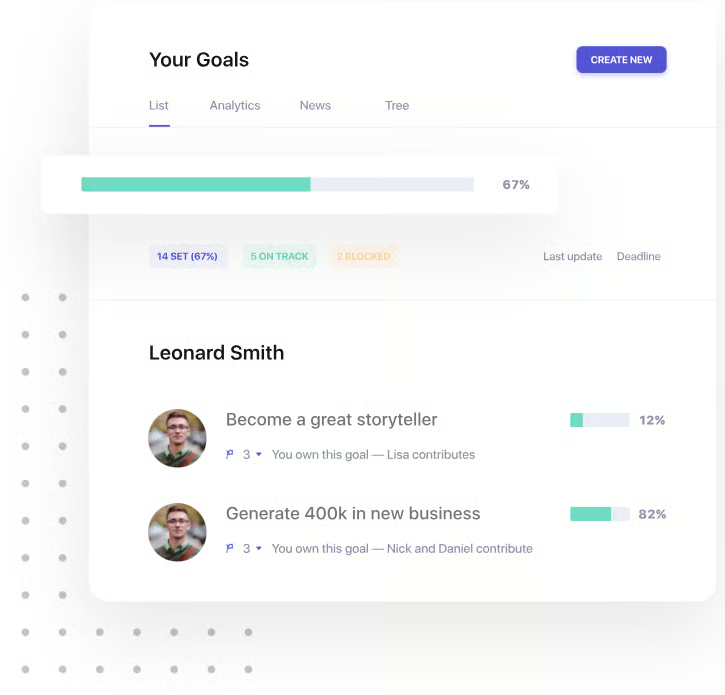
ERGs are most successful when they tie their purpose to key performance indicators (KPIs) to track their progress. Performance management software, like Leapsome’s Goals, can help ERGs keep track of their day-to-day progress while ensuring it aligns with their mission strategy.
3. Align with company DEI initiatives
Your executive team, HR department, or DEI committee can work with ERGs to transform DEI aspirations into realities. Because ERGs have committed members, they can carry out changes to improve your DEI metrics.
For example, if your company’s objective is to increase the number of people of color in leadership roles, your ERG groups can assist you in finding eligible internal candidates who belong to these communities. They can even source their external networks and encourage the appropriate talent to apply.
Example:
HR at Acme shared its Q1 goal to increase representation of people of color in manager roles with the newly formed Parents and Caregivers ERG.
The ERG ran a short internal referral drive and created a “leadership readiness” shortlist of five members who met baseline requirements. Acme’s talent team fast-tracked those five into interviews for two open manager roles; one was promoted within three months.
Outcome: ERG-sourced candidate pipelining directly contributed to a measurable hire and strengthened ERG-to-talent workflows.
4. Provide organizational support
ERGs need access to funding, communication channels, and company endorsements to be successful. Ensure they have a set company budget plan activities, support their communities, and recruit new members.
Similarly, allow ERG members time from their work duties to participate in meetings, activities, and event planning. Employees should not have to sacrifice their professional or personal time to support the group and enact meaningful workplace change.
Moreover, listen and implement appropriate ERG suggestions in the workplace, as long as they align with company values and can improve employees’ feeling of workplace belonging. Doing so gives the groups legitimacy and increases overall employee satisfaction.
Example: After the Parents and Caregivers ERG pilot, Acme approved a $2,500 per quarter budget for speakers, materials, and a $500 leadership stipend. They also added a recurring calendar slot and a short manager note telling teams to allow one hour for ERG meetings.
Result: Attendance rose 40% the next quarter and the ERG could run a paid coaching series that produced two visible policy asks for flexible shifts.
5. Set regular meeting and activity cadences
ERGs should plan weekly, biweekly, or monthly meetings with agendas and clear objectives for their members. Members should work together and decide on the best schedule for everyone. Your company should also provide both physical space and time away from work duties to facilitate the meetings.
Although the meetings are great opportunities for members to express concerns, group leaders should also schedule times to plan activities, events, or company-wide educational materials. In doing so, they can balance open and supportive conversations with bigger-picture goals, like advocating for changes with your company’s senior leadership.
Example: Acme’s Parents and Caregivers ERG met monthly for a 60-minute session: 15 minutes for check-ins, 30 minutes to plan the next program (e.g., a mentoring circle), and 15 minutes to assign owners and confirm dates. They also created a small “program team” that met biweekly to chase logistics. That team’s work produced a successful mentoring pilot within two months.
6. Evaluate its effectiveness
Mark times to look back on the effectiveness of your ERGs monthly, quarterly, or annually. Use their KPIs as a quantitative representation of how well they are meeting their goals and impacting workplace culture.
Another way to measure ERG effectiveness is to survey members and the rest of the employee population. How satisfied are employees with the ERG? Does it fulfill its mission statement? Depending on the results of the surveys, your ERG can either stay the course and build upon its successes or change tactics to improve.
Example:
Acme’s Q2 ERG report read:
- Roster: 95 members
- Average attendance: 18
- Events: 2 (120 attendees)
- Outcomes: Launched caregiving resource guide and piloted flexible-shift
The report included one member quote about why the ERG mattered and a single ask: funding for a paid childcare panel. The clarity made it easy for the exec sponsor to approve the next quarter’s budget.
Ideas for employee resource group programming
Once you’ve implemented an employee resource group, let them be creative and develop programming aligned with their mission statements. Although some may have plenty of ideas to start with, others may need inspiration.
Some ideas to consider include the following:
- Professional development workshops: Connect ERG members with professionals in a topic or field to help foster upskilling.
- Cultural events: Plan a company educational event around a cultural one, such as black history month.
- Volunteering: Reach out to your local community and offer members’ time or support, such as fundraising.
- Book clubs: Choose a book that aligns with your ERG, discuss its points, and share with members and the company.
- Lunch and learn outings: Dine at a restaurant of choice and use it to share the cuisine and history of group members.
For ERGs to be successful, they need the support of the entire company and employee population. Taking this action can lead to positive changes and increase the happiness of your employees within your organization.
Employee resources groups FAQs
Who can join an ERG?
Anyone. ERGs are typically open to the affinity group (members) and allies. Clarify on launch whether the group welcomes non-members, allies, or external guests.
What should an ERG measure?
Track a few simple KPIs: Roster size, average meeting attendance, program reach (events × attendees), and one career impact metric (promotions or internal moves among members). Pair these numbers with 1–2 member stories each quarter.
Can ERGs be involved in hiring or discipline?
No. To avoid legal and fairness risks, ERGs should not make hiring or disciplinary decisions. They can recommend candidates or surface issues, but final decisions must go through HR and hiring managers.
If you’re unsure if an ERG suits your company, explore our Employee Engagement Software Guide for solutions to start surveying your employees.

Jessica Dennis has more than six years of experience in HR administration, having held roles as an HR representative, generalist, and office manager. Her specific areas of expertise include onboarding, payroll, benefits, compliance, workforce management, unemployment insurance, and workers’ compensation claims management. Her hands-on HR background fuels her insightful writing on HR technology and best practices. Her work has been featured in TechnologyAdvice, TechRepublic, Fit Small Business, CNBC, and HR Digest, providing nuanced takes on HR topics.