

AI recruiting software can help hiring teams source candidates, summarize résumés, automate screening, schedule interviews, and maintain candidate communication. However, these products differ substantially in how much control they give recruiters over AI recommendations and where their AI capabilities sit within the hiring workflow.
After comparing six leading platforms across seven weighted categories, Workable earned my highest overall score. Manatal offers the strongest value for teams that want built-in AI recruitment features at a lower price, while Paradox is the best option for high-volume conversational hiring.
For a quick overview of my top AI recruiting software choices, see the comparison below:
| AI recruiting software | Best for | Starting price |
|---|---|---|
| Workable | Best overall | $299 per month, billed annually |
| Manatal | Value and candidate matching | $15 per user, per month, billed annually |
| Greenhouse | Structured, responsible hiring | Custom quote |
| Teamtailor | Candidate experience | Custom quote |
| Breezy HR | Small recruiting teams | Free; paid plans from $157 per month, billed annually |
| Paradox | High-volume conversational hiring | Custom quote |
Why you can trust my advice
My background combines postdoctoral training in data curation and data science with professional experience evaluating AI and business technology. That perspective is especially important in recruiting, where an efficient algorithm is not necessarily a fair, transparent, or appropriate decision-maker. I evaluated each platform based on what its AI can do, how it fits into established recruiting workflows, and whether recruiters can retain meaningful oversight of candidate decisions.
I also reviewed official product documentation, pricing pages, security materials, integration directories, and available demonstrations. I did not give a provider extra credit simply for labeling a feature as AI. Higher scores went to platforms that applied AI to practical recruiting problems while providing a capable ATS, usable controls, data protections, and sufficient information for buyers to evaluate the product.
Methodology
I evaluated the six providers using a 100-point rubric divided into seven categories. Each provider received a score from zero to five in every category, and the category scores were multiplied by the following weights.
Core recruiting features: 25%
I evaluated key recruiting features, such as job distribution, applicant tracking, and reporting, prioritizing native capabilities over add-ons.
Advanced and AI features: 20%
This category examined candidate matching, talent rediscovery, generative writing, semantic search, automated summaries, AI screening, conversational recruiting, fraud detection, and recruiting analytics. I also considered whether the platform explained the AI’s role and allowed recruiters to review or control its output.
Integrations and compatibility: 15%
I reviewed integrations with job boards, HRIS platforms, calendars, email, video conferencing, assessments, background checks, productivity tools, and analytics platforms. API availability and support for enterprise systems also influenced this score.
Customer support and usability: 15%
I considered interface design, setup requirements, mobile access, documentation, training, support channels, and whether occasional hiring managers could participate without extensive technical training.
Security and reliability: 10%
I assessed access controls, single sign-on, multifactor authentication, audit capabilities, data privacy tools, compliance support, and published security information. Because recruiting platforms process sensitive applicant information, basic privacy claims alone did not earn a high score.
Pricing and value: 10%
Providers received higher scores for transparent pricing, free trials, scalable plans, included AI features, and competitive functionality. Hidden pricing and AI capabilities sold only through unspecified add-ons reduced the score.
User scores: 5%
I incorporated aggregate user feedback from established software review platforms. Because individual reviews can be subjective or reflect older product versions, user ratings represented only 5% of the final score.
Provider | AI approach | Key features | My score |
|---|---|---|---|
Autonomous recruiting agent |
| 4.61/5 | |
AI embedded throughout the ATS |
| 4.36/5 | |
Structured and governance-focused AI |
| 4.30/5 | |
Recruiter-facing AI copilot |
| 4.28/5 | |
Credit-based AI add-on |
| 4.21/5 | |
Candidate-facing conversational AI |
| 4.16/5 |

Workable: Best overall AI recruiting software
Pros
- AI agent can source, evaluate, qualify, and chat with candidates
- Access to more than 400 million candidate profiles
- Complete ATS with interview kits, scorecards, offers, and reporting
- Transparent base-plan and AI-credit pricing
Cons
- Higher starting price than Manatal or Breezy HR
- Heavy AI usage can increase costs significantly
- Video interviews, assessments, and texting are paid add-ons
- Subscription pricing increases with company size
Why I chose Workable
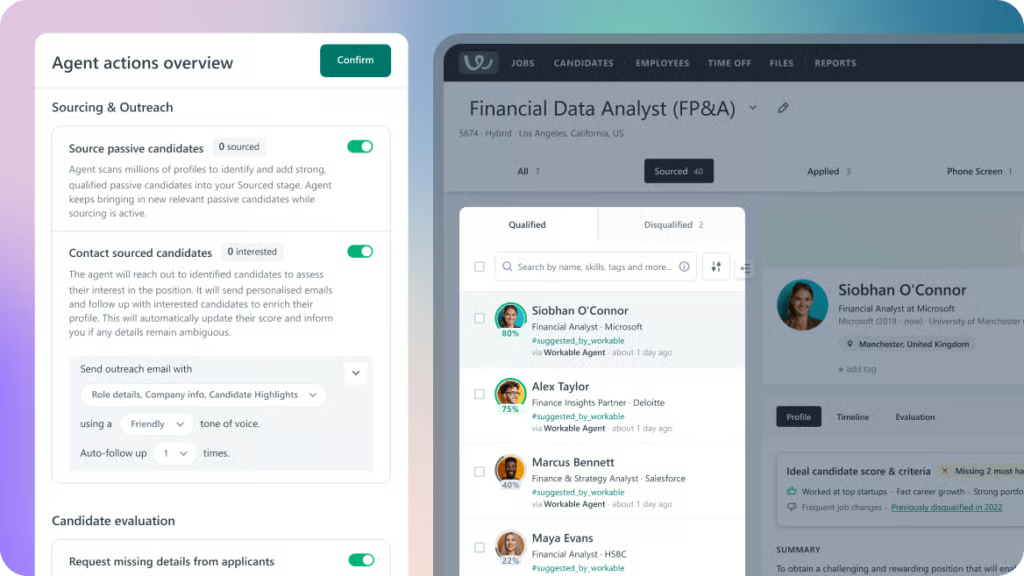
I chose Workable as the best overall AI recruiting software because it provides the strongest balance of candidate sourcing, applicant tracking, structured evaluation, and AI automation. Workable Agent can identify passive candidates, evaluate applicants against an ideal candidate profile, qualify prospects, and communicate with candidates through chat. The broader recruiting platform also includes job distribution, interview scheduling, scorecards, automated workflows, offer management, and reporting.
I also appreciate that Workable explains how its AI usage is priced. This makes it easier to estimate the cost of adding AI to a recruiting workflow instead of purchasing an unspecified add-on. Although Manatal is more affordable, and Greenhouse provides stronger enterprise governance, Workable earned the highest score in my rubric because it offers the most complete AI-assisted recruiting experience for a broader range of businesses.
What makes Workable stand out?
Workable Agent
Workable Agent is more comprehensive than the writing assistants included with most recruiting platforms. It can source passive candidates, evaluate applicants against your ideal candidate profile, qualify prospects, and communicate with candidates through chat. By comparison, Breezy Intelligence and Teamtailor Co-pilot focus more heavily on summarizing information, generating content, and supporting recruiter-led evaluations.
I also like that Workable publishes how its AI credits are consumed. Evaluating a candidate uses one credit, sourcing a candidate uses two, and a candidate chat uses 10. This provides more information for estimating AI costs than Greenhouse, Teamtailor, or Paradox, which require buyers to request custom quotes.
Built-in candidate sourcing
Workable provides access to a searchable database of more than 400 million candidate profiles. Its sourcing tools can identify passive candidates, resurface previous applicants, and add qualified prospects directly to the hiring pipeline.
Manatal also offers AI-assisted sourcing and access to a large advertised candidate database. However, Workable connects sourcing more directly with its ATS, automated screening, candidate communication, interview management, and hiring reports. This makes it easier to manage the recruitment process without combining several point solutions.
Structured candidate evaluations
Workable combines AI screening with interview kits, scorecards, and standardized evaluation tools. These features help hiring teams compare candidates against shared criteria instead of relying entirely on an AI-generated match score.
Greenhouse offers more advanced structured-hiring and governance controls, but Workable’s tools are easier to adopt for small and midsize teams. Recruiters can use AI to organize and prioritize candidate information while retaining control over interviews and final hiring decisions.
Gallery
How is Workable priced?
Workable offers three main plans. Prices below are for organizations with one to 20 employees.
Standard
$299 per month or $3,588 annually
Includes:
- Candidate sourcing suite
- Applicant tracking system
- Unlimited active jobs, subject to fair-usage limits
- Hiring plans
- Five native language options
- Custom report builder
- Additional permission sets
- 3,000 Workable Agent credits
Available add-ons include:
- Texting: $89 per month
- Video interviews: $109 per month
- Assessments: $59 per month
- Performance and engagement: $39 per month
Premier
$599 per month, billed annually
Includes everything in Standard, plus:
- Texting
- Video interviews
- Assessments
- Employee referrals
- Performance and engagement
- Priority support
- 3,000 Workable Agent credits
Enterprise
$719 per month, billed annually
Enterprise includes Workable’s recruiting and HR capabilities with advanced service and support options. Workable recommends contacting its sales team to confirm the package for larger or more complex organizations.
Workable Agent credits
Every paid account includes 3,000 Workable Agent credits. Additional credit packages cost:
- 5,000 credits: $600, or 12 cents per credit
- 10,000 credits: $1,000, or 10 cents per credit
- 50,000 credits: $4,750, or 9.5 cents per credit
Workable Agent consumes:
- One credit each time it evaluates a candidate
- Two credits each time it sources and adds a candidate
- 10 credits each time a candidate uses the chat
Credits expire one year after purchase and are nonrefundable. Workable also offers a 15-day Standard-plan trial without requiring a credit card, but the trial does not include Workable Agent.

Manatal: Best value for AI candidate matching
Pros
- AI recommendations and candidate scoring included in every plan
- Transparent per-user pricing starting at $15 per month
- Recruitment CRM supports staffing agencies and internal hiring teams
- All standard plans include a 14-day free trial
Cons
- Professional plan is limited to 15 active jobs
- Workflow automation requires the Enterprise plan
- Open API and single sign-on require Enterprise Plus
- Phone support is available only with a custom plan
Why I chose Manatal
Manatal is my top choice for AI candidate matching because it includes substantial AI recruiting capabilities in its lowest-priced plan. For $15 per user, per month with annual billing, recruiting teams receive AI candidate recommendations, match scores, profile enrichment, résumé parsing, semantic search, and AI-generated job descriptions. This gives smaller teams access to tools that often require an enterprise plan or a separately purchased add-on.
Manatal earned 4.36 out of 5 in my rubric, including a 4.80 for both pricing and advanced features. It lacks Workable’s all-in-one depth and Greenhouse’s enterprise governance, but its combination of transparent pricing, customizable candidate recommendations, recruitment CRM tools, and support for unlimited hiring managers makes it a compelling option for staffing agencies and growing internal recruiting teams.
What makes Manatal stand out?
Customizable AI recommendations
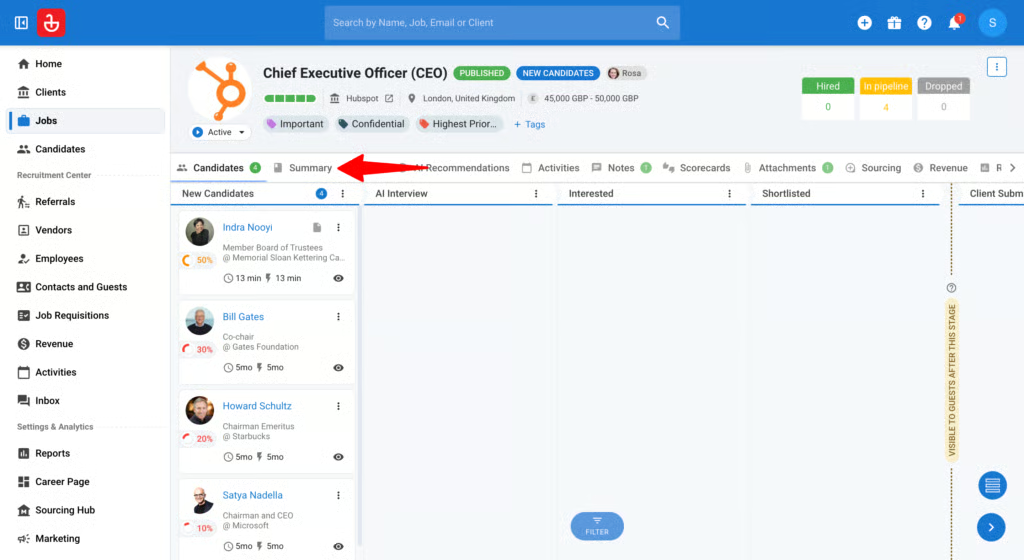
Manatal uses AI to recommend candidates for jobs, recommend jobs for candidates, and generate match scores and qualification summaries. Instead of providing only a general fit score, it lets recruiters adjust the criteria and weights used to compare candidates with job requirements.
This customization matters because two companies hiring for the same job title may prioritize different qualifications. Workable can evaluate candidates against an ideal candidate profile, but Manatal gives recruiters more visible control over the criteria influencing its recommendations.
AI candidate enrichment
Manatal supplements résumé data with information associated with candidates’ public professional profiles, including their experience, education, and listed skills. It then organizes this information into a more comprehensive candidate record.
This is especially helpful for staffing agencies and sourcing teams that frequently work with incomplete résumés or profiles collected from multiple channels. Breezy HR and Greenhouse also provide detailed candidate records, but Manatal places more emphasis on automatically enriching those records before recruiters begin their evaluations.
Low-cost access to AI tools
Manatal includes AI recommendations, candidate scoring, résumé parsing, profile enrichment, semantic search, and AI-generated job descriptions in its Professional plan. At $15 per user, per month with annual billing, it has the lowest published starting price among the paid AI recruiting platforms in this guide.
Breezy HR offers a free ATS, but its Breezy Intelligence tools require separately purchased credits. Workable also uses AI credits and starts at $299 per month. For small recruiting teams that want built-in AI matching without a large initial investment, Manatal provides the strongest value.
Gallery
How is Manatal priced?
Manatal has three standard plans and a custom option. It also provides annual and month-to-month subscriptions, and every standard plan includes a 14-day free trial.
Professional
$15 per user, per month with annual billing or $19 with monthly billing
Includes:
- Up to 15 active jobs per account
- Up to 10,000 candidates
- Unlimited hiring managers
- AI candidate enrichment
- AI recommendations and candidate scoring
- AI-generated job descriptions
- Custom recruiting pipelines
- Résumé parsing
- Career-page builder
- Candidate scorecards
- Screening and knockout questions
- Recruitment CRM
- Reports and analytics
- 24/5 chat and email support
Enterprise
$35 per user, per month with annual billing or $39 with monthly billing
Includes everything in Professional, plus:
- Unlimited jobs
- Unlimited candidates
- Workflow automation
- Additional recruiting and candidate-management capabilities
This is the minimum plan I would recommend for a growing recruiting team that wants to automate candidate emails, assessments, interview invitations, and rejection messages based on workflow events.
Enterprise Plus
$55 per user, per month with annual billing or $59 with monthly billing
Includes everything in Enterprise, plus:
- Advanced report builder
- ChatGPT, Claude, and other LLM integrations
- Manatal open API
- Candidate portal and internal mobility
- Custom permissions and user groups
- Single sign-on
- Priority support
- Priority access to beta features
Custom plan
Custom quote
Includes everything in Enterprise Plus, along with:
- Dedicated account manager
- Phone support
- Custom product features
- Custom integrations
- Custom compliance tools and reports
Available add-ons
Manatal offers several capabilities as separately priced add-ons, including:
- AI Interviewer
- Guest portal
- Premium candidate sourcing and contact data
- Job-board contract integration
- SMS recruitment
- Custom career-site domains

Greenhouse: Best for structured, responsible hiring
Pros
- Structured interview kits and scorecards support consistent evaluations
- Extensive marketplace of more than 500 integrations
- AI talent matching is available in every plan
- Strong enterprise security, permissions, and governance controls
Cons
- Lacks pricing transparency
- More complex to configure than small-business ATS platforms
- Several automation and AI tools require Plus or Pro
- Most advanced governance controls require the Pro plan
Why I chose Greenhouse
I selected Greenhouse as the best AI recruiting software for structured, responsible hiring because it connects AI recommendations with defined candidate criteria, interview kits, shared scorecards, and approval workflows. This approach helps recruiting teams use AI to organize and prioritize information without allowing an automated recommendation to become the final hiring decision.
Greenhouse earned 4.30 out of 5 in my rubric, including a perfect integration score and a 4.90 for security and reliability. It requires more configuration than Workable, Manatal, or Breezy HR, but its combination of structured hiring, fraud detection, reporting, integrations, and enterprise governance makes it a stronger option for scaling organizations with complex recruiting processes.
Also read: Lever vs Greenhouse Comparison
What makes Greenhouse stand out?
Structured hiring
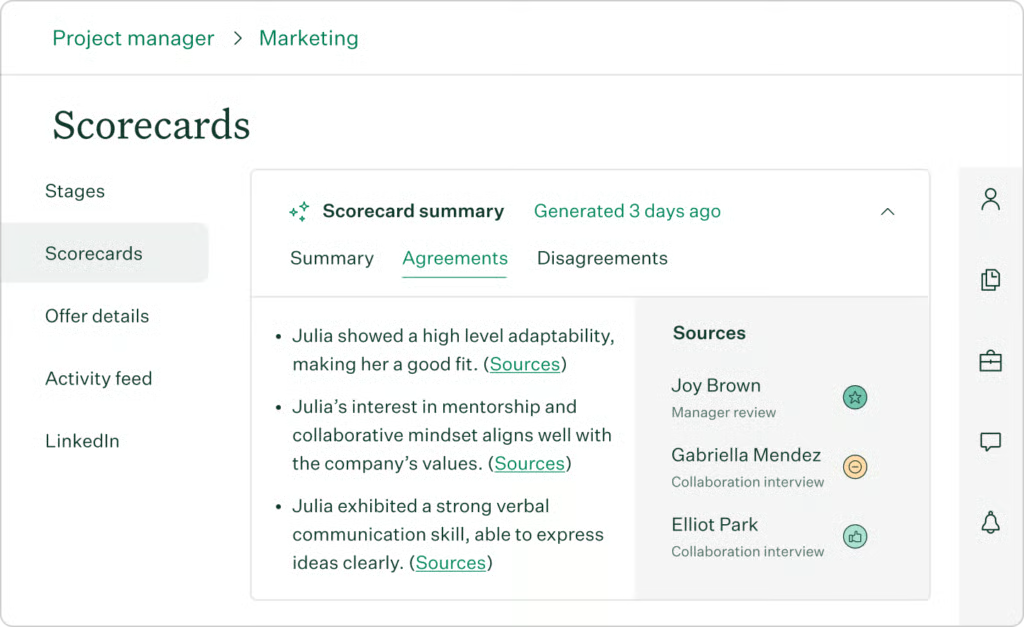
Greenhouse organizes candidate evaluations around predefined criteria, structured interview kits, and shared scorecards. Hiring teams can assign specific evaluation areas to interviewers and compare feedback using the same job-related standards.
Workable also provides interview kits and scorecards, but Greenhouse offers more extensive tools for standardizing hiring across departments, locations, and business units. I would choose Greenhouse when consistent evaluations and auditable hiring processes matter more than rapid setup.
Real Talent
Greenhouse Real Talent combines candidate matching with spam detection, fraud detection, and identity-verification options. These capabilities help recruiters identify relevant applicants while addressing fabricated applications and possible candidate misrepresentation.
Breezy HR’s Résumé Audit can also surface potential résumé-quality or authenticity concerns. However, Greenhouse offers a broader fraud-prevention layer that connects talent matching, application review, blocklists, and identity verification. This is particularly useful for organizations receiving large volumes of AI-generated or fraudulent applications.
Recruiting governance
Greenhouse Pro includes granular permissions, audit logs, advanced data configuration, developer sandboxes, and enterprise security controls. These tools give organizations more visibility into who can access candidate information and how the recruiting system is configured.
Paradox and Workable also provide enterprise security capabilities, but Greenhouse offers the strongest combination of structured evaluation and system governance. The main drawback is that its most advanced controls require the Pro plan.
Gallery
How is Greenhouse priced?
Greenhouse’s official pricing page does not list numerical prices. Quotes vary based on the selected plan, hiring volume, organizational complexity, and required features.
- Core: Structured interviews, scheduling, reporting, sourcing, CRM, single sign-on, and talent matching
- Plus: Adds sourcing automation, AI report filters, fraud detection, texting, and deeper reporting
- Pro: Adds enterprise security, audit logs, developer tools, advanced governance, and data configuration
Greenhouse requires buyers to request a customized quote. I recommend asking for an itemized estimate that identifies implementation costs and which AI, reporting, and security capabilities are included.

Teamtailor: Best for candidate experience
Pros
- Combines applicant tracking with employer-branding tools
- Co-pilot assists with screening, interviews, and candidate communication
- Provides more than 450 software integrations
- Modern interface designed around the candidate experience
Cons
- Does not publish standard pricing
- Advanced automations and other capabilities may cost extra
- Reporting is less flexible than Greenhouse’s enterprise tools
Why I chose Teamtailor
I chose Teamtailor as the best AI recruiting software for candidate experience because its capabilities extend beyond résumé screening and candidate rankings. Teamtailor combines AI assistance with career sites, candidate relationship management, employer branding, nurture campaigns, interview management, and candidate communication. This helps recruiting teams improve how candidates experience the hiring process from initial job discovery through onboarding.
While Workable is stronger for all-in-one candidate sourcing, Greenhouse provides more extensive governance and reporting. However, Teamtailor is the better choice when employer branding, timely communication, and an engaging candidate journey are central to the recruiting strategy.
What makes Teamtailor stand out?
Meeting insights
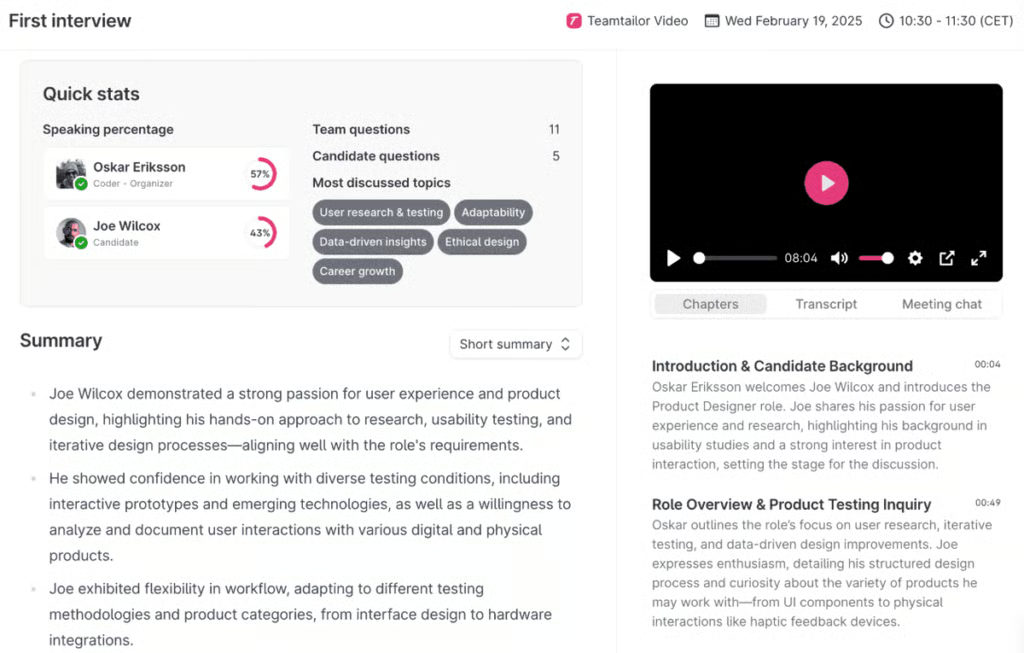
Teamtailor Co-pilot can record and transcribe candidate meetings, generate summaries, organize recordings into chapters, and help complete interview-kit questions using a candidate’s responses. This reduces the administrative work that follows an interview while keeping the original conversation available for review.
In contrast to other platforms, Teamtailor applies AI to the interview itself, not just the résumé or application. Workable and Manatal are stronger for sourcing and initial candidate matching, while Teamtailor provides more assistance with organizing information gathered during recruiter-led conversations.
Candidate-focused content assistance
Co-pilot can generate job descriptions, application questions, interview questions, translations, résumé summaries, and rejection emails. It uses information already connected with the role or candidate, such as job requirements, selected skills, interview results, and previous communications.
This makes its output more context-aware than a disconnected writing assistant. I particularly like that Teamtailor can prioritize existing interview questions from your account before generating new ones, helping recruiters maintain a more consistent evaluation process.
Employer branding and career sites
Teamtailor combines its ATS with a customizable career-site builder, candidate relationship management, nurture campaigns, employee stories, and multilingual content. Recruiting teams can create more detailed career pages without depending entirely on developers or a separate website platform.
Breezy HR also provides career sites and candidate nurture tools, but Teamtailor offers more design flexibility and employer-branding options. It is the stronger choice when attracting and engaging candidates is as important as processing their applications.
Gallery
How is Teamtailor priced?
Teamtailor uses custom pricing based on factors such as company size, hiring requirements, and selected features. It does not provide a standard starting price.
Advanced automation, employee referrals, WhatsApp messaging, onboarding, and certain integrations may cost extra. I recommend requesting an itemized quote showing which capabilities are included in the base subscription and which are add-ons.

Breezy HR: Best for small recruiting teams
Pros
- Free plan supports unlimited users
- Breezy Intelligence is an add-on across all plans
- Easy-to-use visual recruiting pipelines
- Transparent base-plan and AI-credit pricing
Cons
- Free plan supports only one active position or candidate pool
- AI features require separately purchased credits
- HRIS integrations require the Business plan
- Advanced reporting requires a custom Pro plan
Why I chose Breezy HR
I recommend Breezy HR because it provides an accessible entry point into applicant tracking and AI-assisted hiring for small teams. The free Bootstrap plan supports unlimited users and one active position or candidate pool, while Breezy Intelligence can be added without moving immediately to an expensive enterprise subscription.
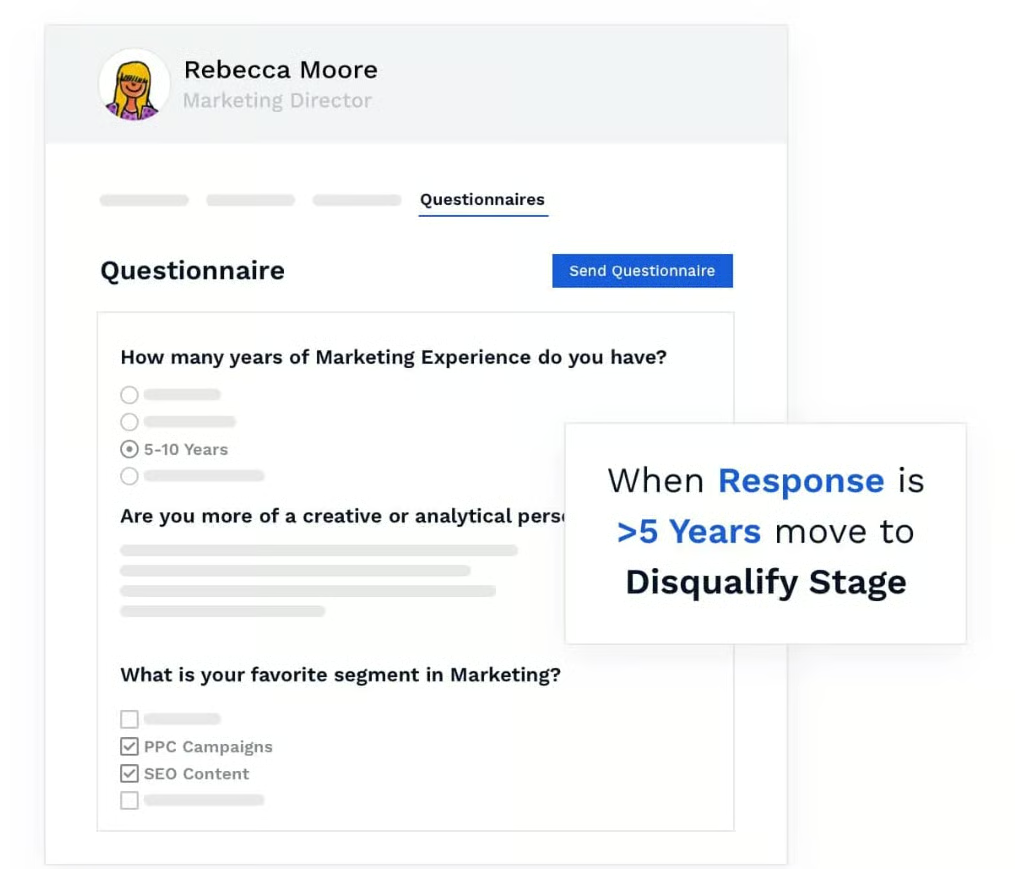
While Manatal offers more built-in AI matching at a low per-user price, Breezy HR is easier for occasional hiring managers to navigate. Its visual pipelines, questionnaires, interview self-scheduling, templates, and candidate automations make it a practical choice for small teams without a dedicated recruiting operations specialist.
What makes Breezy HR stand out?
Breezy Intelligence
Breezy Intelligence includes Applicant Insights, Résumé Audit, Activity Summary, AI Candidate Sourcing, and Help Me Write. Together, these tools help recruiters evaluate applicants, summarize candidate activity, search previous applications, and draft recruiting content.
Breezy’s AI is less autonomous than Workable Agent or Paradox’s conversational assistant. However, small teams can introduce its capabilities gradually because Breezy Intelligence is offered as an add-on across the platform’s plans.
Résumé Audit
Résumé Audit examines résumé quality and can surface potential authenticity concerns. This gives small recruiting teams an additional review layer before advancing an applicant or scheduling an interview.
Greenhouse provides more extensive fraud and identity controls for larger organizations. Breezy HR makes this type of assistance more accessible to small businesses that do not need enterprise-level governance or identity-verification workflows.
Visual candidate automation
Breezy HR uses a visual pipeline where recruiters can move candidates between stages and trigger messages, assessments, questionnaires, scheduling requests, and other actions. The drag-and-drop layout makes these automations easier to understand than the more complex workflow builders included with some enterprise ATS platforms.
The combination of visual pipelines and AI assistance makes Breezy HR particularly approachable for managers who hire only occasionally. Manatal provides stronger candidate matching, but Breezy HR is easier to recommend when usability and team collaboration are the primary concerns.
Gallery
How is Breezy HR priced?
Breezy HR offers the following plans:
- Bootstrap: Free
- Startup: $157 per month annually or $189 monthly
- Growth: $273 per month annually or $329 monthly
- Business: $439 per month annually or $529 monthly
- Pro: Custom quote
Breezy Intelligence credits start at $30 per 100,000 credits. Annual subscriptions include two months free, and Breezy HR offers a 14-day trial with 100,000 Breezy Intelligence credits.

Paradox: Best for high-volume conversational hiring
Pros
- Automates candidate screening and interview scheduling
- Supports conversational applications and candidate communication
- Designed for high-volume and frontline recruiting
- Integrates with major enterprise HR platforms
Cons
- May require a more extensive implementation process
- Can be excessive for companies with occasional hiring needs
- Product packages are difficult to compare before consulting sales
Why I chose Paradox
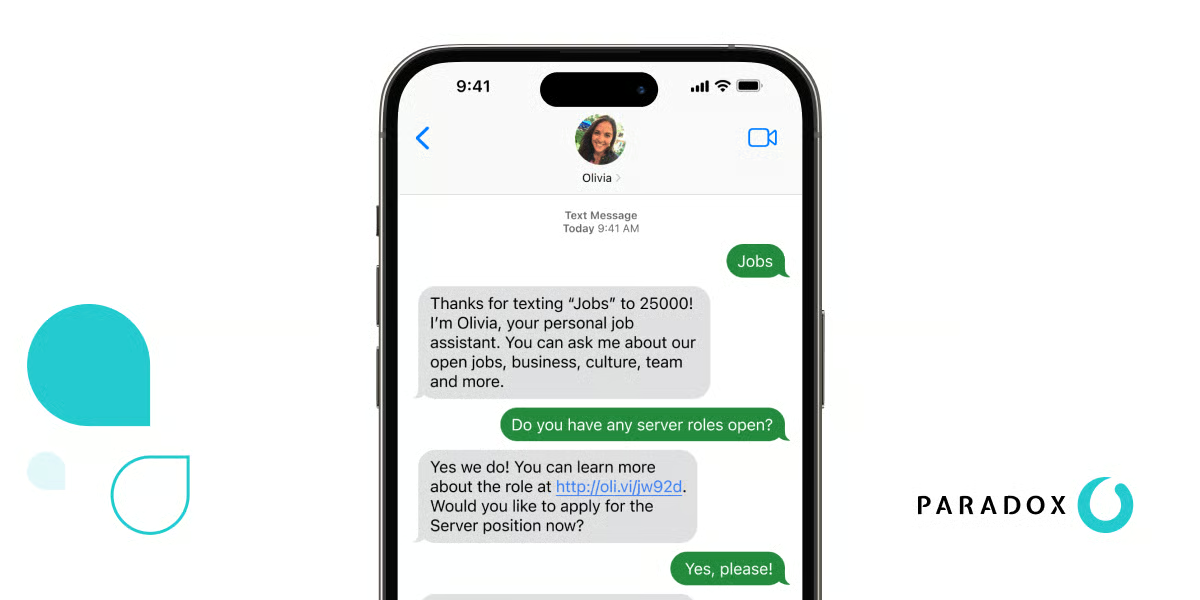
Paradox stands out for its high-volume conversational hiring because it automates more of the candidate-facing journey than the other providers in this guide. Its AI assistant, Olivia, can guide candidates through job descriptions, applications, screening, interview scheduling, preparation, offers, and onboarding using chat and text-based interactions.
Although I gave Paradox a perfect score for advanced features and a 4.80 for security and reliability, its lack of transparent pricing lowered its overall score, and it is likely more software than an occasional hiring team needs. However, Paradox is a strong option for service industries, healthcare, manufacturing, and logistics employers that need to process large candidate volumes without adding more manual recruiting work.
What makes Paradox stand out?
Conversational Apply
Paradox lets candidates search for jobs, answer screening questions, and complete applications through a conversational interface. Olivia can guide applicants through the process using chat or text instead of directing them through a traditional multipage application.
This approach is particularly useful for frontline and hourly roles, where candidates may apply from a mobile device and expect a fast response. The other providers in this guide offer candidate messaging, but Paradox makes the conversation the primary application experience.
Automated interview scheduling
Paradox can screen a candidate and immediately offer appropriate interview times based on recruiter and hiring-manager availability. It can also send reminders, provide preparation materials, and handle rescheduling without requiring a recruiter to coordinate each step.
Workable, Breezy HR, Greenhouse, and Teamtailor all support interview self-scheduling. Paradox stands out because scheduling is connected directly to its conversational screening workflow, allowing qualified candidates to move from application to interview without waiting for manual follow-up.
Existing ATS enhancement
Organizations can deploy the Paradox Candidate Experience Agent alongside an existing ATS instead of replacing their system of record. Paradox provides integrations for platforms such as Workday and SAP SuccessFactors, along with direct integrations and an open API.
This differentiates Paradox from Workable, Manatal, Breezy HR, and Teamtailor, which are primarily positioned as complete recruiting platforms. I would consider Paradox when an enterprise already has an ATS but needs to automate high-volume candidate communication, screening, and scheduling.
Gallery
How is Paradox priced?
Paradox uses custom pricing based on the selected products, organization size, hiring volume, integrations, and implementation requirements. It does not publish a standard starting price.
Available products include its Conversational ATS, Candidate Experience Agent, Conversational Apply, scheduling, career sites, CRM, and recruiting-event tools. When selecting a plan, keep subscription, implementation, integration, messaging, and support costs in mind.
How to choose the best AI recruiting software
Start by identifying the recruiting bottleneck you want AI to address. Candidate sourcing, application screening, interview scheduling, résumé summarization, and candidate communication are separate problems. A platform that performs well in one area may offer only basic functionality in another.
Specifically, consider the following factors before purchasing:
- Human oversight: Recruiters should be able to review AI recommendations, change evaluation criteria, and override automated actions.
- Job relevance: Candidate scoring should use criteria connected to the actual role rather than opaque assumptions about who appears successful.
- Workflow fit: Decide whether you need a complete ATS or an AI layer that integrates with your existing system.
- Candidate communication: Determine when candidates interact with AI and whether the platform clearly discloses that interaction.
- Data governance: Review retention rules, permissions, audit trails, integration security, and how candidate information is used to generate recommendations.
- True cost: Include AI credits, implementation, integrations, messaging, training, and required plan upgrades.
- Measurement: Establish how you will assess time-to-fill, candidate conversion, recruiter workload, hiring quality, and potential disparate outcomes.
Workable is the strongest option when you want one system for sourcing, tracking, evaluation, and AI assistance. Choose Manatal when transparent pricing and AI matching matter most. Greenhouse is stronger for structured hiring and governance, Teamtailor for candidate experience, Breezy HR for small teams, and Paradox for high-volume conversational automation.
Frequently asked questions (FAQs)
What is AI recruiting software?
AI recruiting software applies artificial intelligence to tasks such as candidate sourcing, résumé parsing, applicant matching, screening, interview scheduling, communication, and recruiting analytics. Some products provide a complete applicant tracking system, while others add AI automation to an existing ATS or HR platform.
Can AI recruiting software make hiring decisions?
AI recruiting software can rank, summarize, or recommend candidates, but employers should not treat those recommendations as final hiring decisions. Recruiters remain responsible for validating job criteria, reviewing outputs, accommodating candidates, monitoring outcomes, and complying with applicable employment and data-protection requirements.
What are the risks of using AI in recruiting?
Potential risks include biased criteria, inaccessible application processes, inaccurate candidate summaries, unclear automated decisions, excessive data collection, and overreliance on algorithmic rankings. Employers should document where AI is used, maintain human review, test workflows for adverse outcomes, and provide candidates with an appropriate way to request assistance.
Which AI recruiting software is best for small businesses?
Breezy HR is the best choice for small businesses that prioritize usability and a low-cost starting point. Manatal is better for small recruiting teams that want more extensive AI matching and candidate enrichment, while Workable is the stronger all-in-one option for companies with a larger software budget.