

Choosing the right AI prospecting tool depends on more than who has the biggest database or the flashiest AI assistant. I evaluated these platforms based on how well they help sales teams identify the right accounts, prioritize outreach, personalize messaging, and move faster without sacrificing data quality.
For this guide, I focused on tools that support real prospecting workflows rather than standalone AI writing or generic lead capture. That means I looked for capabilities like B2B contact data, account intelligence, buyer signals, enrichment, CRM connectivity, and AI-assisted research or recommendations. I also considered pricing transparency, implementation effort, and whether each platform is best suited for small teams, scaling sales organizations, or enterprise GTM motions.
Based on that evaluation, ZoomInfo is my top overall pick because it combines AI prospecting with a strong B2B data foundation, intent signals, and broader go-to-market workflows. However, Apollo.io, Clay, Cognism, and LinkedIn Sales Navigator each stand out for specific prospecting needs.
| Provider | Best for | Monthly starting price |
|---|---|---|
| ZoomInfo | Best overall AI prospecting platform | Custom quote |
| Apollo.io | All-in-one option for SMB and midmarket teams | $49/user/month, billed annually |
| Clay | Custom enrichment and AI research workflows | $185 |
| Cognism | Compliant B2B sales intelligence | Custom quote |
| LinkedIn Sales Navigator | Relationship-based prospecting | $89.99 per license/month |
Why you can trust TechnologyAdvice
At TechnologyAdvice, we evaluate business software to help buyers make practical, confident decisions. For this guide, I focused on AI prospecting tools that support real sales workflows, including prospect research, account prioritization, enrichment, buyer signals, outreach preparation, and CRM-connected execution.
I reviewed each provider based on the criteria most relevant to B2B sales teams: core prospecting functionality, AI usefulness, integration fit, pricing and value, usability, advanced features, security and reliability considerations, and user sentiment. I also prioritized provider-sourced product information where available, so feature descriptions reflect how each platform is positioned by the vendor, not just third-party summaries.

ZoomInfo: Best overall AI prospecting platform
Pros
- Combines B2B contact data, company intelligence, and AI-guided prospecting in one platform
- Strong fit for revenue teams that need account prioritization, buyer intent, and GTM workflow support
- AI recommendations can help sellers identify who to contact, when to engage, and what to say
- Better suited for scalable outbound and account-based sales motions than lightweight AI email tools
Cons
- Quote-based pricing makes it harder to compare costs upfront
- Can be too complex for small teams
- Best value depends on sales, marketing, and RevOps teams adopting the platform together
- Advanced features, credits, and add-ons can increase total contract cost
Why I chose ZoomInfo
ZoomInfo is my choice for the best overall AI prospecting platform because it addresses the biggest weakness I see in many AI prospecting tools: they can generate messages, but they do not always improve targeting. For sales teams, better prospecting starts with better account and contact data, clearer buying signals, and stronger prioritization before a rep ever writes an email.
ZoomInfo stands out by combining AI-guided prospecting with a large B2B data foundation, intent signals, company intelligence, and GTM workflows. In my view, that makes it a stronger fit for teams that want AI to influence the entire prospecting process, not just the final outreach message. It is especially compelling for B2B organizations with SDR teams, account-based sales motions, or RevOps functions that need a shared source of prospect and account intelligence.
Gallery
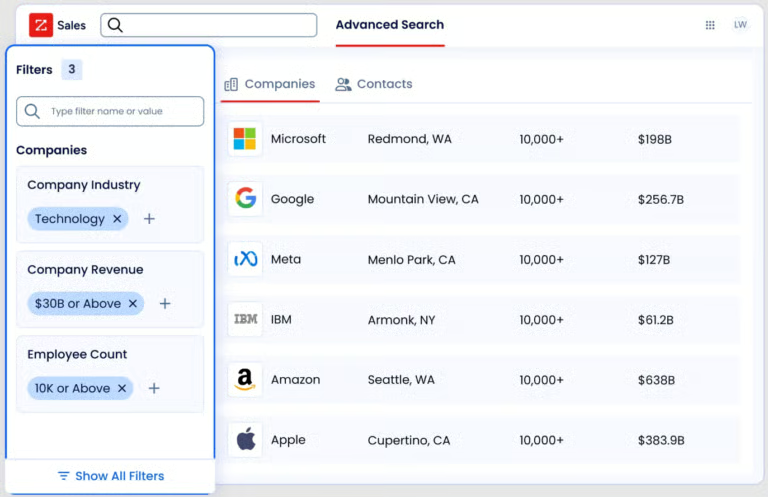
Key features
- AI-guided prospecting: ZoomInfo Copilot prioritizes target accounts based on recent sales triggers, intent signals, and company insights. This helps reps focus on accounts more likely to be in-market, rather than relying on static lists.
- Dynamic buying committees: Use AI-powered filters to surface the members of a buying committee most likely to engage. This is useful for account-based prospecting because it helps sellers identify multiple relevant contacts inside a target account.
- Next Best Action: ZoomInfo’s Next Best Action feature uses account insights and intent signals to recommend the seller’s next move. This can help reps decide whether to call, email, research further, or prioritize a different prospect.
- AI Email Assistant: Generates personalized email drafts based on the seller’s objective and available account context. This supports faster outreach while still grounding the message in prospect and company data.
- B2B contact and company intelligence: ZoomInfo provides access to business contact and company data that sales teams can use for list building, segmentation, and account research. For AI prospecting, this data foundation is important because recommendations are only useful if the underlying records are accurate and relevant.
Pricing
- ZoomInfo uses quote-based pricing rather than publishing simple monthly rates for most SalesOS and AI prospecting packages. Buyers should expect pricing to vary based on the number of users, data access, credits, intent features, integrations, and add-ons.

Apollo.io: Best all-in-one AI prospecting tool for SMBs
Pros
- Combines prospecting data, AI research, sequencing, enrichment, and sales engagement in one platform
- Transparent entry-level pricing compared with many quote-based sales intelligence providers
- AI Assistant can help users find prospects, research accounts, build sequences, and improve messaging
- Strong fit for SMB and midmarket teams that want to consolidate outbound tools
Cons
- Credit limits and export usage can affect total value for high-volume teams
- Data accuracy may still require manual verification for strategic accounts
- Enterprise teams may need deeper governance or data operations controls
- May not offer the same depth of account intelligence or intent data as larger enterprise GTM platforms
Why I chose Apollo.io
Apollo.io is best for SMB and midmarket teams because it gives sales teams a practical way to combine prospecting and outreach execution without building a complicated stack. In my experience evaluating prospecting workflows, smaller teams often struggle less with a specific feature than with switching between too many tools to find contacts, research accounts, write emails, and track engagement.
Apollo.io is a strong fit for that use case because its AI Assistant works inside the broader Apollo workspace. Rather than only suggesting copy, it can help users find key decision-makers, prioritize accounts with research, build and optimize sequences, create workflows, and report on performance. That makes Apollo.io especially useful for teams that need AI prospecting software that supports both list building and campaign execution.
Gallery
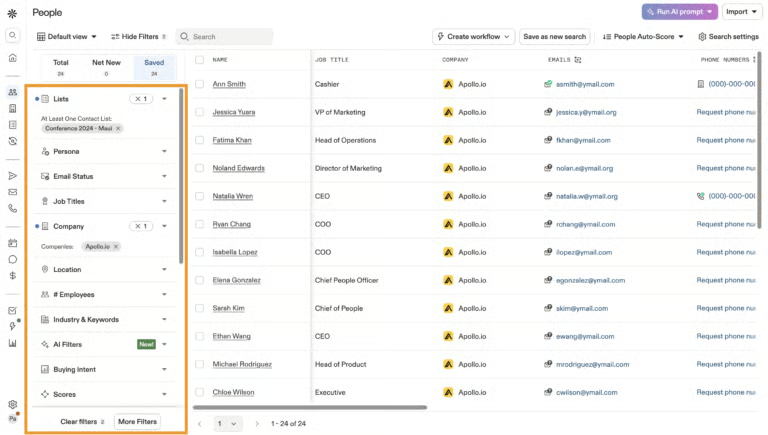
Key features
- AI Assistant: Apollo’s AI Assistant uses natural language prompts to help sellers take action across Apollo. Users can ask it to find decision-makers, prioritize accounts, build sequences, improve deliverability, create workflows, export lists, or report on performance.
- Contact and company database: Apollo provides access to a large B2B database for finding contacts and companies. This supports prospecting workflows by giving users a starting point for targeted lead lists, segmentation, and enrichment.
- Sales engagement and sequencing: Apollo includes tools for building and managing outbound sequences. This helps teams move from prospect discovery to multichannel outreach without exporting records into a separate engagement platform.
- Enrichment and workflow automation: Apollo supports data enrichment and workflow automation to help sales teams update records, standardize outreach processes, and scale repeatable prospecting motions.
Pricing
| Plans and pricing | Free | Basic | Professional | Organization |
|---|---|---|---|---|
| Monthly | $0 | $59 | $99 | $149 |
| Annual | $49 | $79 | $119 |

Clay: Best for custom enrichment and AI research workflows
Pros
- Highly flexible prospecting workflows for enrichment, AI research, scoring, and personalization
- Supports multi-provider enrichment waterfalls across many data sources
- Claygent AI research can generate custom data points from web research
- Strong fit for RevOps, growth, and outbound teams with specialized targeting needs
Cons
- Requires more setup and workflow design than simpler prospecting tools
- Pricing can be harder to forecast because usage depends on actions and data credits
- May be too complex for teams that only need basic contact search
- Advanced GTM and security features may require higher-tier or enterprise plans
Why I chose Clay
Clay is the best AI prospecting software for custom enrichment and AI research because it gives advanced outbound teams a flexible way to build prospecting systems around their exact ICP. When I evaluate AI prospecting tools, I look for whether they help teams uncover stronger buying signals, not just pull another list of contacts. Clay is strongest when the signal you need is specific, custom, or spread across multiple sources.
Clay is also a good fit for RevOps and growth teams that want to design their own workflows. Teams can enrich records through multiple providers, use AI research to generate custom fields, track signals, and connect results to downstream sales or marketing systems. That flexibility makes Clay less plug-and-play than a standard database, but more powerful for teams with a clear outbound strategy.
Gallery
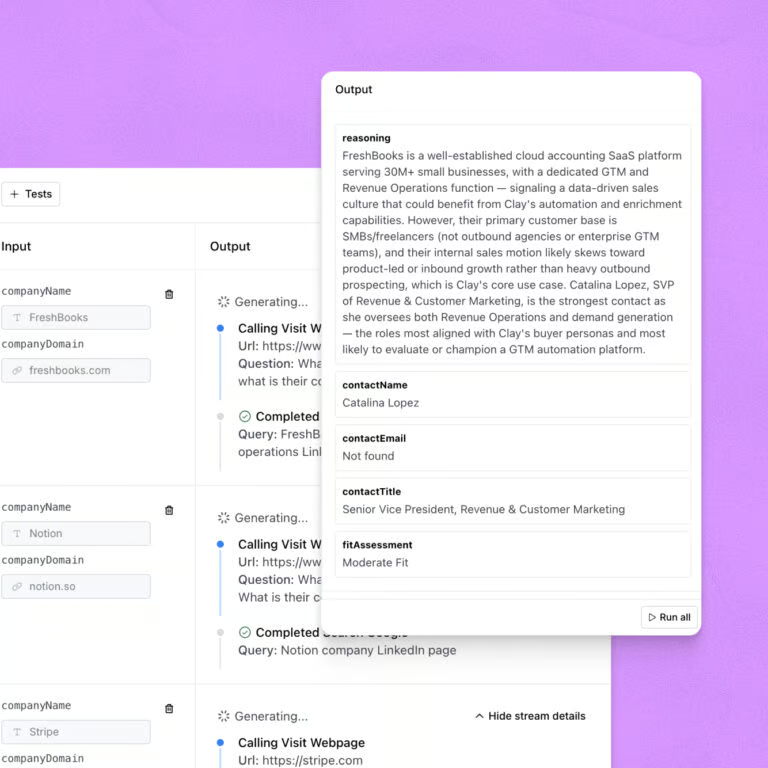
Key features
- Multi-provider enrichment waterfalls: Clay lets users run enrichment across multiple providers to find and validate prospect data. This helps teams improve match rates and reduce dependence on a single data source.
- Claygent AI research: Clay’s AI agent with access to web research, generating custom data points for prospecting workflows. Teams can use it to research companies, qualify accounts, or create personalization fields at scale.
- Actions and data credits: Clay separates workflow orchestration from data usage. This gives teams more flexibility but also requires buyers to forecast how much enrichment and AI research they expect to run.
- CRM sync and automation: Higher-tier Clay plans add CRM auto-sync, HTTP API integrations, webhook automation, and related workflow capabilities. This helps GTM teams move enriched prospecting data into operational systems.
Pricing
| Plans and pricing | Monthly | Annual |
|---|---|---|
| Free | $0 | |
| Launch | $185/month | $167/month |
| Growth | $495/month | $446/month |
| Enterprise | Contact sales for custom pricing | |

Cognism: Best for compliant B2B sales intelligence
Pros
- Strong focus on accurate B2B contact data and phone-verified records
- Useful for teams that prioritize compliant prospecting and global data coverage
- AI Search can speed up direct contact and account discovery
- Supports sales prospecting, CRM enrichment, and data-as-a-service use cases
Cons
- Quote-based pricing limits upfront cost comparison
- More focused on sales intelligence than full outbound orchestration
- Teams may still need a separate sales engagement platform
- Best suited to organizations with enough volume to justify a dedicated sales intelligence investment
Why I chose Cognism
I chose Cognism for compliant B2B sales intelligence because prospecting quality is not only about finding more contacts; it is also about finding contacts your team can confidently use. For teams selling to markets where privacy, consent, and phone-outreach rules matter, compliance and data quality can be just as important as AI-generated efficiency gains.
In this sense, Cognism is a strong fit for organizations that need reliable contact data, phone-verified records, account context, and actionable sales signals. Its AI Search also supports faster prospect and account discovery, helping teams reduce manual searching while still grounding outreach in accurate data.
Gallery
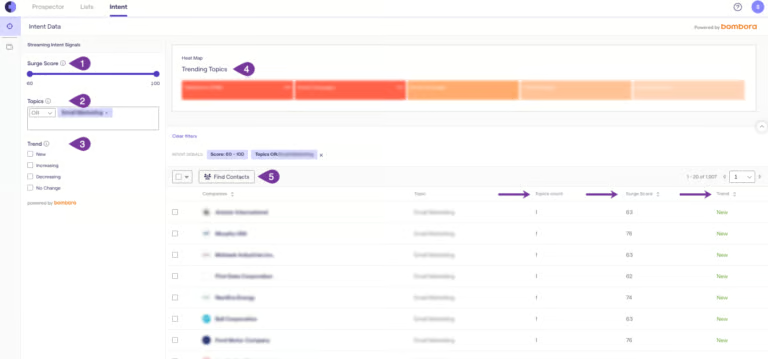
Key features
- AI Search: Find prospects and accounts faster through AI-assisted search. It supports direct prospect or account search and includes voice search with multilingual support.
- Phone-verified data: Cognism helps reps connect with the right people quickly. This feature is valuable for sales teams that rely on calling as part of outbound prospecting.
- Recommended contact suggestions: Cognism can recommend contacts to help users connect with relevant decision-makers. This supports faster account mapping and can reduce manual research time.
- CRM enrichment: Identify missing, outdated, or incomplete fields in sales and marketing databases. Teams can prioritize enrichment for ICP segments, personas, and high-value contacts rather than treating all records equally.
- Data-as-a-Service: Delivers Cognism data via API or in bulk. This is designed for teams that want to embed data into internal tools, enrichment workflows, or routing systems.
Pricing
- Cognism uses custom pricing rather than public self-service rates. Its sales prospecting product is offered in Standard and Pro packages on a per-user subscription-and-credits model, while CRM Enrichment and Data-as-a-Service are priced based on setup, usage, delivery method, and data requirements.

LinkedIn Sales Navigator: Best for relationship-based prospecting
Pros
- Strong first-party professional network data for relationship-led prospecting
- Helpful for finding decision-makers, warm paths, and buying committee gaps
- AI-assisted features such as Lead IQ, Account IQ, and Message Assist support research and outreach
- Useful companion tool for account-based selling and social selling workflows
Cons
- Usually needs to be paired with a contact data or enrichment platform for verified emails and phone numbers
- Not designed as a complete outbound sequencing or sales engagement platform
- Advanced CRM integrations require higher-tier plans
- Pricing can add up quickly for larger sales teams
Why I chose LinkedIn Sales Navigator
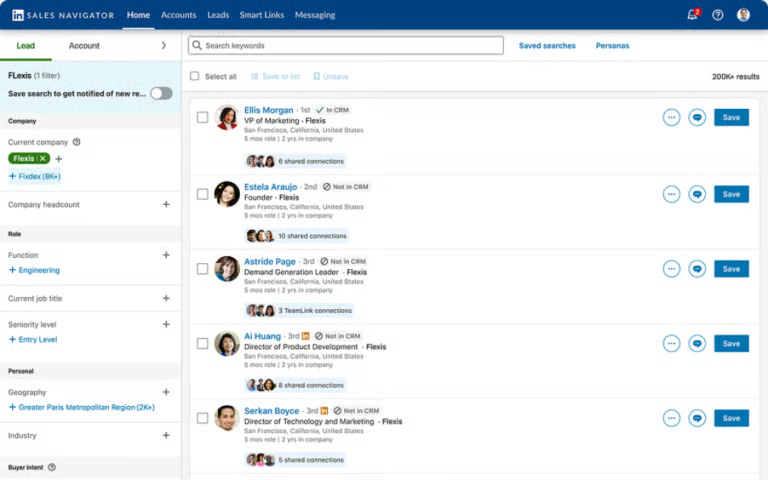
LinkedIn Sales Navigator is an excellent lead-generation tool because many B2B opportunities start with context: who has changed roles, who is connected to whom, which accounts are showing interest, and where a seller has a credible path into the buying committee. In my view, Sales Navigator is strongest when reps need to understand people and relationships before outreach.
It is not a full replacement for a B2B data provider or enrichment tool, but it is one of the most useful platforms for social selling and account research. For teams that sell into complex buying committees, LinkedIn Sales Navigator can help reps identify decision-makers, monitor account activity, and personalize outreach using professional context.
Gallery
Key features
- Advanced search filters: Sales Navigator includes detailed search filters to help users find relevant leads and accounts. This supports targeted prospecting by role, company, geography, industry, and other professional criteria.
- Recommended leads: Provides automated lead recommendations and buyer intent signals based on user activity. This can help sellers expand their prospect lists and uncover new contacts inside target accounts.
- Relationship Map: Helps sellers create dynamic org charts and identify buying committee gaps. This is useful for multi-threading because it shows whether the team has enough coverage across an account.
- Lead IQ: Includes an AI-generated summary of key information about a lead and their company. The summary can include profile, activity, connection, and account context that helps sellers prepare for first interactions.
- Message Assist: Helps sellers draft personalized messages with AI. This can speed up outreach while still encouraging reps to tailor messages to the lead and account context.
Pricing
| Plans and pricing (per license) | Core | Advanced | Advanced plus |
|---|---|---|---|
| Monthly | $119.99 | $159.99 | Contact sales for pricing |
| Annual | $89.99 | $149.99 |
- How to choose the best AI prospecting tool
- 1. Identify your primary prospecting gap
- 2. Match the tool to your sales motion
- 3. Evaluate data quality before AI features
- 4. Check CRM and workflow compatibility
- 5. Compare pricing against expected usage
- 6. Shortlist based on best-fit use case
- Methodology: How I evaluated the best AI prospecting tools
- Frequently asked questions (FAQs)
How to choose the best AI prospecting tool
Before choosing an AI prospecting tool, define the exact prospecting problem you need to solve. Some platforms are built to improve contact data quality, while others focus on AI research, account prioritization, relationship mapping, or outbound execution. Use the steps below to narrow your options.
1. Identify your primary prospecting gap
Start by reviewing where your current prospecting process breaks down. If reps spend too much time building lists, prioritize tools with strong contact and company databases. If they struggle to decide which accounts to pursue, look for buyer intent, account scoring, and AI recommendations. If personalization takes too long, prioritize AI research and message-assist features.
2. Match the tool to your sales motion
Choose a platform that fits how your team actually sells. High-volume outbound teams may need data enrichment, sequencing, and automated workflows. Account-based teams should prioritize insights from buying committees, intent signals, and account intelligence. Relationship-led sales teams should look for social selling tools, warm-path insights, and lead recommendations.
3. Evaluate data quality before AI features
AI prospecting depends on the quality of the underlying data. During demos or trials, test how well each platform finds accurate contacts, current job titles, relevant companies, and usable phone or email data for your target market. A tool with strong AI writing features will still underperform if reps are contacting the wrong people.
4. Check CRM and workflow compatibility
Review how each provider connects with your CRM, sales engagement platform, enrichment tools, and reporting workflows. The best AI prospecting software should reduce manual work, not create another disconnected system for reps to manage.
5. Compare pricing against expected usage
Do not compare providers solely by their monthly starting price. Ask how pricing changes based on users, credits, exports, enrichment, AI research, intent data, integrations, and contract terms. For credit-based tools, estimate monthly prospecting volume before choosing a plan.
6. Shortlist based on best-fit use case
After narrowing your criteria, choose the provider that best matches your most important need. ZoomInfo is the strongest fit for teams that need a scalable AI prospecting platform with B2B data and intent signals. Apollo.io is better for teams that want an all-in-one prospecting and sequencing tool. Clay is best for custom enrichment and AI research workflows. Cognism is a strong option for compliant B2B sales intelligence, while LinkedIn Sales Navigator is best for relationship-based prospecting.
Methodology: How I evaluated the best AI prospecting tools
To evaluate the best AI prospecting tools, I prioritized the criteria most relevant to B2B sales teams:
- Data quality and coverage: Does the platform help reps find accurate account and contact information?
- AI usefulness: Does AI improve targeting, research, prioritization, or personalization?
- Workflow fit: Can the tool connect to CRM, sales engagement, or RevOps workflows?
- Buyer signal support: Does it surface intent, engagement, job changes, company changes, or other timing signals?
- Ease of adoption: Can sales teams use it without heavy technical setup?
- Scalability: Can it support growing SDR, AE, RevOps, or ABM teams?
- Pricing and contract flexibility: Is pricing transparent, predictable, and appropriate for the buyer segment?
Frequently asked questions (FAQs)
What are AI prospecting tools?
AI prospecting tools use artificial intelligence to help sales teams identify, research, prioritize, and engage potential buyers. Common features include AI-assisted lead scoring, account research, buying signals, email personalization, enrichment, and workflow automation.
What is the best AI prospecting tool in 2026?
ZoomInfo is the best overall AI prospecting tool for teams looking for a scalable platform that combines B2B data, intent signals, and AI-guided recommendations. Apollo.io, Clay, Cognism, and LinkedIn Sales Navigator are also strong choices depending on your team’s sales motion.
Are AI prospecting tools the same as lead generation tools?
Not exactly. Lead generation tools help capture or source leads, while AI prospecting tools help sales teams decide which accounts to pursue, who to contact, when to reach out, and how to personalize outreach.
Can AI prospecting software replace SDRs?
AI prospecting software can reduce manual research, improve targeting, and draft outreach, but it should not fully replace human judgment. SDRs still need to validate fit, handle objections, interpret buyer context, and build trust with prospects.