Key takeaways
- Some best practices for giving employee feedback include preparing what you will say beforehand, holding the conversation in private, and providing space for employee self-reflection.
- For serious situations like workplace violence, harassment, and other criminal activity, refer to your workplace disciplinary procedures instead of employee feedback channels.
- Tools like performance management software can facilitate employee feedback by managing private, one-on-one conversations and monitoring employee development goals.
Leena Rinne, VP of Coaching at Skillsoft
- Oct. 1, 2025: Hanna Sillo made a updates on the element blocks. She also added a “what to avoid” callout for giving feedback, a comparison table of frameworks, and tailored feedback tips for remote team members.
Effective employee feedback is timely, specific, and collaborative. It is best to choose a simple framework (AID, SBI, or Pendleton), agree on clear next steps, and set a follow-up to review progress. But for serious issues, such as harassment, violence, or theft, skip feedback conversations and follow your disciplinary policy.
How to give employee feedback in 8 steps
Feedback is an essential part of any manager’s position. You are doing a disservice to your employees if you never give them positive or constructive feedback when they exceed or fall short of expectations. This can result in decreased motivation, declining performance, potential disciplinary actions, employee resentment, or separation.
Instead, use the steps below to provide effective employee feedback.
Check out our video overview below
Step 1: Decide on a feedback framework and prepare
If you notice a behavior you want to celebrate or change, the first thing to do is decide the most appropriate course of action. For example, an employee who demonstrates some of the following behaviors might benefit from a feedback discussion:
- Working extra hours to meet a deadline.
- Excessive absences or tardies.
- Supporting coworkers on a task.
- Heated disputes with coworkers.
- Finishing a project or task ahead of schedule.
- Missing a deadline.
- Exceeding a goal or expectation.
- Failing to meet key performance indicators (KPIs) or objectives and key results (OKRs).
Prepare what you want to discuss with the employee beforehand. Writing it down and reading it aloud is also a great way to practice and put yourself in your direct report’s shoes.
Think: how would you feel if you heard this feedback? If you don’t like what you hear, go back and revise as many times as necessary until you feel like it balances facts with recognition or empathy.
Remember to provide specific examples and focus on the impact of the situation. For constructive feedback, don’t overwhelm employees with everything they did wrong; instead, detail two or three examples so employees can focus on improving the areas that need the most attention first.
If you’re unsure how to start, explore our performance review templates and learn more about the various feedback frameworks to find one that works for you and your team.
The AID model stands for the following:
- Action: Examples of current actions or behaviors the employee does well or needs to improve.
- Impact: Description of how the employee’s actions affect working relationships, goals, or company success.
- Do: Explanation of what the employee should do more or what they should do differently going forward.
With this model, the idea is to use past behavior to encourage future actions. As a result, you can use this to deliver positive and negative feedback to employees.
AID in action
Let’s say you want to congratulate someone for taking the reins on a project after a coworker takes an unexpected leave. Here’s how you can use the AID method to show appreciation:
- Action: “I love how you took over the project after we were down a critical team member.”
- Impact: “You stepped out of your comfort zone, ensuring the project met the deadline and to the client’s standards.”
- Do: “I think you should start spearheading more of these projects and encourage your team members to follow suit.”
The SBI model stands for the following:
- Situation: Explanation of the circumstances around which a particular positive or negative behavior occurred.
- Behavior: Detailed description of the behavior you observed without judgment.
- Impact: Description of the results of this behavior from your point of view.
Like the AID method, you can use the SBI model to highlight the positive or negative behavior you witnessed. However, this method is more collaborative, leaving off with the impact of the employee’s actions and inviting the employee to comment on what they should do next. This two-way conversation aims to understand the employee’s intent and inspire growth.
SBI in action
Pretend you are a fast food restaurant manager with an employee who is consistently late and does not notify you ahead of time of their tardiness. Using the SBI method, here’s how you can approach them:
- Situation: “Yesterday morning and last week on Tuesday and Wednesday…”
- Behavior: “… you did not notify me that you would be tardy for your 9 a.m. shifts.”
- Impact: “When you do this, you put your teammates at a disadvantage since they have to work extra hard to deliver quality service, even when they’re a team member short.”
You can continue this conversation by reminding the employee of your attendance policy, inquiring about their side of the story, and asking how you can help. They may have a legitimate reason they are late, like childcare concerns. Together, you can work to find a solution, like changing their shifts around so they can take their children to school.
The Pendleton method is a series of even steps to outline the feedback conversation. This method allows employees to actively participate in the feedback session, encouraging self-reflection and an open dialogue.
The steps include:
- Determine if the employee is prepared to receive feedback.
- Ask the employee how they think the situation went and their behavior.
- Ask the employee what went well.
- Confirm or tell the employee what went well.
- Ask the employee what could be improved.
- Confirm or tell the employee what could be improved.
- Create an action plan based on the discussion to ensure the employee implements these improvements from now on.
Pendleton method in action
You currently have a mid-manager who talks over their junior direct report whenever the three of you are on client calls together. It is disruptive and doesn’t allow the junior employee to learn how to navigate these conversations. With the Pendleton method, you can have a productive feedback conversation like the scenario below.
(Note: In this example, Jack is a junior employee.)
You: Do you have a few minutes for some feedback about yesterday’s client call?
Employee: Sure.
Y: I wanted your take on how the conversation went with you, Jack, and the client.
E: I think we did well. The call was professional, and we answered the client’s questions succinctly.
Y: What do you think went well during the conversation?
E: We delivered all that they asked for and then some. I even highlighted how we’re ahead of schedule on the project, which I think they’re excited about considering their aggressive timetable.
Y: I agree. I’m excited that we were able to get ahead of schedule and prove to them how valuable we are as partners. It is incredibly commendable how you and your team pulled that off.
Y: Now, how do you think you could have improved that conversation?
E: Mmm, I think I could have clarified better when we will complete the project’s next phase. We still don’t have that completely outlined yet.
Y: I don’t think they expect us to have that all figured out just yet — they know our planning takes at least a week. But I do want to talk about Jack. I noticed you spoke over them frequently during the conversation instead of giving them a chance to answer. This can be disruptive and does not give Jack a chance to learn how to talk to clients. What do you think?
E: I didn’t realize I did that — I just wanted to make sure our client was getting the best answer.
Y: We do want to give our clients the best answers, but I think giving Jack a chance to try will help them grow and feel more confident in their role. You can always support Jack if necessary during those calls. Let’s come up with a plan to get Jack more involved in these conversations. How does that sound to you?
The conversation can continue by developing a plan to get Jack involved in more calls and help the employee take a backseat in these conversations.
| Model | Best for | Example starter |
|---|---|---|
| AID (Action, Impact, Do) | Clear direction after observed behavior | “When you… it resulted in… next time, please…” |
| SBI (Situation, Behavior, Impact) | Two-way discussion to uncover context | “In [meeting X]… I observed… which led to…” |
| Pendleton | Coaching and self-reflection | “How do you think it went? What would you change?” |
Step 2. Involve the employee in the process
Feedback works best as a two-way conversation; never leave it one-sided where employees have no say in when and how they get feedback. Establish this early on with your direct report so that they know what to expect when you are ready to give them feedback. To do this, ask your employee the following:
- How would you like to receive feedback?
- When is a good time to receive feedback?
- Could you provide me with some feedback?
Giving the employee the option to set the how and when of feedback is a powerful way to establish employee-manager trust and illustrate your emotional intelligence.
Beyond that, it gives employees time to professionally and emotionally prepare for the feedback. Employees can self-reflect on where they succeeded and where they could do better so they can articulate these thoughts during the discussion. Moreover, they know they have a safe space to provide feedback, aiding your growth and development as a leader.
Step 3. Decide on the time and setting
You should always give all constructive feedback in private. Even with positive feedback, ask employees how they would like to receive recognition. While many enjoy public appreciation for their efforts, others may shy away from scrutiny, preferring a private thanks or celebration with direct team members only.
Work with employees on deciding the best date and time to have your conversation, but make sure it happens as soon as possible after the incident, event, issue, complaint, or success. Doing so ensures that you recognize positive behavior or address problem areas quickly.
Giving feedback for remote and async team members
- Send a written pre-brief: Share the purpose, two to three examples, and the decision you’re asking for so no one is ambushed.
- Confirm camera-on consent: Ask whether video works for them today, don’t assume. Accessibility and bandwidth matter.
- Respect time zones: Choose overlap hours, avoid end-of-day Fridays, and rotate inconvenient times across regions.
- Document the outcome: Post a short recap with examples, decisions, owners, and dates in your wiki or 1:1 doc the same day.
- Mind the medium: Use live calls for sensitive topics and go for async comments for simple clarifications and praise.
- Protect privacy: Keep constructive feedback in DMs or private meetings. It’s best to use public channels only for recognition by preference.
Step 4. Be specific and empathetic
Don’t be afraid to be specific with your feedback. Vague statements, whether for positive or negative feedback, will not help the employee grow.
For example, “your work hasn’t been great lately” doesn’t explain what work is in question, how it’s wrong, or why it doesn’t meet your standards.
Similarly, don’t make judgments on the employee’s personality or other traits they may not be able to change. Instead, focus on the facts in your prepared statement, including the following elements:
- Specific examples of the behavior, either observed yourself or documented by others.
- KPIs, OKRs, or other performance metrics.
When delivering constructive feedback especially, remember to be empathetic. We’ve all received feedback at one time or another, so it’s important to allow employees to reflect and react. Avoid accusatory statements like “you failed to meet this project deadline” and instead provide context on how their behaviors impacted the company.
Step 5. Give the employee time for feedback
Offer the employee time to provide their perspective on their performance. Be patient and listen to what they have to say. You may uncover information that changes your perception, like:
- Inefficiencies in departmental workflows.
- Severe issues with coworkers, such as discrimination or harassment.
- Personal issues, like a medical diagnosis or family problems.
- A disability affecting their productivity.
Similarly, engaging in a dialogue gives you an opportunity to understand the employee’s thought processes. Growth in areas like critical thinking, strategic planning, and decision-making strategies may indicate the employee is ready for a promotion.
In some instances, this discussion may lead you to change your mindset or plan of action. For example, new awareness of a disability may prompt you to talk about reasonable accommodations under the Americans with Disabilities Act (ADA) instead of zeroing in on productivity coaching.
Let this be a teaching moment for you to grow as a leader. You may learn how your own actions put a wrench in the employee’s workflow. Or, your conversation may lead you to reflect on the unconscious biases, like affinity, cultural, or proximity biases, that may cloud your judgment. Whatever the case, be open to their perspective and feedback so that you can, ultimately, help them thrive in their role.
Step 6. Offer guidance and resources
After your conversation, propose solutions and offer the employee assistance to help them succeed. This lets you discuss what you hope to see from them going forward.
If you’re giving employees positive feedback, offer resources, like leadership training, so they can continue growing. If you’re providing constructive feedback, come prepared with options like:
- Additional training courses.
- Goal realignment.
- Coaching or mentoring sessions.
- Helpful productivity tools.
Alternatively, if you learn the employee has problems outside of their control affecting their performance, make sure to talk about additional company resources to help, such as:
- Employee assistance programs (EAPs).
- Financial wellness programs.
- Medical and mental health benefits.
- Paid time off (PTO).
- Medical or family leave (such as the Family and Medical Leave Act).
Step 7. Document the conversation
Although uncomfortable, it is imperative to document your conversation about the employees’ performance, whether for constructive or recognition purposes. Besides serving as a way to monitor employee behavior, it also provides historical evidence for future decisions like:
- Performance bonuses and raises.
- Promotions, demotions, and transfers.
- Performance improvement plans (PIPs).
- Performance reviews.
- Employee development plans.
- Disciplinary actions or termination.
Performance management or employee engagement platforms offer ways to keep track of employee feedback, even anonymously. For example, Workleap allows employees to respond anonymously to open calls for feedback, encouraging honesty without fear of retaliation. Workleap also saves the feedback so employees can revisit for insights whenever.
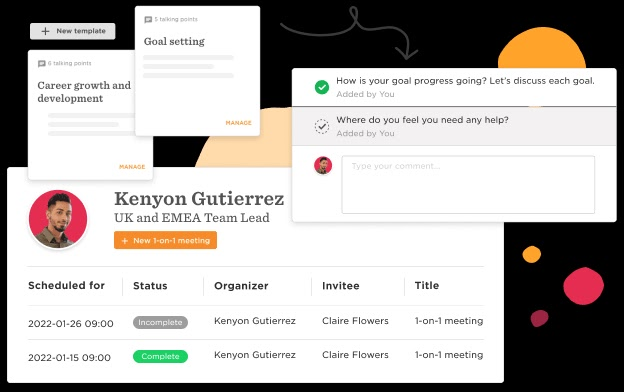
All-in-one HR suites let you tie employee feedback directly to other aspects of the employee life cycle. For example, Bob allows you to schedule one-on-one reviews with managers for regular feedback and recordkeeping. Plus, information from these sessions flows into understanding and taking action on company trends, like retention and turnover.
Step 8. Set a follow-up cadence
Regularly follow up with the employee after you give them feedback. This is especially important if you give the employee constructive feedback since a good follow-up cadence allows you to monitor their performance improvement, provide additional support when needed, and celebrate their progress on a continuous basis. Typically, follow-ups are either weekly, biweekly, or monthly.
What to avoid
Effective feedback also means steering clear of common pitfalls. Avoid vague judgments—name the specific behavior and its impact instead. Drop labels, such as “careless” or “lazy” and stick to observable actions. Keep constructive conversations private unless the employee explicitly prefers public recognition. And don’t pile on: Address one high-impact issue at a time and schedule follow-ups for the rest. This protects psychological safety, reduces risk, and strengthens your credibility.
How to give a constructive employee feedback
Consider some of the following best practices when meeting with your employees:
- Prepare beforehand. Don’t “wing it” — know what you want to say to your employee so your conversation will have the most impact.
- Be timely. Offer feedback to employees as soon as the behavior occurs so they can course-correct or continue what they’re doing quickly.
- Make the meeting private. This provides a safe space for you and your employee to be open and honest; even for positive feedback, not everyone likes to be recognized publicly.
- Focus on objective metrics. Use KPIs, OKRs, or other performance metrics to avoid making judgments about their personality.
- Propose solutions. Show employees you’re here to help them succeed by offering practical guidance.
- Ask for employee feedback. Allow employees to give you feedback so you can grow as a leader and strengthen the relationship with your direct report.
- Skip feedback only for serious issues. Violence in the workplace, theft, harassment, discrimination, use of illegal substances, and other serious incidents should follow your progressive discipline steps or termination in place of feedback.
Lastly, always practice your feedback before giving it — you can even leverage technology to help. Virtual reality, for instance, can simulate the entire experience, allowing you to practice the conversation without real-world consequences.
Alternatively, you can leverage AI tools like Skillsoft’s CAISY. These programs offer isolated chat environments so you can run through potential scenarios and prepare for various outcomes before approaching the employee.
See how CAISY works in the video below:
Employee feedback FAQs
Start a culture of continuous feedback
Feedback should not be a one-off occurrence but an integral part of your workplace culture.
Continuous feedback encourages employees to grow, empathize with their peers, and understand their strengths and weaknesses. And it helps “leaders foster an environment where talent feels at ease sharing their ideas, asking questions, and being open,” explains Leena Rinne, VP of Coaching at Skillsoft. In fact, feedback makes managers become better coaches for their direct reports, inspiring growth and company innovation.
If you need help figuring out where to start, learn why performance management is important. Or, check out our Performance Management Software Guide for a complete list of tools that help facilitate employee feedback discussions.
Featured partnersFeatured performance management partners