

Key takeaways
- Performance reviews facilitate fair promotions, salary increases, and workplace modifications while ensuring employees with comparable job roles are evaluated similarly.
- Developing a successful performance review process involves establishing a rhythm that motivates staff to enhance their skills and excel in their duties.
- Performance management software can help regulate your performance review cadences, establish consistency, and measure employee development over time.
Update notes
Aug. 1, 2025: Robie Ann Ferrer revised and restructured the article to clarify each step of the performance review process and improve overall flow. She also simplified the FAQs for better readability and added a new “Best Practices” section to highlight key implementation strategies.
- How to create a performance review process in 7 steps
- Step 2: Choose the performance review frequency
- Step 3: Run a calibration meeting to select evaluation criteria
- Step 4: Construct your performance review workflow
- Step 5: Complete performance reviews
- Step 6: Conduct a performance review meeting
- Step 7: Follow-up after the review
- Best practices for an effective performance review process
- Performance review FAQs
How to create a performance review process in 7 steps
High-performing companies use performance reviews to identify growth opportunities, maintain productivity and profitability, and align each worker’s progress with business outcomes. With a consistent and well-structured performance review process, you can retain top performers, promote internal mobility, and keep staff engagement strong.
Performance reviews are just one part of overall performance management, but they do not have to cause stress or annoyance across your organization. By following the steps below, you can create an efficient and effective process while motivating employees to continue their professional development.
Step 1: Determine the type of performance review process
Step 2: Choose the review frequency
Step 3: Run a calibration meeting to select evaluation criteria
Step 4: Construct your performance review workflow
Step 5: Complete performance reviews
Step 6: Conduct performance review meeting
Step 7: Follow up after the review
Check out our performance review templates and performance management software guide to explore tools that can support your employee review process from setup to follow-through.Or watch our video overview of the performance review process below.
Step 1: Determine the type of performance review process
There are various types of performance reviews to choose from, but the most common include top-down, self-evaluation, 360-degree, and rating-based reviews. To learn more, expand the sections below.
Top-down reviews
In a top-down review, the manager or supervisor evaluates the employee’s performance and delivers direct feedback. This is the most traditional review type and often works best in clear, manager-led reporting structures.
| Best for | Benefits | Drawbacks |
|---|---|---|
| Traditional or hierarchical organizationsCompanies that want to link reviews closely to business metrics | Connects performance to company goalsKeeps accountability with the managerEasy to roll out without needing extra tools or stakeholders | Can feel subjective or one-sidedMay miss peer contributionsProne to bias if ratings aren’t calibrated |
Self-evaluations
In a self-evaluation, employees assess their own performance, typically using a structured form or template.
| Best for | Benefits | Drawbacks |
|---|---|---|
| Startups or companies with strong feedback culturesTeams that encourage personal responsibility and career growth | Encourages reflection and ownershipSurfaces insights about personal goals or challengesBuilds engagement in the employee review process | Some employees may over- or under-rate themselvesNot as reliable without additional manager inputHard to compare across roles without calibration |
360-degree reviews
This type of review combines multiple perspectives, including feedback from peers, managers, direct reports, and sometimes customers or clients. It gives a fuller view of how someone performs within a team or across departments.
| Best for | Benefits | Drawbacks |
|---|---|---|
| Cross-functional teams or companies with matrix org structuresRoles that rely heavily on collaboration or external relationships | Captures a holistic view of employee performanceHelps reduce single-rater biasIdentifies leadership or communication strengths that may not appear in manager reviews | Takes longer to coordinateFeedback quality can varyMay overwhelm employees if not framed or filtered properly |
Rating-based reviews
With this performance review procedure, managers assign scores based on a defined scale. Common examples include Likert (1–5 scale), Behaviorally Anchored Rating Scales (BARS), and Behavioral Observation Scales (BOS).
| Best for | Benefits | Drawbacks |
|---|---|---|
| Companies with large workforces or multiple locationsRetail, foodservice, logistics, or shift-based teamsOrganizations that want consistent, trackable metrics | Makes it easier to compare performance across employeesHelps track trends over timeStandardizes criteria by role or department | Lacks nuance without narrative commentsCan feel too rigid for cross-functional or creative rolesNeeds careful calibration to avoid inflated scores |
Generally, the best performance review process combines all four types for a more holistic and nuanced view of your employee’s performance and development. For example, involving multiple stakeholders can prevent performance reviews from becoming too one-sided, while quantitative measurements can help you easily track and visualize performance over time.
While combining these types can yield more constructive performance review results, incorporating all of them may not work for you. If you’re a new employer or have a smaller team, I recommend starting with a top-down approach with employee self-evaluations.
Step 2: Choose the performance review frequency
When determining how often a performance review should occur, consider a cadence that gives you enough data to make strategic company decisions — such as identifying employee promotions or handling staff layoffs — without causing major disruptions to day-to-day operations. You may want to use multiple performance review frequencies or different review schedules by role, department, or location.
Most companies use formal reviews that happen once a year, but future trends point to an increase in the frequency of performance appraisals. 54% of HR professionals anticipate the rise of continuous feedback sessions, according to HR.com’s 2025 Future of Managing and Leading Performance study.
Performance reviews are also moving toward continuous check-ins with AI assistance. AI tools can generate summaries and surface insights, while managers retain the responsibility for applying human judgment to ratings and decisions. This shift allows organizations to blend efficiency with fairness, making performance conversations more frequent and data-informed without losing the human element.
However, there’s no one-size-fits-all performance review schedule. It depends on your goals, team structure, and how fast your organization moves.
Types of review cadences
Annual
This employee review process occurs once a year. It’s usually the default option of many organizations, especially smaller teams just starting a formal performance review procedure. Annual reviews are relatively easy to manage and often tied to compensation cycles or year-end planning.
However, feedback that happens once a year is rarely enough. Managers and employees typically struggle to recall a full year’s work. Plus, it can make workers feel disengaged if they don’t get the immediate feedback they need when it’s most important.
Semi-annual
Semi-annual reviews occur twice a year. The review cadence strikes a good balance between annual and quarterly intervals, allowing enough time for employees and managers to assess recent performance changes without repeating feedback.
Moreover, the increased frequency also means the likelihood of forgetting important feedback is lower than in annual reviews. Nevertheless, running performance reviews twice a year may be too much for smaller businesses that lack the time and resources to devote to this frequency.
Quarterly
Quarterly reviews happen once every three months and are great for measuring an employee’s progress on specific goals. For example, you may want to adopt a quarterly review cadence for new hires to monitor their progress and quickly address any concerns as they acclimate to their role.
However, quarterly reviews may require more time for businesses to complete. For tenured employees, a quarterly review may not yield any new feedback from the previous review cycle. Therefore, you may only want a quarterly review cycle for particular instances, such as project progression.
Ad hoc
Ad hoc performance reviews take place on an “as needed” basis. If you’re a brand-new company, you might want an ad hoc performance review frequency until you have the staff to orchestrate a more consistent schedule or an idea of how you will evaluate various positions.
Generally, however, an ad hoc performance review’s inconsistent frequency can be off-putting for employees who want an orderly cadence to prepare for their reviews. Therefore, it’s better to maintain a consistent schedule and regulate ad hoc reviews to specific situations, such as evaluating employee performance upon completing a project.
Continuous
Continuous performance reviews occur more than once a month, typically weekly or daily. The purpose of continuous feedback is to evaluate employee performance as it happens, so workers can instantly receive recognition for good work or correct any problems immediately.
Continuous feedback does not have to replace other performance review cadences. In fact, you may decide to pair informal continuous feedback with formal performance reviews. This helps motivate and encourage employees daily while tracking bigger-picture milestones during your formal review sessions.
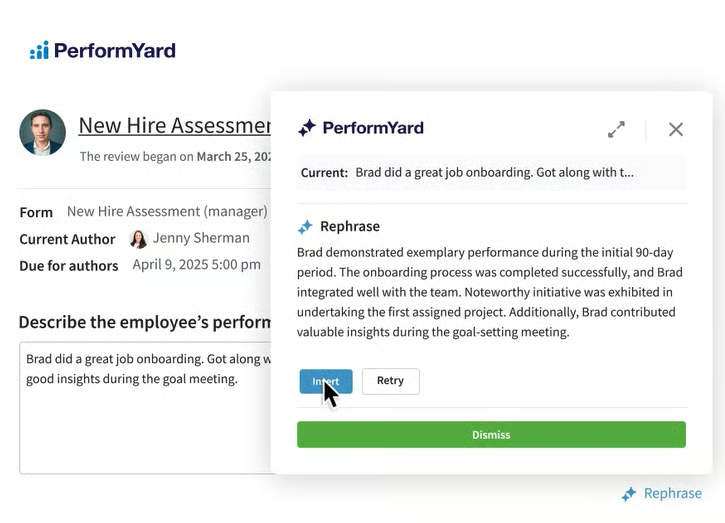
Software can help with the administrative upkeep of multiple performance review cadences and timelines. PerformYard, for instance, offers various review cadences, including continuous feedback, semi-annual reviews, quarterly conversations, or project-based reviews, which you can mix and match to fit your preferred performance management workflow.
Step 3: Run a calibration meeting to select evaluation criteria
Once you’ve decided on the type and timing of your reviews, the next step is to define what you’re evaluating. That’s where calibration meetings come in.
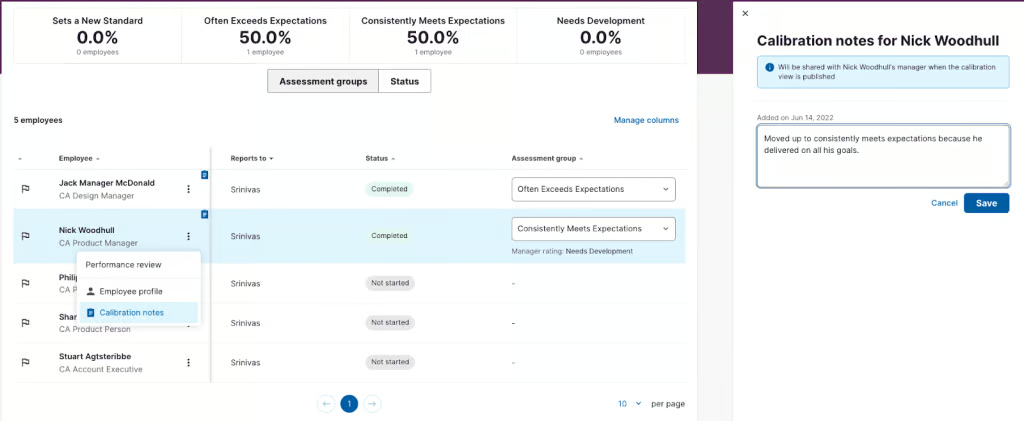
A calibration meeting helps people managers and HR leaders determine the appropriate criteria for evaluating each role, ensuring consistency and minimizing the risk of performance review biases. These meetings also enable you to identify and align on the performance rating scales for different roles, teams, or departments, including the evaluation forms to use.
For example, you can use an ordinal, 1-5 rating scale to determine if an employee completed a core duty satisfactorily. Rating scales are also useful for assigning numbers to measure hard and soft skills, allowing you to compare employees across the organization and identify skill gaps. Beyond rating skills, calibration meetings can also determine what portions of performance reviews should be quantitative, qualitative, or both. In most cases, I recommend using a mixed evaluation criterion.
Quantitative evaluations use measurable metrics, such as key performance indicators (KPIs), to judge employee performance. For example, you may rate a customer service representative’s performance based on whether they met the following KPIs: answered and resolved 60 calls per day and maintained an average customer satisfaction score of three or higher out of a five-point scale.
Quantitative evaluations can also help monitor metrics like employee attendance or progress toward professional development goals. Focusing most of your performance reviews on quantitative feedback is a great way to move your organization to a results-only work environment.
Qualitative evaluations rate employee performance on intangible criteria you can’t measure directly. For example, using the customer service representative from before, a qualitative review may involve evaluating the employee on soft skills like:
- Initiative.
- Adaptability.
- Teamwork.
- Demonstration of company values.
- Time management skills.
A good way of remembering the difference between quantitative and qualitative evaluations is that the former focuses on numerical feedback, while the latter focuses on descriptive feedback.
Combining qualitative and quantitative evaluations ensures you can track employee productivity and provide the necessary context for their performance, especially in roles with “less tangible outputs,” like financial analysts or sports coaches.
For example, roles with clear KPIs and metrics like those in sales or customer success may have an evaluation criterion that contains more quantitative data. For roles focused on planning, problem-solving, or managing others, qualitative feedback carries more weight than quantitative data.
ALSO SEE: Top Performance Metrics Examples & What They Measure
Running a calibration meeting and choosing what evaluation criteria to focus on for each role can be daunting, but leveraging performance management software can streamline the process. Culture Amp, for example, offers templated review questions and shareable calibration views to simplify the collaboration effort among all performance review stakeholders.
Step 4: Construct your performance review workflow
Without a defined workflow, performance reviews often break down. Managers may start strong but lose track of forms. Employees may submit self-evaluations without knowing the next step. And HR might get stuck chasing responses or piecing together missing ratings and vague comments.
Your performance review workflow determines the order in which actions for your performance review cadence will occur. Ideally, your workflow should take into consideration the following:
- Participants: Who is involved in an employee’s performance review?
- Deadlines: When does the review cycle start and end? How long does each stakeholder have to complete their review portion? Is there a reasonable time for each participant to provide critical feedback by the deadline?
- Training: Do recent new hires or managers need training on how to complete performance reviews? Where in your employee review process will you offer this training?
- Post-review actions: What happens after the review cycle? Do certain results trigger promotions, raises, or objectives and key result (OKR) adjustments? Will there be feedback surveys to measure review effectiveness?
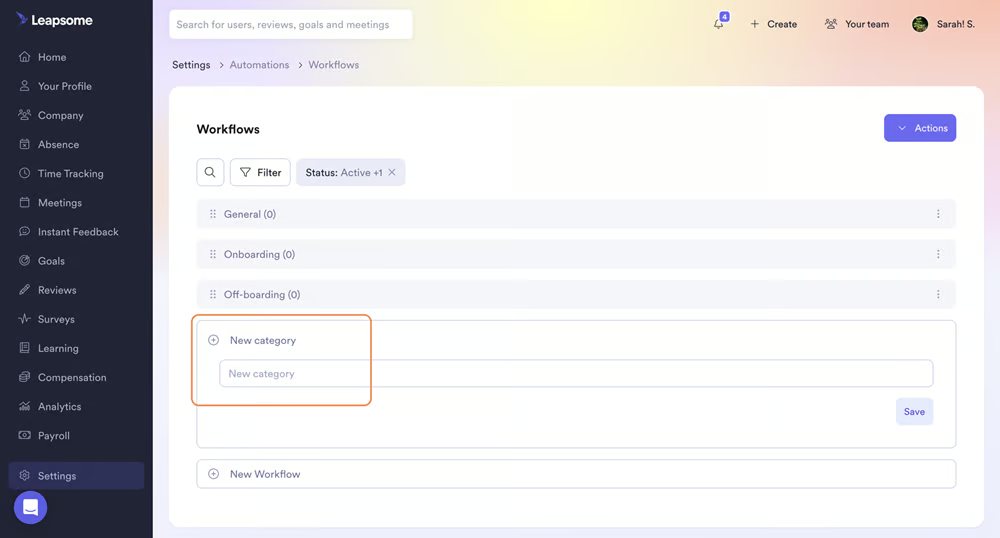
Performance management software automates most of these actions, so you don’t have to manually create workflow timelines or remind stakeholders to complete their portions. For example, Leapsome centralizes performance workflows in one place and creates customized workflows.
Step 5: Complete performance reviews
With your forms finalized, your evaluation criteria aligned, and your review workflow in place, it’s time to move into execution. This is the part where participants complete their reviews, which can include employee self-assessments, manager evaluations, peer feedback, and any other components you’ve built into your performance review procedure.
Have all participants complete their review portions according to your workflow. If you or your employees need help to complete the evaluation, consider using the STAR method for self-evaluations and critical feedback.
STAR, or Situation, Task, Action, and Result, is a framework to outline a project or issue faced, what actions you or your employee took to resolve it, and how the outcome positively affected the company. The STAR method can help you briefly explain your or your employee’s contributions and tie them to company objectives.
If you still struggle to write constructive feedback, generative AI like ChatGPT can help you develop constructive feedback from employees based on the parameters you provide. SAP SuccessFactors even includes a writing assistant that lets you write feedback for your employees on particular competencies without discouraging them.
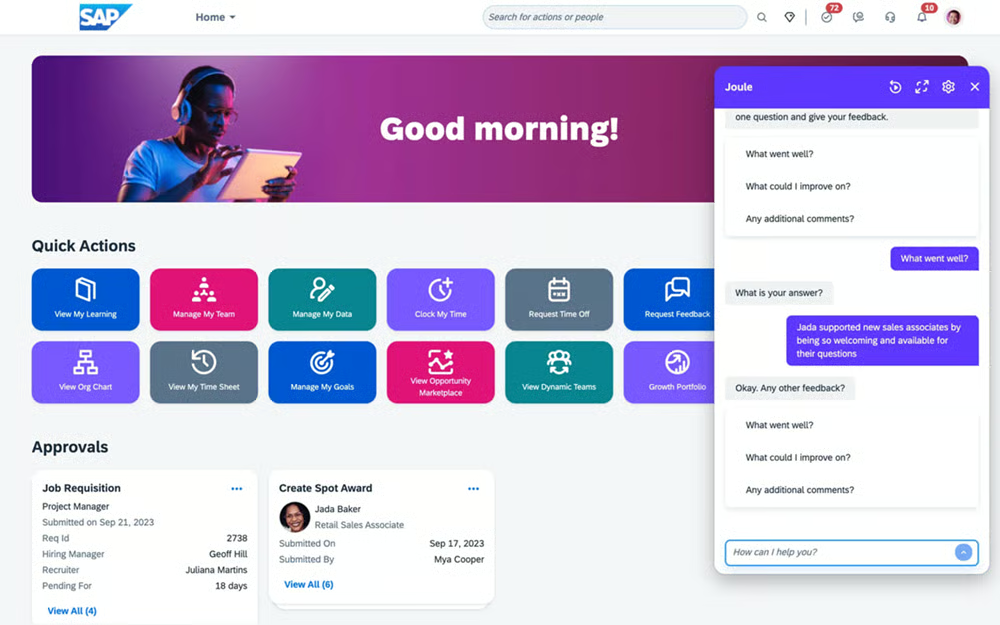
For more AI review tools, check out this article: I Tested 8 Free AI Performance Review Generators: Here’s How It Went
Step 6: Conduct a performance review meeting
Once the written reviews are in, it’s time for the most human part of the performance review process: the one-on-one conversation. This is where a well-structured employee review process can build trust, clarify expectations, and boost talent development.
The meeting involves the employee and the direct supervisor, but an HR representative or indirect manager may also attend. This usually happens when the direct supervisor is new or when there are discussions on promotions or demotions, transfers, pay raises, or management changes. Whatever the setup, make sure the employee knows who will be attending and why.
Managers or supervisors conducting these meetings should prepare for the following:
- Provide specific feedback on areas where the employee excelled or needs improvement, with examples or documents for support.
- Outline both role and professional goals to achieve before the next review period.
- Advise on how to improve in weak areas.
- Listen and take notes on the employee feedback.
Preparation is especially important if the review contains constructive or critical feedback. It’s not enough to say the employee needs to “communicate better.” The manager should be able to explain what hasn’t been working and offer clear suggestions for improvement.
Further, it’s best to consider performance review meetings as “coaching” sessions instead of “judging” sessions. In addition to helping reduce employee anxiety during these meetings, the sessions become opportunities to discuss career goals and development plans.
ALSO READ: How to Give Feedback to Employees: Top Tips for Managers
Step 7: Follow-up after the review
Your performance review process continues even after you’ve held your one-on-one with employees. Crucially, you need to follow up on any promises you made to employees during the evaluation and learn how to optimize the employee review process for future cycles.
Typically, post-review actions include the following:
- Salary adjustments: If you run your compensation review process alongside your performance reviews, complete the necessary procedures to adjust the employee’s salary.
- Rewarding top performers: Traditionally, these include raises or promotions, but you may also reward employees for a job well done with recognition awards, public shoutouts, staff bonuses, gift cards, or company swag.
- Helping underperformers improve: For struggling employees, provide them with the resources to help meet performance targets, such as extra training, productivity tools, one-on-ones, SMART goals, or performance improvement plans.
- Correcting underlying issues: Take measures to fix problems employees reveal during their evaluations, such as workflows, communication cadences, or employee experience.
- Completing post-performance review surveys: Gather feedback from employees after performance appraisals to learn what worked, what didn’t, and how to improve the process in the future. Survey platforms, like Workleap, can automate the process and track responses over time.
- Analyzing performance review results: Performance review evaluations provide a treasure trove of data to help you plan strategic company initiatives. Using software like Lattice, for example, can help you uncover insights on pay equity, skills progression, and succession planning.
ALSO READ: How Performance Bonuses Help Avoid Bias and Increase Productivity
Best practices for an effective performance review process
Once your employee review process is in place, these best practices can help you get the most out of it. They can reinforce structure, improve quality, and ensure the process drives both employee growth and business outcomes.
- Set expectations early and often: Performance reviews work best when everyone knows what’s coming. Share expectations at the start of each review cycle and revisit them during 1:1s, project planning, and onboarding.
- Equip managers to lead strong reviews: Well-run reviews depend on well-prepared people managers. To help them lead consistent and clear conversations, offer review checklists, templates, how-to guides, and coaching sessions.
- Tie reviews to development and business priorities: The review process isn’t just about tracking employee performance. You can use the review data to identify skill gaps, create a training program, assess readiness for new roles, and guide promotions or succession planning.
- Stay flexible within a structured process: Adjust the cadence or format for different roles or departments, if needed. Just make sure that the goals, evaluation criteria, and expectations stay aligned, so the performance appraisal review process remains fair and focused.
Want to know more? Head on over to our FAQ section or check out our video answering common performance review questions below.
Performance review FAQs
What is a performance review?
A performance review, or performance evaluation or appraisal, is a formal assessment of an employee’s productivity, growth, development, and impact on a company. Most are two-way conversations between employees and managers that happen semi-regularly throughout the year. It can also involve feedback from additional stakeholders like peers, clients, or customers.
What is performance management?
Performance management is the broader strategy behind tracking and improving employee performance. It includes tools like performance evaluations, goal tracking, pulse surveys, coaching, and recognition.
What are the benefits of performance reviews?
A well-structured performance review helps you set clear expectations, track employee performance and progress over time, and boost staff development. It also encourages transparency between managers and employees, while keeping performance standards consistent across the company.
What are the drawbacks of performance reviews?
Performance reviews can become frustrating if they’re infrequent or take too long to complete. They can also lose impact when the process is too complex or isn’t clear, and when people don’t understand how the feedback will be used. However, a simple, consistent approach helps make performance reviews more effective for everyone.
How do you make sure employees participate in the performance review process?
Make sure employees understand why the review matters. If the performance review process is tied to pay raises, promotions, and career goals, people are more likely to take it seriously. You can also set clear deadlines, ask managers to follow up, and use performance review tools that send automatic reminders to keep things moving.