

Key takeaways
- A performance improvement plan (PIP) is a strategic document intended to help underperforming employees course-correct.
- An effective PIP can improve employee performance by providing clear guidelines on how to succeed in their role.
- Performance management software can help you identify performance issues early and minimize the need for PIPs through company-wide, continuous feedback.
Update notes
- Oct. 17, 2025: Hanna Sillo refreshed this article to improve structure and readability. She also included practical examples and manager tips, added common PIP mistakes to avoid, and removed outdated vendor mentions for accuracy.
What is a performance improvement plan?
A performance improvement plan (PIP), or a performance action plan, is a strategy companies use to help employees who are not meeting performance objectives. It typically includes a document outlining role expectations, areas for improvement, and SMART goals to help get performance back on track.
Too often, organizations use PIPs as part of progressive discipline or to document poor performance before termination. Instead, PIPs should be a part of your wider learning and development initiatives.
When implemented effectively, PIPs can help employees build confidence, meet their goals on time, and contribute to overall company productivity.
Learn why employee performance management is important and limit the need for PIPs.
What are the advantages of a PIP?
Successful PIPs set clear employee expectations, give them extra help, and save time and money by preventing turnover.
Sets clear expectations
PIPs clarify what objectives employees are being judged by and provide actionable goals to demonstrate their contributions to the company. PIPs can also help you move to a results-only work environment for a more objective look at employee performance.
Gives poor performers extra help
Struggling employees may feel uncomfortable asking for help. A PIP is an opportunity for HR teams and managers to demonstrate their willingness to help employees in their roles. Plus, by making PIPs a part of your company’s learning and development (L&D) culture, employees are more likely to open up about their struggles and be willing to participate in PIPs.
Saves time and money
According to 2022 SHRM research, hiring a new employee can cost almost $4,700. Thus, keeping an existing employee can be much less expensive and time-consuming in the short term than investing in a replacement. By using a PIP, you can reduce turnover, prevent productivity delays, and avoid spending time and money on finding and training new talent.
What are the downsides of a PIP?
PIPs are not right for every situation or every company. They can easily demotivate employees, lead them to look for other work, and take HR and managers away from other high priorities.
Demotivates employees
PIPs can make affected employees feel inadequate or singled out. This is especially true if PIPs are not a typical aspect of performance management at your company. As a result, PIPs can have the opposite effect, such as demotivating employees or even making them quit.
Some employers want PIPs to create this very outcome, but it is not good practice. Using PIPs in this way can tarnish your reputation by indicating to your employees that you don’t care about their professional success.
Leads employees to look for other work
Like above, employees on PIPs may feel like they have little choice but to look for other work. As a result, employees could quit before completing their PIP, forcing you to look for a replacement, especially if they’re in a critical position.
Requires time and effort
PIPs take significant time and effort to implement since they require collaboration from multiple stakeholders, formal documentation, research into historical data, goal tracking, and check-ins. This means PIPs take HR teams and managers away from other primary duties, potentially lowering productivity.
How to implement a PIP in 6 steps?
If an employee could benefit from a PIP, follow the steps below to create a focused, goal-oriented plan.
PIPs are most effective for helping employees meet measurable performance goals—not for addressing behavioral issues. To ensure fairness and avoid claims of bias, offer PIPs consistently to all employees in similar situations.
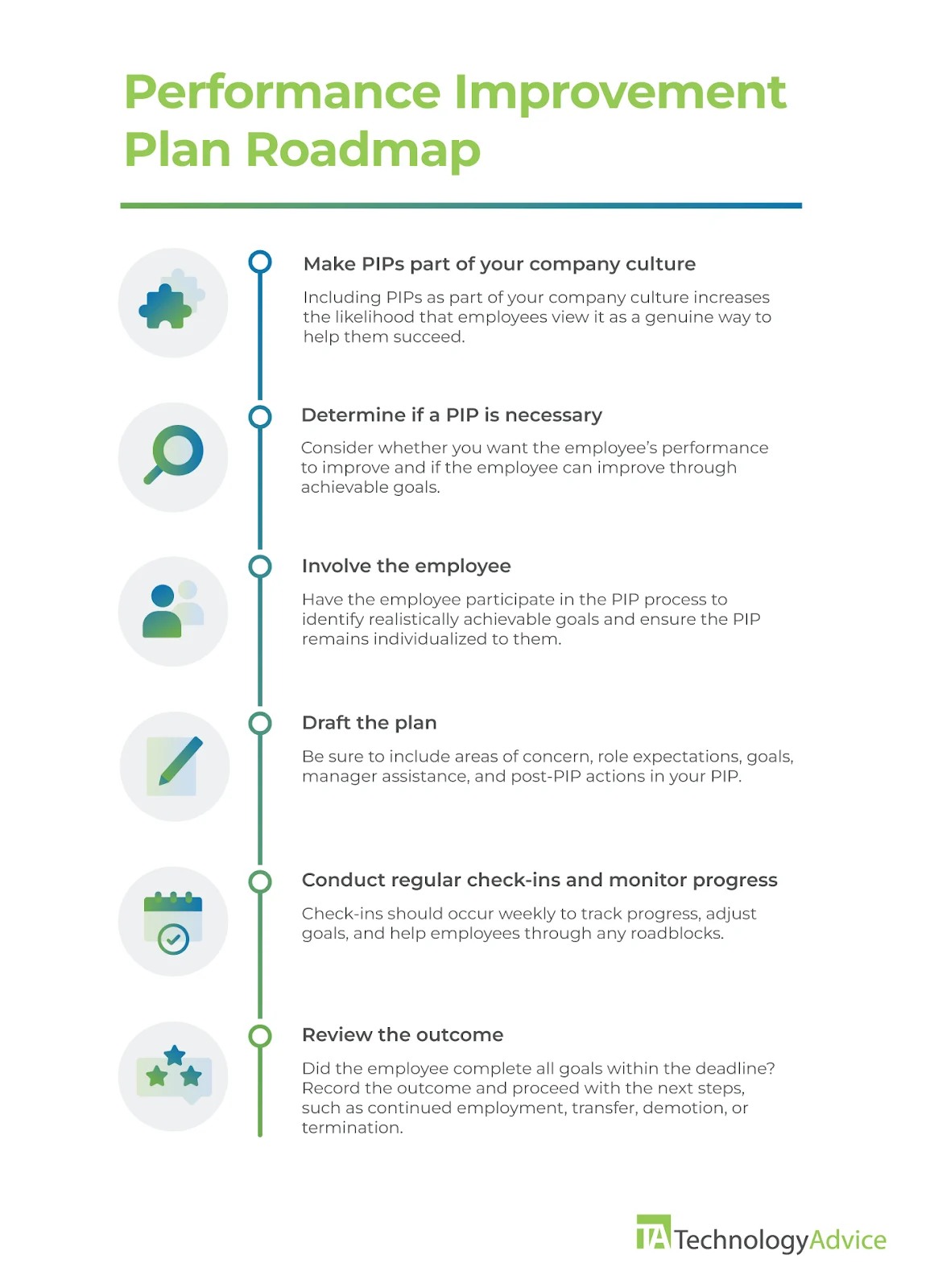
Step 1: Make PIPs part of your company culture
By including PIPs as part of your typical performance, learning, and development management processes, you can remove the perception of PIPs as a termination death knell. Instead, a company culture that embraces PIPs as normal signals to employees your commitment to continuing their professional development.
One way of doing this is by democratizing who receives PIPs, such as issuing PIPs equally to both traditionally high and low performers. This can help underperformers get up to speed while challenging or upskilling overachievers.
- Example: Some companies issue short “development PIPs” to high performers who are transitioning into leadership roles or tackling stretch projects. These plans outline growth goals rather than corrective actions—turning the PIP into a visible coaching tool that supports career development instead of punishment.
- Common mistake: One of the biggest misuses of performance improvement plans is treating them as a formality before firing someone. When a PIP is issued with no real intent to help the employee improve, it’s often obvious—to the employee, the team, and even to the courts.
Step 2: Determine if a PIP is necessary
You should only use PIPs as a genuine way to get an employee’s performance back on track, not as a way to create termination evidence. Before drafting your PIP action plan, ask yourself the following:
- Is this a performance or behavioral issue?
- Can the performance issue be fixed through actionable goals?
- Do you want the employee to succeed in their PIP?
- Can you dedicate time and resources to helping the employee improve?
- Have you counseled the employee about their performance and goals in the past?
PIPs should target specific performance issues with achievable, time-bound goals. PIPs also work best for recent performance issues, not ongoing issues that you have tried to counsel employees on in the past. And, if you can provide extra one-on-ones or training to the employee, they’ll be more likely to complete their PIP successfully.
- Example: Before starting a PIP, managers at high-trust organizations often hold a feedback meeting to explore root causes—like role ambiguity, insufficient resources, or unclear expectations. If the performance gap stems from poor communication or training needs, a coaching plan or job-shadowing assignment might be more effective than a formal PIP.
- Common mistake: Using a PIP to address attitude or interpersonal conflicts. Behavior issues such as negativity, gossip, or poor teamwork can’t easily be measured or resolved through SMART goals. For these, it’s better to use coaching, mediation, or conflict-resolution strategies. A PIP focused on “fix your attitude” will almost always fail because it lacks clear success criteria.
Step 3: Involve the employee
Do not make a PIP a one-sided affair by drafting a performance plan without the employee’s input. Instead, involving the employee in the PIP process demonstrates that you are committed to helping them improve.
Involving the employee in the PIP discussion also means you avoid creating the PIP in a vacuum. You can be transparent about the minimum acceptable benchmarks for their performance. At the same time, employees have a say in what goals they can realistically achieve.
Moreover, employees can be open and honest in areas they feel they need extra support so you can provide training, resources, or other accommodations for them to be successful.
- Example: During the initial meeting, invite the employee to outline two or three performance goals they believe are achievable. For instance, an analyst might suggest “reducing report turnaround time by 20%.” Collaboratively refining these goals builds accountability and signals respect, turning the PIP into a partnership instead of a top-down directive.
- Common mistake: Drafting a PIP in isolation and surprising the employee with it. When employees see a plan they had no voice in, they may shut down or feel ambushed. This approach damages trust and often leads to disengagement or early resignations.
- What to do instead: Schedule a discussion first, then finalize the plan together so expectations are shared and understood.
Step 4: Draft the plan
At a minimum, PIPs should include the following:
Areas of concern
Explain in detail where the employee is not meeting expectations, and be sure to include relevant documentation. For example, if a customer service representative consistently receives customer complaints, include these complaints with explanations of how this impacts the business.
Make sure to discuss the problem’s root cause with the employee. In the case of the customer service representative, they may need more training on the product to troubleshoot customer issues better or on proper phone etiquette. You won’t know until you ask the employee.
Role expectations
Define the employee’s expectations in the role, including what success looks like. For example, using the customer service representative from earlier, perhaps they need to receive a customer satisfaction score of three or higher on a 1-5 scale in a three-month lookback period.
The PIP should clarify what the employee should be working toward in their position so they can continue to succeed, even past the PIP.
Actionable goals
You should work with the employee to develop performance goals to meet by the end of their PIP. These goals may differ slightly from their role expectations, depending on the employee’s current performance.
For instance, if the customer service representative’s current customer satisfaction score is two, the goal of the PIP may be to raise it to 2.5 within the next three months. However, after the conclusion of the PIP, the expectation is that the score will continue to increase to a minimum of three without backsliding.
The best goals are SMART: specific, measurable, achievable, relevant, and time-bound. In other words, the goals should:
- Include deadlines, such as 30, 60, or 90 days.
- Relate to the work that the employee performs every day.
- Identify the actions the employee should take to be successful.
- Be easily trackable and specific to the employee.
Manager assistance
Include how you will be helping the employee succeed in their PIP. Some of the ways you can assist the employee include:
- Offering additional training in specific areas of struggle, including budgeting for necessary training courses.
- Granting access to productivity tools or other resources to increase their work efficiency or focus.
- Assigning mentors, coaches, or coworkers as resources outside the employee’s manager or human resources (HR) department.
Remember to work with the employee to see what things you can do that will benefit them the most, and don’t assume offering the same assistance will work with every employee.
Post-PIP actions
The employee PIP should include language outlining what will happen after the deadline. For instance, if the employee completes everything in their PIP, you might note the goals you hope they will continue to achieve.
Or, if they do not meet the goals as anticipated, you may proceed with demotion, transfer, or possible termination. The PIP should be explicit with the consequences so there are no surprises.
Drafting an employee PIP does not have to take a long time. Your current HR software or performance management software may already have PIP workflows to expedite the process. Some platforms offer PIP templates you can customize to your needs. Alternatively, you can download our free PIP template below.
Step 5: Conduct regular check-ins and monitor progress
Determine a regular performance check-in cadence with the employee to monitor their PIP progress. Ideally, these meetings should happen weekly to keep the employee on track and assist them with any roadblocks.
- Example: Managers who hold short weekly or bi-weekly check-ins keep momentum high and catch roadblocks early. These sessions should focus on progress toward each goal, feedback on what’s working, and any adjustments needed to meet deadlines. Consistent follow-up communicates investment in the employee’s success.
- Common mistake: Waiting until the end of the PIP to assess results. Without interim feedback, small issues compound into failure. Employees may assume silence equals approval, while managers lose visibility into improvement trends. Regular, structured check-ins (documented briefly in HR software) make the process transparent and defensible.
Step 6: Review the outcome
Once the PIP hits the deadline, review the PIP and determine how well the employee did. Ask yourself:
- Did both you and the employee make a concerted effort to improve performance?
- Did the employee hit all required targets?
- Were there any issues with hitting these targets? If so, are there explainable reasons why not?
If the answer to these questions is “yes,” you can close the PIP. The worker can continue their employment as long as they meet their role expectations.
If the answer to these questions is no, close the PIP and continue with the next steps. This may include a PIP extension, reassignment, demotion, a last-chance agreement, or termination. If you extend the deadline of the PIP, make sure it is because the employee demonstrated their commitment to improving their performance or because the goals were too unrealistic upon review.
Common mistake: Ending a PIP abruptly without clearly communicating the results or next steps. Leaving employees uncertain about their status creates anxiety and can undermine morale across the team. Even if the outcome is termination, transparency and respectful communication preserve professionalism and reduce legal risk.
What are some alternatives to a PIP?
PIPs are not always the answer to all performance-related issues. Jennifer Preston, an HR consultant with Flex HR, even notes some drawbacks with PIPs, such as increasing tensions between managers and employees or creating divisiveness.
Before implementing a PIP, try the following strategies to motivate employees and improve workplace performance:
- Outside training courses: These courses can be beneficial if you lack in-house training or your employee needs a new, safe environment to practice their skills.
- Mentorship programs: Consider pairing your employee with an internal mentor to troubleshoot problems in a low-stakes environment; employees can even find mentors for free through vendors like Pushfar.
- Continuous feedback cycles: These cycles give employees immediate feedback so that they can fix any performance issues early without waiting for formal performance reviews; most performance management software, like PerformYard, accommodate continuous feedback workflows.
Free downloadable PIP template
Use this PIP form template to get started on crafting a personalized PIP for your employees:
Performance improvement plans FAQ
What is the HR department’s involvement in a PIP?
The HR department’s role in PIPs includes the following:
- Determining if PIPs are appropriate for particular performance issues.
- Ensuring PIPs are implemented fairly among employees in similar situations and roles.
- Drafting PIPs with the help of the employee and the manager.
- Providing training and other support to employees on PIPs.
- Monitoring the effectiveness of PIPs through goal tracking and check-ins.
- Following up on PIP outcomes, such as creating transfer documentation.
How long are PIPs?
PIPs typically range between 30, 60, or 90 days. This gives employees time to understand their work expectations while emulating actual work demands. You are unlikely to see significant changes in an employee’s performance by extending PIPs past 90 days since you lose the sense of urgency with longer deadlines.
When should I use a PIP?
- Other methods fail. Try a PIP after performance reviews, feedback cycles, or other disciplinary processes have not worked.
- SMART goals can help. A PIP is an excellent strategy if you can break the performance issue down into trackable goals.
- Training availability. If you have additional L&D courses or resources to help the employee in specific problem areas, a PIP can help you administer and track their effectiveness.
- Unclear work expectations. PIPs make the main objectives of employee positions transparent, allowing them to focus on the areas of their job that are most important to the company’s success.
When should I avoid a PIP?
- Paper trail creation. You should document performance issues for employees as they occur; PIPs should not act as a way to legitimize termination when you lack proper documentation.
- Personal issues. If a manager and employee do not get along for personal reasons, a PIP will not help resolve differences.
- Behavioral issues. PIPs cannot always correct behavioral problems, such as a generally poor attitude, since they are difficult to quantify and track effectively.
- Serious incidents. Some incidents, such as sexual harassment, violence, or theft, are severe enough to warrant immediate termination instead of other disciplinary or performance measures like PIPs.
Check out our Performance Management Software Guide for a complete list of options to help you start drafting PIPs.