Key takeaways
- Aug. 25, 2025: Robie Ann Ferrer revised the article to improve clarity, readability, structure, and keyword alignment. She also added new sections on how high attrition impacts businesses, best practices for improving retention, visualizing attrition dashboards, and AI-powered attrition prediction tools.
What is attrition rate?
Attrition rate measures how many employees leave a company over a period of time. It gives a glimpse into your company’s overall health, such as the strength of your hiring and retention efforts. It also aids in strategic human resources (HR) processes, such as workplace planning, succession planning, labor cost management, employee engagement, and recruitment.
Some call it erosion rate because it shows how your headcount declines. And unlike turnover, which counts all employee departures even when positions are filled, attrition focuses only on positions that remain vacant.
I look at attrition rate as a signal. It tells you how your company is evolving. Are you scaling down intentionally? Losing key talent without backfilling? Or, cutting costs through unfilled exits? The number reveals more than just movement; it reveals strategy (or the lack of it).
Featured partners
Attrition rate and HR metrics
Attrition rate is one of several critical metrics your HR department should track over time. Learn more about various people processes and data to track in our HR metrics series:
How to calculate attrition rate?
You can calculate your attrition and turnover rates by dividing the total number of employee departures by your average employee headcount and multiplying that by 100. This gives you the attrition percentage.
To get an accurate number, make sure the numerator and denominator cover the same timeframe. This can be monthly, quarterly, or annually.
For the more nuanced version of attrition, only consider the number of employees who left and were not replaced before dividing that by your average headcount.
Attrition rate =
Number of employees who left and weren’t replaced in a timeframe
Average number of employees in the same timeframe
x 100
Understanding how to manually calculate attrition rate gives you deeper insight into your workforce trends. Once you’ve got the formula down, it’s easy to spot changes over time and explain the numbers behind them. And if you’d rather skip the math, use the calculator below.
Attrition rate calculator
Adjusting the formula also allows you to examine attrition from various angles. The math stays the same, but you can tweak your inputs based on what you want to learn.
Attrition rate examples
Types of attrition
While it’s important to know your company’s total attrition rate, the overall number rarely tells the full story. Breaking it into categories gives you a more granular look at the different causes of attrition, allowing you to craft targeted approaches to improve the company culture and workplace.
There are four types of attrition: voluntary, involuntary, internal, and demographic-specific. Understanding what type of attrition you’re seeing can help you decide whether your attrition rate is expected, healthy, or a red flag.
Voluntary attrition is the result of employee-initiated separation due to:
- Resignation.
- Retirement.
- Relocation.
- Personal reasons.
Voluntary attrition is one of the most important categories to monitor since it can indicate more serious problems within your company. For example, high voluntary attrition rates could point to issues like:
- Negative company culture.
- Lack of career development or advancement opportunities.
- Unsafe work environment or practices.
- Unclear work expectations.
- Poor compensation and benefits.
Read more: The 7 Warning Signs of an Unhappy Employee
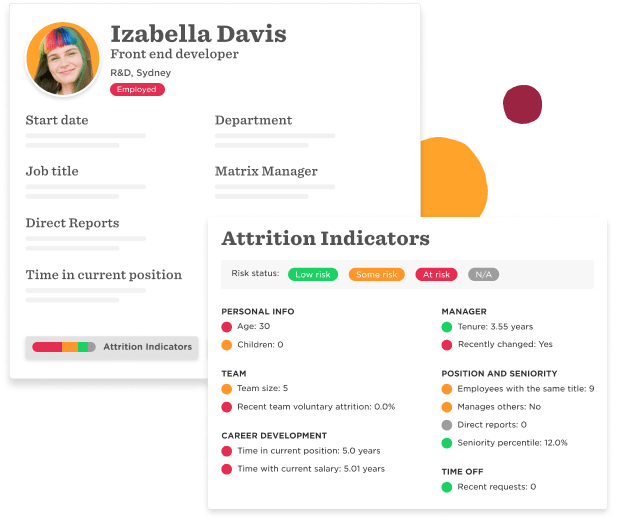
Conducting exit interviews when employees leave is one way to gain insight into the reasons behind voluntary attrition and build plans to address it. HR systems can also help you develop a proactive strategy, especially those that use artificial intelligence (AI) in HR features, like reporting and analytics. Some HR software, like Bob, offers AI-driven insights to pinpoint employees at risk for attrition so you can take steps to retain them.
Involuntary attrition is attrition from employer-initiated separation, including:
- Employee terminations.
- Layoffs.
- Eliminated positions.
Outside of dismissals for cause, involuntary attrition can result from changes to your business, industry, or market that lead to downsizing or cost-cutting measures.
Also Read:
- How to Fire an Employee (and Stay Out of Trouble)
- How to Gracefully Layoff an Employee With Compassion
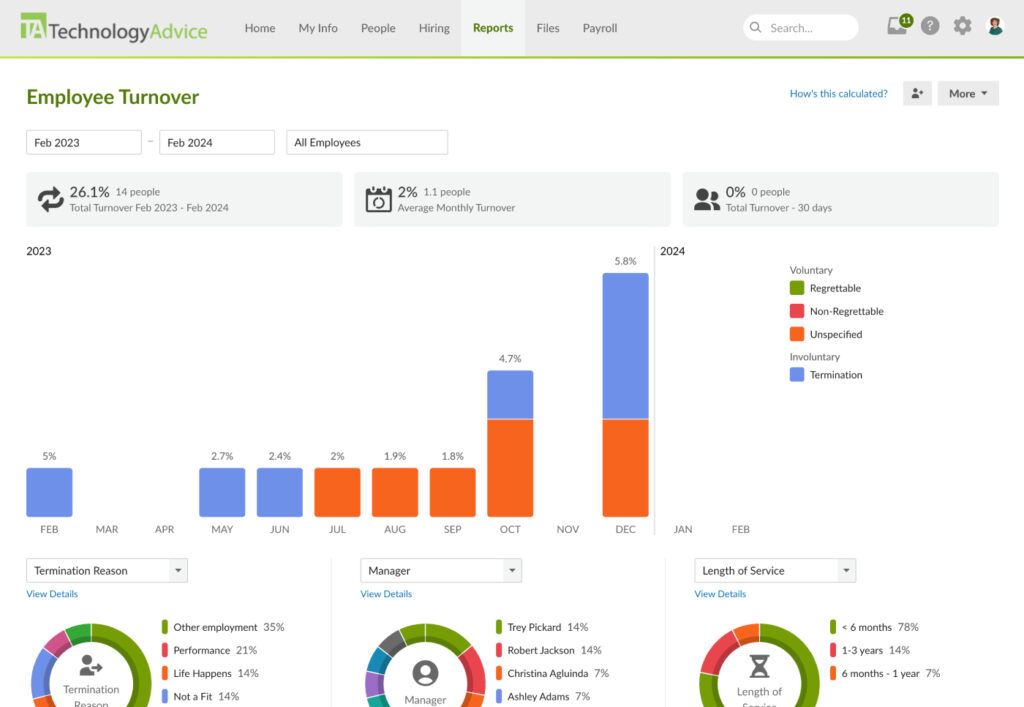
Tracking this type of attrition can reveal workplace or leadership issues before they escalate. High involuntary attrition signals deeper problems, damages staff morale, and disrupts productivity. With BambooHR, you can run reports that filter separations by reasons, including terminations, to spot patterns quickly and address root causes.
Internal attrition occurs when you don’t backfill a position following promotions, demotions, and role or departmental changes. High internal employee attrition is a concern if it causes inequitable work distribution or production bottlenecks from a lack of talent in the roles employees left.
Demographic-specific attrition occurs when employees from a particular group leave your organization. Gender-based attrition, for example, looks at attrition based on gender groups. If your attrition rate is higher for folks who identify as female or non-binary, that could indicate a problem with diversity, equity, and inclusion (DEI) in your company.
You can track similar rates for other employee demographics, like race, age, ethnicity, geography, or employment information, to understand how your business practices affect various groups. Layering your attrition data with performance data can also provide a look into attrition causes.
What are the causes of attrition?
There are several causes of attrition, many of which are natural and not necessarily negative. For example, employee relocation and retirement are examples of attrition beyond your control.
Attrition due to layoffs or company restructuring could also be natural as companies learn to be more productive with fewer staff. One example is using machine automation to handle repetitive tasks previously managed by a human being.
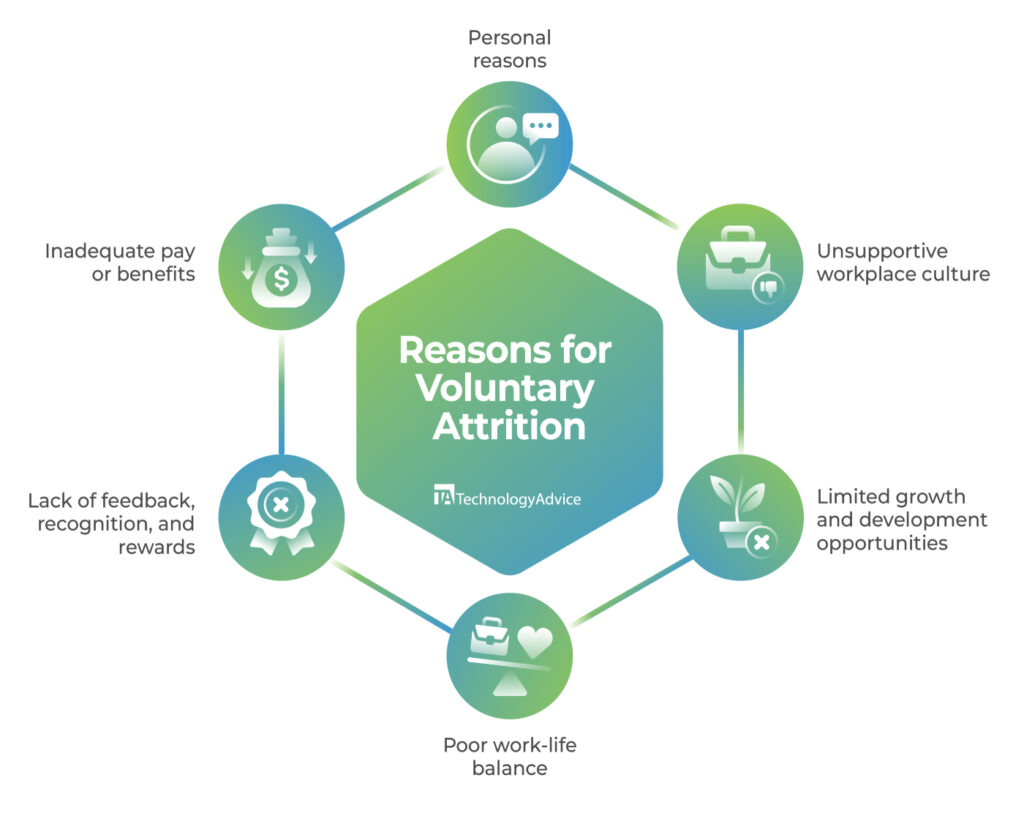
However, you should still examine the voluntary reasons for employee departures, especially if high voluntary attrition is affecting your company’s success. The table below highlights some of the most common reasons for voluntary attrition and possible solutions.
Attrition cause
Solution(s)
Inadequate pay or benefits
- Regularly compare your total rewards package against industry benchmarks to remain competitive.
Limited growth and development opportunities
- Create role bands, upskilling courses, and an internal mobility program to support employee development.
- Consider investing in a learning management system (LMS) to facilitate and create training programs.
Lack of feedback, recognition, and rewards
- Require frequent 1:1s between managers and direct reports.
- Provide a platform to support spontaneous peer-to-peer recognition.
- Implement a reward program.
Poor work-life balance or work overload
- Train managers on equitable work distribution.
- Review workload distribution and manager capacity.
- Provide clear work start and stop times
- Offer flexible schedules and wellness programs.
Unsupportive workplace culture
- Conduct frequent workplace surveys.
- Develop action plans to address the feedback, such as implementing DEI committees or employee resource groups (ERGs).
Personal reasons
- Wish the employee the best — employees leaving due to life changes or external factors unrelated to work are often beyond your control.
How to reduce high attrition rates?
Some of the quick fixes, like benchmarking pay, improving workloads, or boosting recognition, were covered in the above section. Those are important, but they work best when paired with longer-term retention strategies.
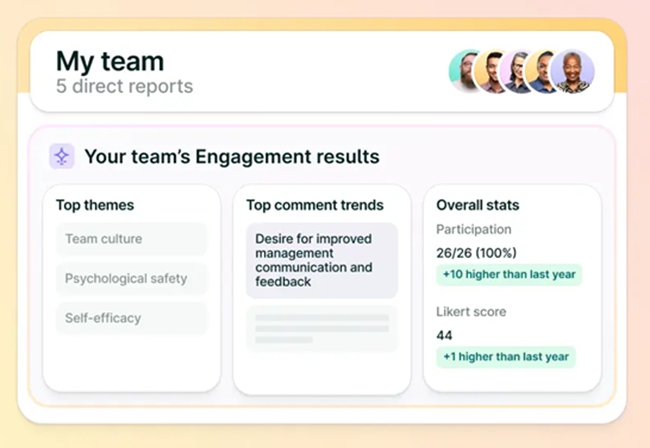
Start by collecting data from multiple sources, such as exit and/or stay interviews, engagement surveys, and performance trends. Use those insights to set priorities. Some HR software, like Lattice and its AI-powered tools, can even help you identify issues by tracking shifts in sentiment, recognition patterns, or gaps in manager interactions.
Amid an evolving labor market, about 38% of employees may leave their roles this year, signaling a significant attrition risk even as quit rates show signs of easing. To stay ahead, many employers are adopting data-driven strategies and advanced predictive models to monitor attrition in real time and proactively design targeted retention programs.
You can also reduce attrition by optimizing the stages of the employee life cycle. For example, you can:
- Offer the right compensation, benefits, and support in onboarding.
- Train managers to be effective leaders and mentors in development.
- Foster employee engagement activities in retention.
These can all improve employee morale and job satisfaction, increasing the likelihood that they will stay with the company longer.
How high attrition impacts your business
Attrition is normal, but an abnormally high number of employees leaving could indicate something more serious, like stagnating growth. While thresholds vary by industry, anything over 20% is generally considered high.
It’s best to compare your attrition rate to others in your field and factor in your company size. You can use the U.S. Bureau of Labor Statistics quit rate data as a starting point.
In addition to hurting team performance, business outcomes, and your employer brand, some consequences of high attrition include:
- Increased recruiting and onboarding costs: Replacing an employee can come with a hefty price in both money and recruiter time. You can expect to spend, on average, approximately $4,700 per role, according to a 2025 Manatal report, with high-demand positions costing around $6,000 to over $12,000.
- Loss of institutional knowledge: When people leave, you lose their know-how. If the new hires or remaining employees aren’t as skilled, this can lead to stalled projects.
- Lower morale and engagement: Frequent employee exits can stir up uncertainty and destabilize the team. That chips away at team morale, which could lead to reduced staff productivity or additional attrition.
- Slower project delivery and decisions: Gaps in staffing slow everything, from projects to everyday tasks and big decisions. This delayed momentum costs time and money.
- Burnout risk spikes: When attrition leaves teams short-staffed, the remaining employees often have to pick up extra work. That sustained pressure can quickly drain staff energy and increase their stress levels, creating a cycle that drives even more people out.
Regularly tracking your employee attrition rate helps avoid these ripple effects. When used alongside turnover and retention metrics, attrition shows a fuller picture of your workforce trends.
Attrition vs turnover
Many companies use these terms interchangeably, and their formulas are similar to each other, but they aren’t the same. Two factors set them apart: time and replacement.
- Attrition rate looks at whether roles are replaced after employees leave, typically over a longer period. It’s a strategic measure for spotting structural issues, like how large-scale changes can affect staffing levels. Think of it as your company’s erosion rate.
- Turnover rate tracks how many employees leave in a short time period, regardless of whether the roles are refilled. It’s also possible to have high turnover rate but a low attrition percentage. Businesses in the retail or restaurant industries often have high turnover but stable attrition because vacant positions are filled quickly. Another term for turnover rate is churn rate.
| Attrition | Turnover | |
|---|---|---|
| Refilled roles? | No | Yes |
| Duration | Long-term changes | Short-term movement |
| Impact | Strategic workforce size and structure | Operational staffing needs |
| Also known as | Erosion rate | Churn rate |
Also Read: 6 Strategies to Reduce High Employee Turnover
Attrition vs retention
Attrition tracks how many employees leave, while retention measures how many stay over a set period. They offer two ways of viewing the same data. For example, if you have a high attrition rate from many people leaving, you might have a proportionally low retention rate.
The difference is in the focus. Leaders may watch attrition to gauge readiness for growth, while HR teams look at retention to measure how well their people strategy is keeping employees engaged.
| Attrition | Retention | |
|---|---|---|
| What is tracked? | Employee exits where roles are not filled | Employees who stay over a given period of time |
| Focus | Workforce reduction | Workforce stability |
| Strategic use | Workforce and succession planning | Engagement and employee experience tracking |
Also Read: How to Engage Employees in the Workplace
Attrition rate FAQs