AI SDR tools use artificial intelligence to automate sales development tasks, including account research, contact sourcing, personalized outreach, follow-ups, lead qualification, and meeting scheduling. Some operate as autonomous digital sales representatives, while others help human reps work more efficiently within a CRM or sales engagement platform.
The best AI SDR tools combine reliable prospect data, contextual personalization, workflow controls, CRM integration, and email deliverability safeguards. I evaluated seven platforms and ranked HubSpot Prospecting Agent first with a score of 4.44 out of 5, followed closely by Regie and Artisan. The table below compares each provider’s key capabilities and expert score.
| Provider | Best for | Starting price |
|---|---|---|
| HubSpot Prospecting Agent | CRM-connected AI prospecting | $1 per researched lead* |
| Regie | AI-orchestrated multichannel prospecting | $180/user/month (minimum of 10 seats) |
| Artisan Ava | Fully managed autonomous outbound | Custom quote |
| Jason AI by Reply | Multichannel sales engagement | $500/month |
| 11x Alice | Enterprise-scale managed outbound | $3,750/month |
| Salesforge Agent Frank | Multilingual email prospecting | $499/month |
| AiSDR | Flexible month-to-month AI SDR adoption | $250/month |
*Requires an eligible HubSpot edition and uses HubSpot Credits.
- Prioritize accounts using buying signals and CRM data
- Identify and enrich key contacts within buying committees
- Research prospects and draft personalized emails
- Review outreach or automate it with defined rules and guardrails
Best AI SDR tools at a glance
| Provider | Prospect data | Multichannel outreach | Email infrastructure | Expert score out of 5 |
|---|---|---|---|---|
| HubSpot Prospecting Agent | ◐ | ✕ | ✕ | 4.44 |
| Regie | ✓ | ✓ | ◐ | 4.41 |
| Artisan Ava | ✓ | ✓ | ✓ | 4.38 |
| Jason AI by Reply | ✓ | ✓ | ✓ | 4.35 |
| 11x Alice | ✓ | ✓ | ✓ | 4.29 |
| Salesforge Agent Frank | ✓ | ✕ | ◐ | 4.13 |
| AiSDR | ◐ | ◐ | ◐ | 4.07 |
Legend:
✓ = native or included
◐ = connected, limited, add-on, or plan-dependent
✕ = not a core capability
How do the best AI SDR tools compare?
What makes HubSpot Prospecting Agent the best for CRM-connected AI prospecting?
Overall score:
4.44/5
Pricing and value:
4.33/5
Prospecting and data:
4.55/5
AI research and personalization:
4.65/5
Outreach and autonomy:
4.13/5
Infrastructure, integrations, and measurement:
4.43/5
Expert score:
4.78/5
Pros
- Connects prospecting directly to HubSpot Smart CRM
- Supports review-first and autonomous operation
- Uses configurable research, messaging, and engagement rules
Cons
- Primarily focused on email rather than full multichannel execution
- Requires an eligible HubSpot subscription and credits
- Prospect sourcing may depend on connected data providers
Why I chose HubSpot Prospecting Agent
HubSpot Prospecting Agent earned my top overall ranking for its balance of CRM context, AI research, personalized outreach, workflow control, and value. Because it operates within HubSpot Smart CRM, prospecting activity stays connected to the contact, company, engagement, and pipeline data that sales teams already use.
Its main limitation is its focus on email rather than fully autonomous multichannel outreach. It offsets this narrower scope with flexible controls: reps can review and edit messages or let the agent operate autonomously within predefined research, messaging, and engagement rules. This combination of connected data, practical automation, and human oversight makes it a reliable option for scaling personalized prospecting.
HubSpot Prospecting Agent is an AI sales agent built into HubSpot’s customer platform. It researches accounts, identifies relevant contacts through connected data providers, drafts personalized outreach, monitors buying signals, and records prospecting activity in HubSpot Smart CRM.
- CRM-connected research: Uses HubSpot records, engagement history, and connected prospecting data to add context to account research.
- Contact sourcing and enrichment: Works with connected providers such as Apollo, ZoomInfo, Seamless.AI, and Surfe to find or enrich contacts.
- Personalized email drafting: Generates outreach based on company information, prospect roles, signals, and configurable selling rules.
- Flexible automation modes: Lets teams review individual messages or enable autonomous execution within predefined controls.
- Centralized reporting: Keeps prospecting activity and resulting engagement connected to HubSpot records and pipeline reporting.
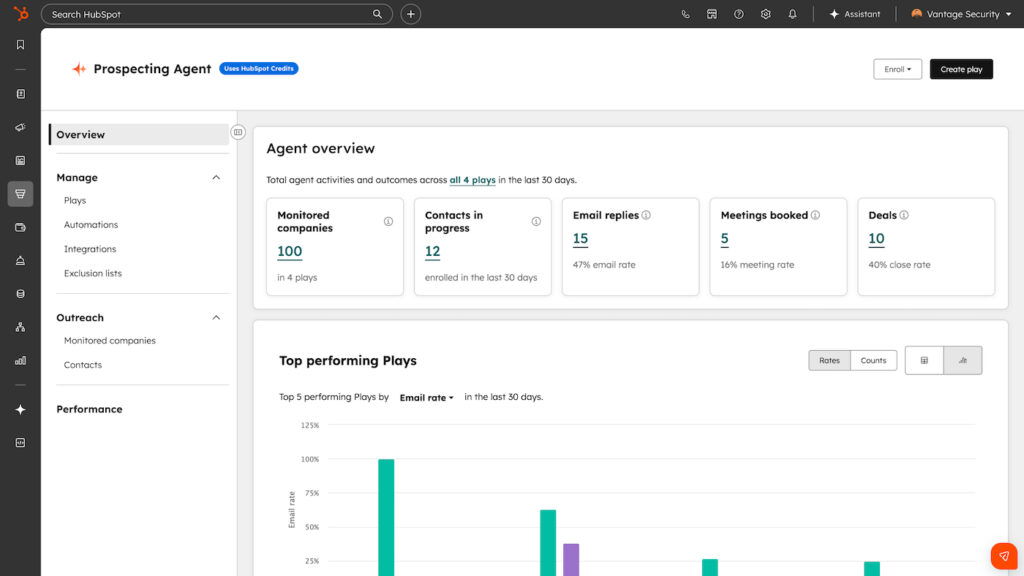
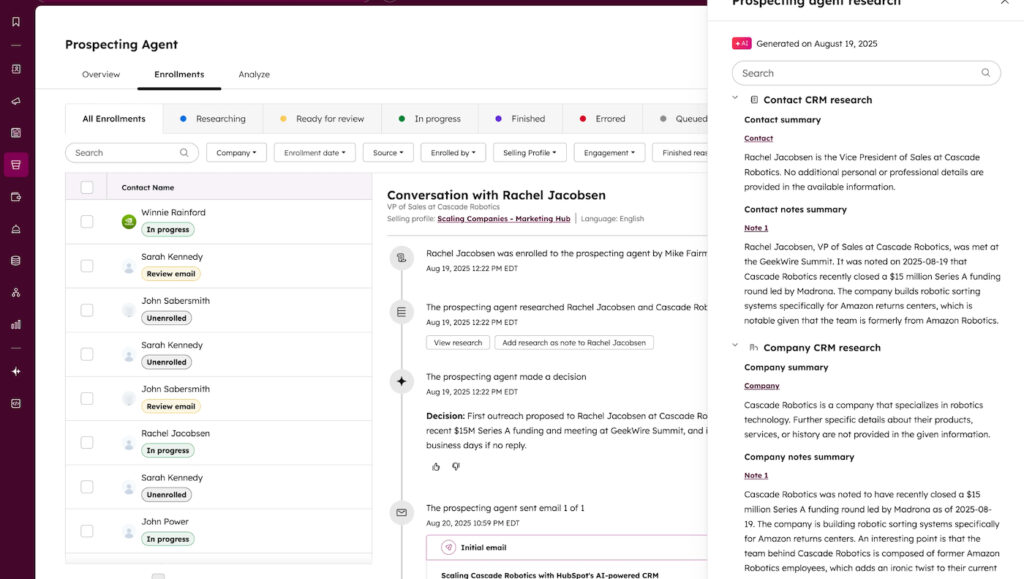
HubSpot charges through HubSpot Credits, with prospect research and message drafting priced at approximately $1 per lead. Prospecting Agent is available with the following plans:
| Starter | Professional | Enterprise | |
| Monthly price, billed annually | $7/user | $90/user | $150/user |
| Monthly price, billed monthly | $10/user | $100/user | N/A |
| AI credits | 500 | 3,000 | 5,000 |
Also read: Best AI Prospecting Tools

What makes Regie.ai the best for AI-orchestrated multichannel prospecting?
Overall score:
4.41/5
Pricing and value:
3.10/5
Prospecting and data:
4.85/5
AI research and personalization:
4.74/5
Outreach and autonomy:
4.69/5
Infrastructure, integrations, and measurement:
4.93/5
Expert score:
4.36/5
Pros
- Combines intent signals, prospect data, and engagement workflows
- Supports email, calling, social tasks, and sales cadences
- Provides detailed activity and pipeline attribution
Cons
- Requires an annual commitment and minimum seats
- More complex than a lightweight AI email assistant
- Requires established outbound processes to realize its value
Why I chose Regie
Regie earned strong scores for prospecting data and sales infrastructure in my evaluation. Its combination of more than 100 intent signals, extensive contact data, AI-generated messaging, sales cadences, and calling tools makes it a strong fit for established outbound teams.
The platform coordinates AI and human sales activity by prioritizing prospects, recommending next steps, and organizing outreach across email, phone, and social channels. Its annual contracts, seat minimums, and implementation requirements may be too demanding for smaller teams. However, established sales organizations can justify these trade-offs through its multichannel capabilities and workflow depth.
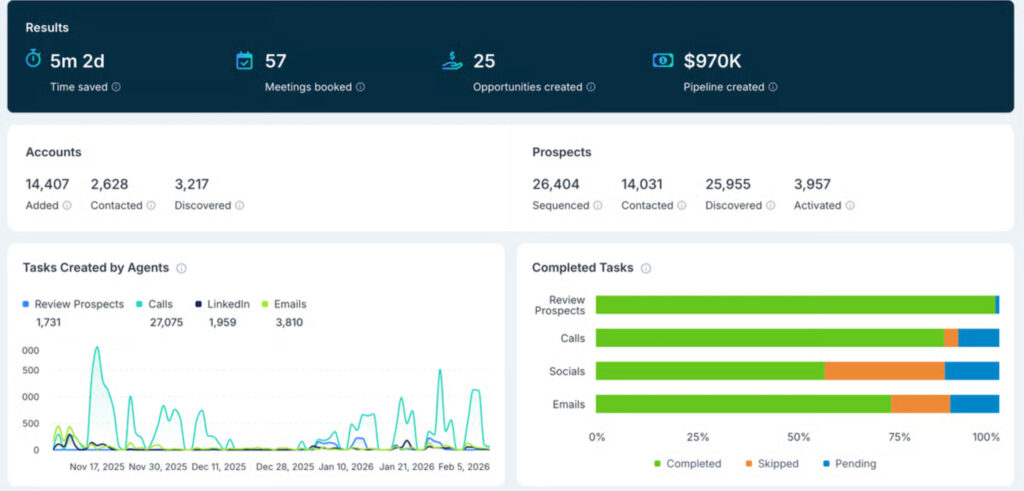
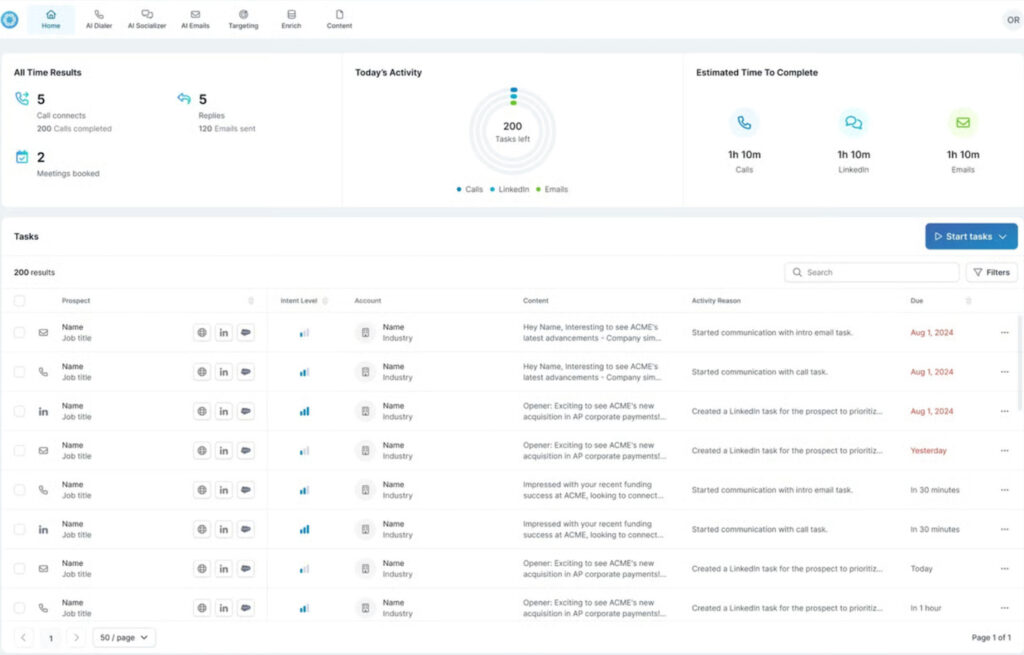
Regie.ai is an AI sales engagement platform that combines prospect data, enrichment, buying signals, content generation, sequencing, calling, and workflow automation. Its AI agents identify and prioritize prospects, personalize outreach, and coordinate follow-ups across email, phone, and social channels.
- Signal-based prioritization: Uses intent and account signals to identify prospects that warrant attention.
- AI-generated messaging: Creates personalized emails, call scripts, and sequence content.
- Multichannel workflows: Coordinates email, phone, and social engagement activities.
- Sales dialers: Offers power-dialing capabilities and parallel dialing on qualifying plans.
- Pipeline attribution: Connects rep activity and campaigns to meetings, opportunities, and pipeline outcomes.
| AI SEP | Force Multiplier Rep | Enterprise | |
| Monthly price, billed annually | $180/user(minimum of 10 seats) | $499/user(minimum of 5 seats) | Custom |
| AI credits | N/A | 12,000 AI + enrichment credits | Custom AI + credit packages |
Also read: Best Customer Database Software Solutions

What makes Artisan Ava the best for fully managed autonomous outbound?
Overall score:
4.38/5
Pricing and value:
3.26/5
Prospecting and data:
4.75/5
AI research and personalization:
4.69/5
Outreach and autonomy:
4.84/5
Infrastructure, integrations, and measurement:
4.55/5
Expert score:
4.25/5
Pros
- Sources prospects, writes messages, follows up, and books meetings
- Includes access to an extensive verified B2B database
- Provides onboarding and customer success support
Cons
- Pricing is not publicly listed
- Requires careful configuration and message governance
- Calling is an add-on rather than a fully autonomous core channel
Why I chose Artisan Ava
Artisan Ava is best for businesses seeking a highly autonomous digital SDR. It can handle much of the outbound process, including prospect sourcing, account research, personalized email creation, follow-ups, reply handling, and meeting scheduling.
Autonomous outreach still requires clear audience criteria, positioning, exclusions, and escalation rules, so Artisan’s onboarding and customer success support add meaningful value. Its main drawbacks are the lack of public pricing and voice calling being an add-on rather than a core autonomous channel. Even so, Ava’s end-to-end email automation makes it a strong option for teams that want to scale outbound prospecting with less manual work.
Artisan Ava is an AI business development representative that researches and sources prospects, creates personalized email campaigns, manages follow-ups and replies, and books qualified meetings. It is designed to automate outbound sales development while allowing teams to define targeting, messaging, and workflow rules.
- Autonomous prospect sourcing: Finds contacts that fit the campaign’s audience and targeting requirements.
- Personalized campaigns: Researches prospects and creates individualized email messaging.
- Reply management: Handles routine responses and escalates conversations requiring human judgment.
- Meeting scheduling: Qualifies interested prospects and books meetings on connected calendars.
- Campaign controls: Lets teams define tone, calls to action, prohibited phrases, and approval requirements.
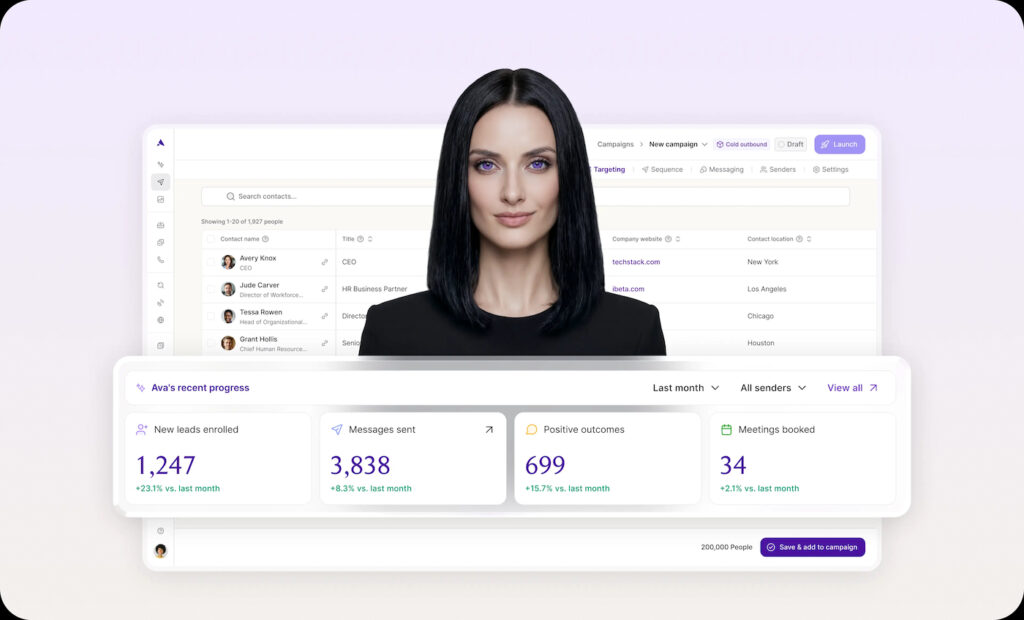
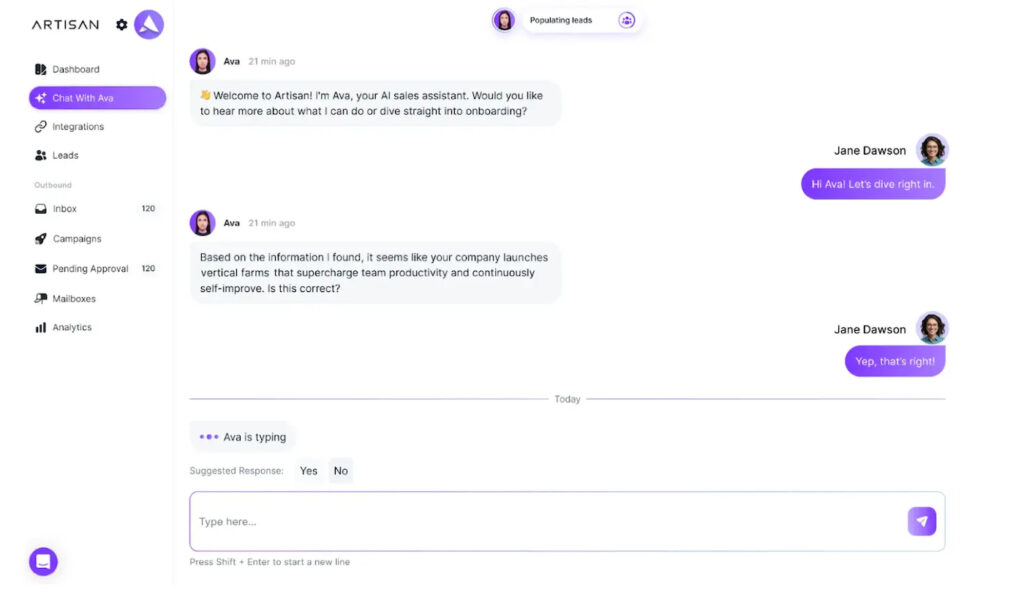
Artisan offers the following packages that include access to its contact database, campaign tools, CRM synchronization, onboarding, and customer success support:
- Team: 2,500 leads per month
- Scale: 6,000 leads per month
- Enterprise: Custom volume, security, and rollout support.
Contact Artisan to obtain a quote.
Also read: Best AI Lead Generation Tools

What makes Jason AI by Reply the best for multichannel sales engagement?
Overall score:
4.35/5
Pricing and value:
3.63/5
Prospecting and data:
4.40/5
AI research and personalization:
4.41/5
Outreach and autonomy:
4.80/5
Infrastructure, integrations, and measurement:
4.50/5
Expert score:
4.45/5
Pros
- Supports email, LinkedIn, calling, SMS, and sales tasks
- Offers autonomous and rep-assisted workflows
- Includes email deliverability and mailbox tools
Cons
- Costs increase with usage and infrastructure requirements
- Requires human review to maintain message quality
- Does not replace a core CRM
Why I chose Jason AI by Reply
Jason AI by Reply works best for sales teams that need coordinated outreach across multiple channels. It can source prospects, build campaigns, manage responses, and schedule meetings through workflows spanning email, LinkedIn, calls, SMS, and manual tasks. This flexibility helps teams reach buyers who may not respond through a single channel.
I also like that teams can choose between copilot and autopilot modes, depending on how much human oversight they want. However, its flexibility requires clear rules for message frequency, personalization, suppression, CRM synchronization, and human handoffs. For teams prepared to establish those controls, Jason AI offers a versatile way to automate multichannel sales development while keeping reps involved where needed.
Jason AI by Reply is an AI sales development agent that sources prospects, creates campaigns, manages multichannel outreach and responses, and schedules meetings. It operates within Reply’s sales engagement platform and supports both assisted and autonomous workflows.
- Multichannel sequences: Combines email, LinkedIn, calls, SMS, and manual sales tasks.
- AI prospect research: Finds relevant context for more personalized outreach.
- Autopilot and copilot modes: Supports autonomous execution or rep-supervised workflows.
- Deliverability tools: Provides mailbox warming and other tools for protecting sending performance.
- Engagement analytics: Tracks campaign activity, replies, meetings, and channel performance.
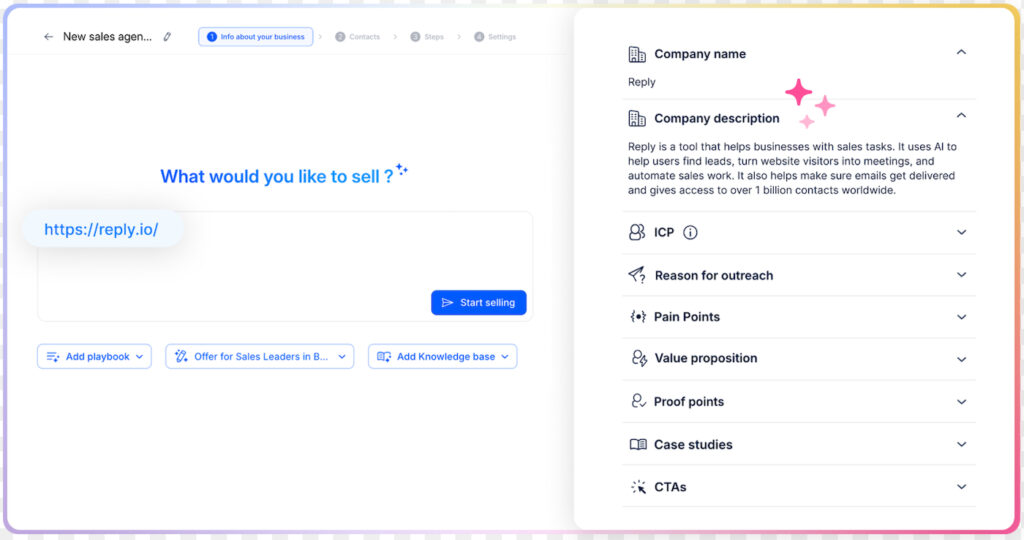
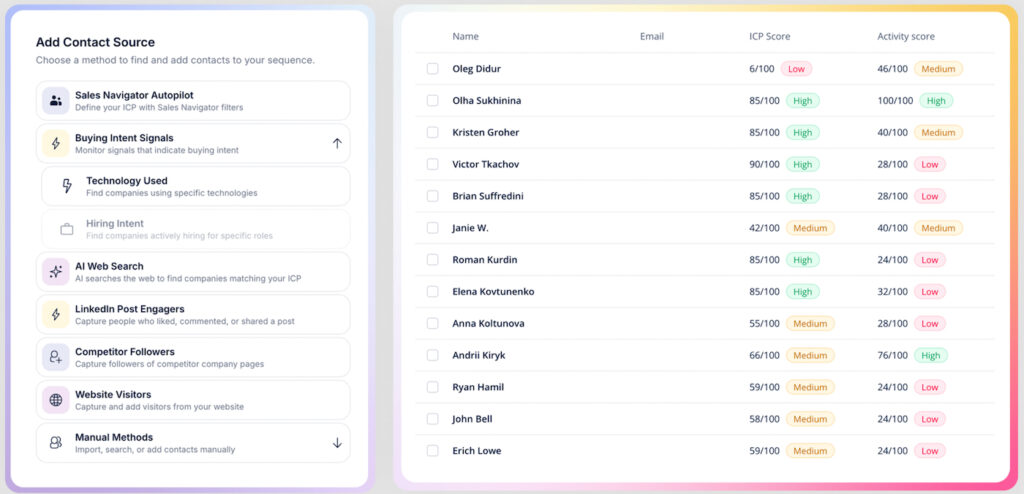
| AI SDR Starter | AI SDR Growth | AI SDR Enterprise | |
| Monthly price, billed annually | Starts at $500 with unlimited users | Starts at $1,500 with unlimited users | Custom |
| Monthly price, billed monthly | Starts at $800 with unlimited users | Starts at $2,500 with unlimited users | Custom |
| Real-time B2B contacts | 1,000 | 5,000 | 25,000 |
Also read: Best Multi Channel Marketing Campaigns for B2B Brands

What makes 11x Alice the best for enterprise-scale managed outbound?
Overall score:
4.29/5
Pricing and value:
3.03/5
Prospecting and data:
4.65/5
AI research and personalization:
4.70/5
Outreach and autonomy:
4.65/5
Infrastructure, integrations, and measurement:
4.69/5
Expert score:
4.18/5
Pros
- Includes managed domains, mailboxes, warming, and monitoring
- Supports multilingual global prospecting
- Offers CRM synchronization and enterprise integrations
Cons
- Higher starting cost than many AI SDR tools
- Entry plan caps the number of new prospects contacted
- Annual commitment may make ROI harder to validate before purchase
Why I chose 11x Alice
11x Alice is well suited to established sales teams that want managed outbound infrastructure alongside AI prospecting. Its Growth plan includes domains, Gmail mailboxes, warmup, inbox rotation and monitoring, and bidirectional CRM synchronization — components businesses would otherwise need to assemble and maintain separately.
The main drawback is cost: the entry plan requires a substantial annual commitment and limits how many new prospects teams can contact each month. However, its managed infrastructure, multilingual outreach, and capacity to support higher-volume campaigns help justify the investment for organizations expanding into multiple markets. Alice makes the most sense for teams that can evaluate its performance against qualified opportunities and pipeline — not those still testing whether outbound sales is viable.
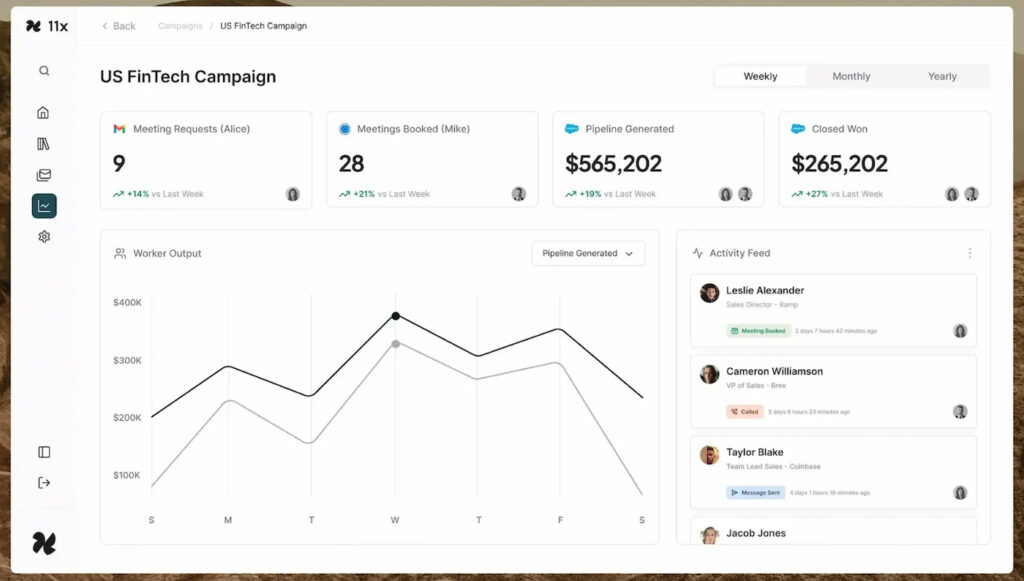
11x Alice is an AI digital worker that researches accounts, identifies prospects, personalizes multichannel outreach, manages follow-ups, and supports meeting generation. Its managed email infrastructure and CRM synchronization are designed to help established sales teams scale outbound campaigns.
- Managed email infrastructure: Includes domains, mailboxes, warming, rotation, and monitoring.
- Prospect research: Identifies and enriches accounts and contacts for outbound campaigns.
- Multichannel sequences: Supports coordinated outreach across multiple prospect touchpoints.
- Multilingual campaigns: Enables outbound prospecting in more than 100 languages on qualifying plans.
- CRM synchronization: Connects campaign and prospect activity with CRM records.
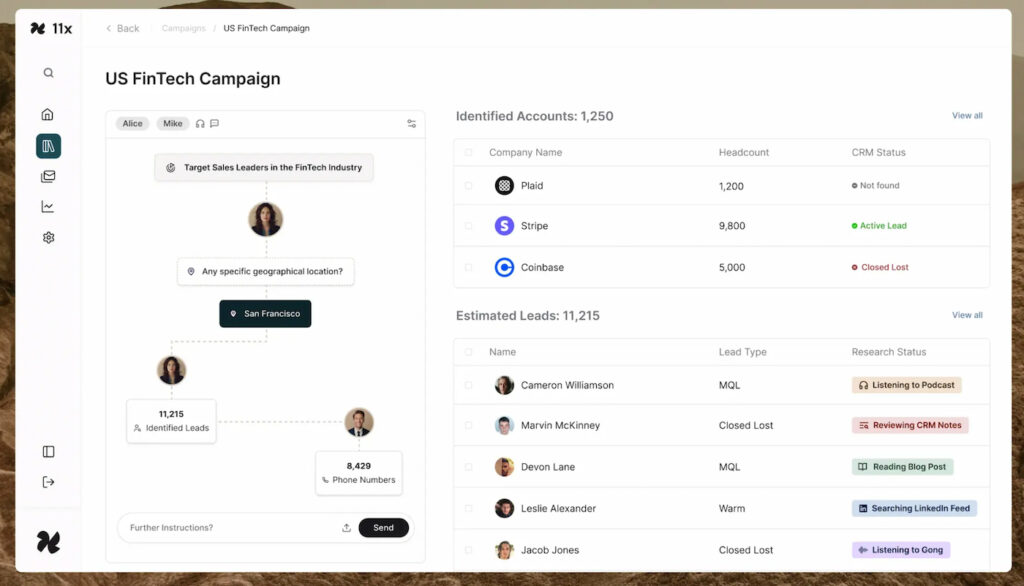
| Growth | Pro | Enterprise | |
| Monthly price, billed annually | $3,750 | Custom | Custom |
| Users | 5 | 10 | Unlimited |
| New prospects per month | 2,000 | 5,000 | 5,000+ |
Also read: What Is Sales Intelligence? A Complete Guide

What makes Salesforge Agent Frank the best for multilingual email prospecting?
Overall score:
4.13/5
Pricing and value:
3.70/5
Prospecting and data:
4.20/5
AI research and personalization:
4.35/5
Outreach and autonomy:
4.28/5
Infrastructure, integrations, and measurement:
4.18/5
Expert score:
4.16/5
Pros
- Supports outreach in more than 20 languages
- Provides access to an extensive contact search engine
- Offers autonomous and copilot modes
Cons
- Primarily focused on email
- Sending infrastructure may require an add-on
- Does not offer a permanent free plan
Why I chose Salesforge Agent Frank
Salesforge Agent Frank is best for small sales teams running international email campaigns. Its support for more than 20 languages lets businesses personalize outreach across regions without assigning a dedicated SDR to each market. Its published starting price also makes it easier to evaluate than platforms available only by custom quote.
Its main limitation is its focus on email rather than broader multichannel outreach. Domains, mailboxes, and deliverability tools from the wider Salesforge ecosystem may also increase the total cost. However, its multilingual messaging, autonomous and copilot modes, and accessible entry point make Agent Frank a practical option for scaling international email prospecting while retaining human oversight.
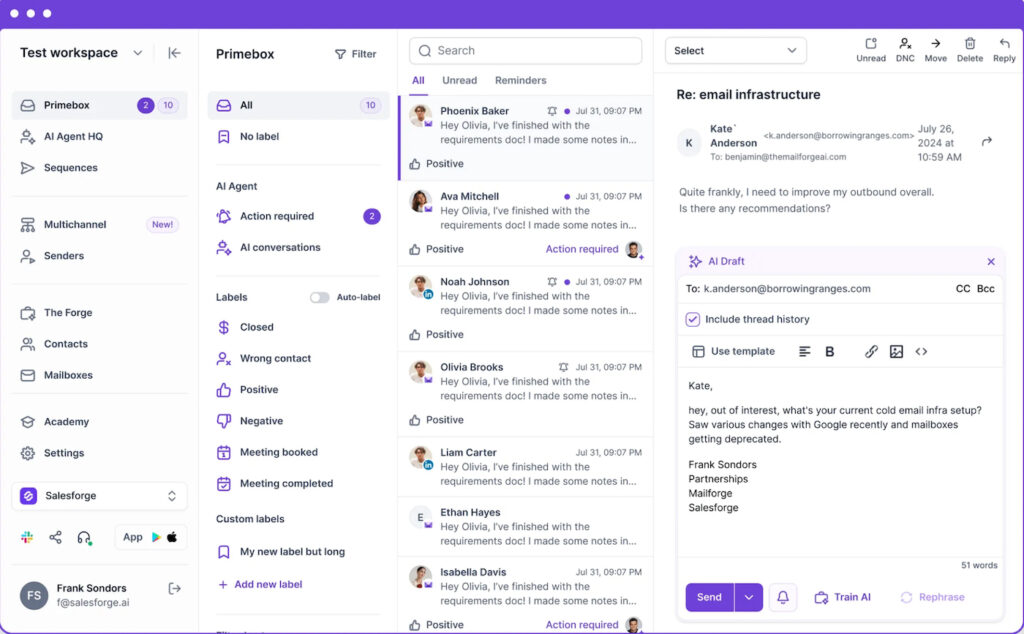
Salesforge Agent Frank is an AI SDR that automates prospect sourcing, personalized email outreach, follow-ups, reply handling, and meeting scheduling. It supports autonomous and assisted workflows within Salesforge’s outbound sales ecosystem.
- Prospect search: Finds target contacts using Salesforge’s contact search engine.
- Multilingual outreach: Creates campaigns in more than 20 languages.
- Personalized email generation: Uses account and contact context to draft messages.
- Flexible operating modes: Supports autonomous execution and a rep-assisted copilot mode.
- Automated follow-up: Continues outreach and helps schedule meetings with interested prospects.
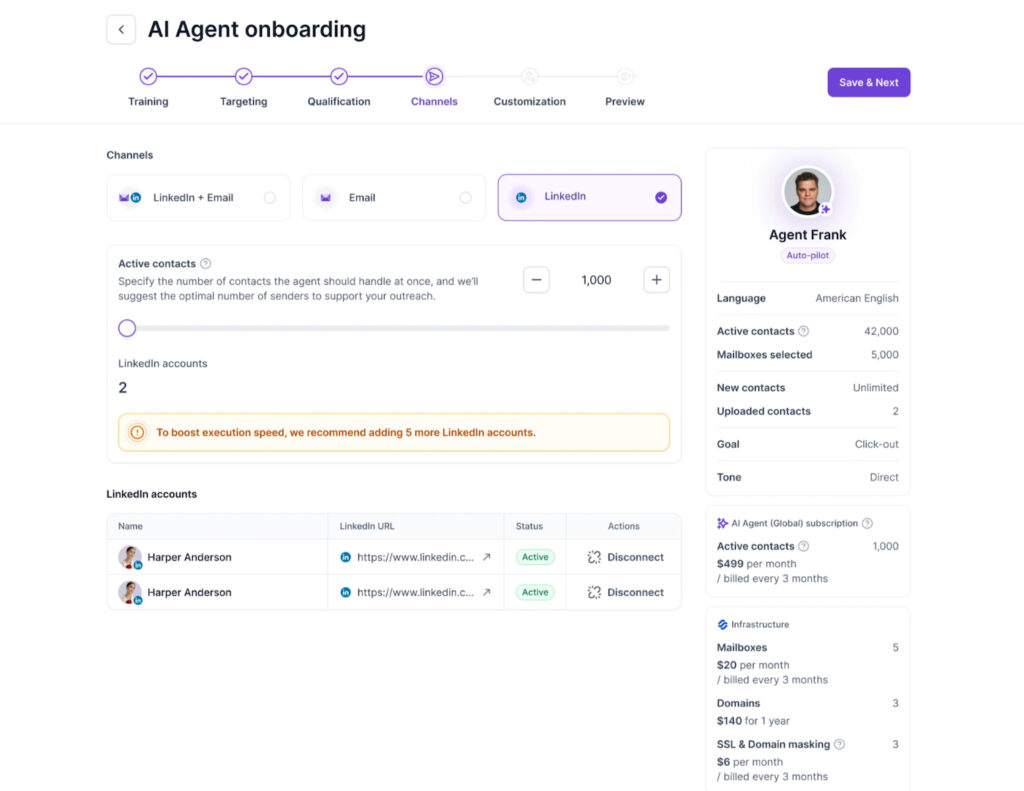
- Annual pricing: Starts at $499/month
- Monthly pricing: Starts at $599/month
- 1,000 active contacts
Also read: Best Channel Marketing Software Platforms

What makes AiSDR the best for flexible month-to-month AI SDR adoption?
Overall score:
4.07/5
Pricing and value:
3.99/5
Prospecting and data:
4.05/5
AI research and personalization:
3.94/5
Outreach and autonomy:
4.29/5
Infrastructure, integrations, and measurement:
4/5
Expert score:
4.10/5
Pros
- Lower entry price than most autonomous AI SDRs
- Offers month-to-month subscriptions
- Automates research, personalization, and follow-up
Cons
- Has a smaller ecosystem than the leading platforms
- Provides less prospecting depth and infrastructure control
- Usage limits require careful review
Why I chose AiSDR
AiSDR is best for smaller sales teams that want to test AI-powered outbound without a lengthy contract or substantial upfront commitment. Its flexible pricing lets businesses validate the platform, refine their targeting, and measure results before expanding campaign volume.
It covers the core sales development workflow, including prospect research, personalized messaging, campaign execution, follow-ups, reply handling, and meeting booking. Its main limitation is that performance still depends heavily on contact quality, messaging, and email deliverability. Even so, its accessible entry point and end-to-end automation make AiSDR a sensible option for teams prioritizing flexibility. I recommend starting with a focused campaign and measuring qualified replies, booked meetings, and pipeline generated — not outreach volume alone.
Also read: Best AI Sales Automation Tools
How to choose AI SDR tools
Before comparing AI SDR tools, identify the part of sales development you want to automate.
- Identify your primary workflow bottleneck.
Determine whether your biggest problem is:
- Finding accurate contacts
- Researching accounts
- Writing personalized messages
- Managing follow-ups
- Reaching prospects across channels
- Qualifying responses
- Scheduling meetings
- Keeping CRM records updated
A CRM-connected product may be the best option if fragmented data is the problem. A more autonomous platform may make sense if your team lacks the capacity to execute campaigns.
- Decide how autonomous the tool should be.
Some AI SDRs only draft messages for review. Others can source contacts, launch campaigns, respond to prospects, and schedule meetings with limited human involvement.
Review what the agent can do without approval, which situations trigger human escalation, and whether administrators can set targeting, messaging, frequency, exclusion, and qualification rules.
- Calculate the full operating cost.
Look beyond the advertised subscription. Additional expenses may include:
- Data and enrichment credits
- Mailboxes and domains
- Email warming
- Calling or SMS
- CRM integrations
- Implementation
- Minimum seats
- Annual commitments
Compare the total cost with qualified meetings, opportunities, and generated pipeline rather than outreach volume alone.
- Test data quality and deliverability.
Start with a controlled pilot before scaling. Monitor contact accuracy, bounce rates, spam placement, positive replies, response sentiment, meeting quality, and opt-out handling.
AI can increase campaign volume quickly, but it can also amplify weak data and generic messaging.
- Review compliance and governance.
Confirm how the provider sources contact data, manages opt-outs, protects customer information, and handles regional privacy requirements. Your business remains responsible for ensuring its outreach complies with applicable laws and platform policies.
Frequently asked questions