


Key takeaways
- Unlimited PTO can reduce HR teams’ administrative overhead while promoting employee well-being.
- Employees may overuse or underuse unlimited time off, which could lead to unfair enforcement or discontent among staff.
- HR software with time-tracking features can help create more equitable PTO practices that support healthy work-life balance.
Update notes
- Oct. 15, 2025: Hanna Sillo refreshed the article, removed outdated provider references, updated key elements and headers, added new data points, and included a comparison table.
- May 31, 2024: Robie Ann Ferrer adjusted the layout, added an FAQ section and a new graphic image, and revised the copy for clarity and readability.
What is unlimited PTO?
Unlimited paid time off (PTO) is a type of leave policy that allows employees to take off as much time as they need for vacation, sick, or personal reasons and still receive full pay. The main caveat is that employees must manage their time effectively and meet work expectations.
Unlimited PTO vs traditional PTO
| Unlimited PTO | Traditional PTO (limited) | |
|---|---|---|
| Leave balance | No set limit, employees take time off as needed | Employees earn a set number of days each year (e.g., 15 vacation + 5 sick days) |
| Tracking | Usually tracked only for scheduling and planning purposes | Hours or days tracked per pay period |
| Payout on separation | Typically no payout since PTO isn’t accrued | Often required by state law; unused days may be paid out |
| Fairness risks | Can create perceived favoritism if approvals aren’t consistent | Can create inequality if accrual policies vary by role or tenure |
This contrasts with traditional leave policies that have paid leave credits for vacation, sick, bereavement, personal, or floating holiday days off. And, while there’s no cap on the number of unlimited PTO days employees can use in a benefit year, setting up a PTO policy for this leave type will add structure to the requesting, approval, and tracking processes.
Software spotlight: BambooHR SPONSORED
Do you need help tracking who has or hasn’t used their unlimited PTO? Or does your HR team continue to receive calls night and day from employees requesting time off?
BambooHR’s all-in-one HR software can make these problems a thing of the past by simplifying time off procedures for you and your employees.
With BambooHR, you can:
- Customize your paid time off policies by team, department, and location.
- Create unique PTO approval workflows, including those requiring multiple sign-offs.
- Facilitate employee self-service tasks, like submitting PTO requests directly from mobile devices.
- Monitor used and accrued PTO balances directly on the homepage and employee pay stubs.
What are the pros and cons of an unlimited PTO policy?
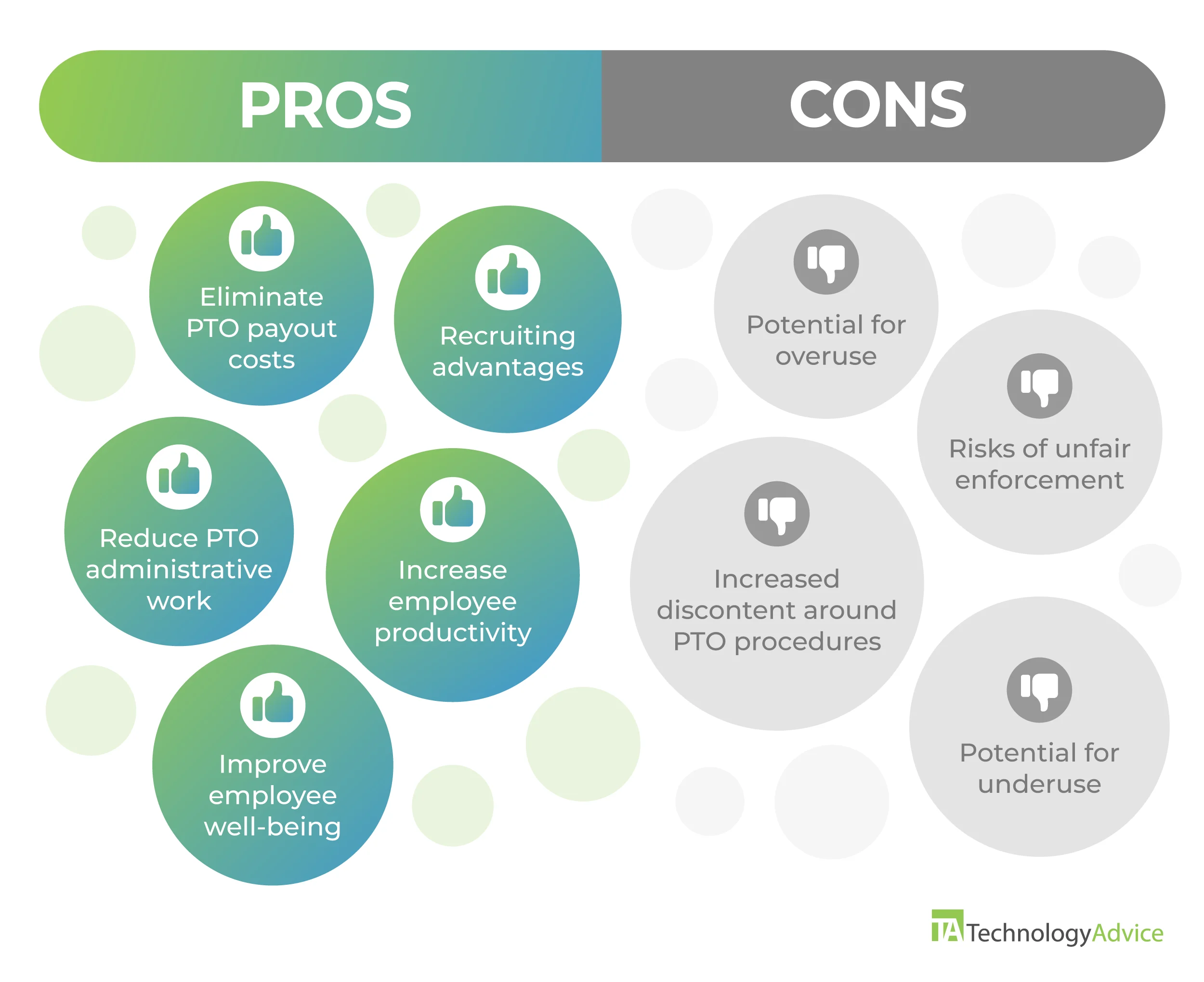
What are the advantages of unlimited PTO?
Providing unlimited PTO is a good way of attracting and retaining employees, but it also benefits your company and HR team’s day-to-day operations.
Eliminate PTO payout costs
While U.S. federal law does not regulate PTO payouts, some states (like California and Nebraska) consider accrued PTO as earned wages that employers must pay out upon employee separation. With unlimited PTO, there are no accrued balances or hours earned, so you don’t have to pay out unused PTO to employees upon termination.
Reduce PTO administrative work
Unlimited PTO policies do not cap the number of vacation days an employee receives. And, while you must still develop and enforce leave approval processes, this leave type allows HR teams to save time by eliminating the need to track PTO hours or document paid leave accruals on paystubs.
Increase employee productivity
To use unlimited PTO, employees must demonstrate they can manage their work responsibilities effectively. This incentivizes workers to do well at work in order to take advantage of this benefit. Moreover, employees are generally more productive after taking time off to rest and recharge.
Improve employee well-being
Unlimited PTO gives employees autonomy over their leave management, allowing them to take a leave when they need it. Whether attending a child’s school function, caring for a loved one, or taking time off to rest, employees are in control. This can help improve their physical and mental well-being.
Recruiting advantages
Unlimited PTO is a great way to attract talent and has become a standard benefit offering for many organizations in recent years. WTW’s 2023 Leave, Disability, and Time-off Trends Survey indicates that 12% of employers have adopted unlimited PTO policies—up from 9% from two years ago. Further, 16% of employers are planning to offer this leave type in the next two years.
What are the downsides of unlimited PTO?
Although offering an unlimited PTO policy sounds attractive as an employee benefit and company recruitment and employee retention tool, it is not for every business.
Potential for overuse
Some employees may overuse their unlimited PTO benefits, causing work performance to slip and resentment among colleagues who have to pick up the slack. This can also lead to decreased productivity and workflow bottlenecks if those off on PTO do not manage their work effectively while away.
Potential for underuse
Some employees might feel guilty about taking too much PTO. Others may be hesitant to take time off because of the demands of their job. Heavy workload is the top reason why employees don’t take PTO, according to the Paid Leave in the Workplace 2024 Survey Report, followed by the lack of adequate staffing. This can lead to an “always working” culture and result in employee burnout if not addressed properly.
The idea that unlimited PTO is not limitless as it requires approval can also increase worker anxiety around taking any time off. This is especially true if the employee is underperforming at work or taking excessive PTO.
Risks of unfair enforcement
If you do not have strict guidelines for approving unlimited PTO requests, you run the risk of appearing discriminatory. For example, approving time-off requests for some individuals over others—even if unintentional—can appear as favoritism or worker bias.
Increased discontent around PTO procedures
People managers may feel that changing from a traditional to an unlimited PTO plan will increase overall absenteeism or make disciplinary action difficult. Meanwhile, employees may resent losing their right to PTO payouts upon termination. It can also contribute to low morale if workers feel frustrated or dissatisfied with transitioning to a PTO approval process based on workplace results.
Check out our video below to spot the warning signs of low employee morale:
How to manage unlimited PTO
Although HR software can help with the administrative side of managing PTO, you can maximize the effectiveness of your unlimited PTO policy by following the steps below.
1. Put the policy in writing
Start with creating an unlimited PTO policy that outlines how employees can use it. This process can be time-consuming, as it involves collaboration from executives, managers, finance teams, and employees.
However, HR compliance service providers such as Mineral can write federal and multi-state compliant policies and handbooks for your business. This helps minimize the risk of employment law violations and reduces the time it takes to create or update company policies. Watch the below video to learn more about Mineral’s services.
While unlimited PTO policies generally don’t have limits to leave days employees can take at a time, you can add temporary caps to PTO requests (such as 10 leave days per request) during busy seasons. This will help you plan manpower resources and avoid work disruptions.
However, if you often need to place temporary time off limits, then a truly unlimited PTO policy may not be right for you. Using a traditionally limited PTO might be a better option for your employees.
2. Define the approval process
A transparent PTO approval process can prevent the abuse or underuse of unlimited PTO. It can also reduce favoritism or bias while increasing employees’ likelihood of using the policy. Here’s a sample approval process:
- Employee submits request in the HR portal at least two weeks before the planned leave (or as soon as possible for emergencies).
- Manager reviews the request to confirm workload coverage and ensure no key project conflicts.
- HR reviews for compliance with company guidelines and overall team scheduling balance.
- Once approved, the time off appears automatically on shared calendars so coworkers can plan accordingly.
- Managers touch base with returning employees to make sure workloads and transitions went smoothly.
You can even include additional steps to the approval process, such as reminders to follow up with employees on the need for additional leave. HR software platforms can also help you manage unlimited PTO by creating customized approval workflows.
Not sure where to start on your HR software journey? Check out our The Best HRIS Systems shortlist for practical HR software for first-time users.
3. Train managers on consistent enforcement
Manager training is critical to making unlimited PTO work. Because managers sit at the center of the approval process, they need clear, consistent criteria (e.g., like staffing needs, workload, and performance) to guide decisions. Otherwise, a poorly trained manager might make biased decisions that create employee resentment or tension.
HR software can compile PTO analytics so you can make fairness measurable. Tools like BambooHR helps you see at a glance who has not taken any PTO during particular periods and investigate further to determine why. HR teams can even pull performance management reports to compare employee productivity with their time off use.

4. Encourage employees to take time off
You can avoid the problem of the “always working” employee and decrease burnout by fostering a company culture that encourages workers to rest. Low engagement rates, performance scores, or other HR metrics are just a few indicators that you have unhappy employees in need of a break.
You can also implement mandatory minimum PTO requirements, regularly remind employees to take PTO, or add time off as a companywide key performance indicator (KPI). This will demonstrate to employees and external stakeholders that the company is committed to maintaining a healthy work-life balance and avoiding exploitative PTO practices.
5. Review and update the policy regularly
As business needs and company culture change, you should reevaluate your unlimited PTO policies. Generally, an annual review cycle provides enough data to reveal actionable insights that help continually improve the policy.
When reviewing your unlimited PTO policy, consider some of the following metrics to measure its success:
- Number of vacation days used over the benefit year.
- Number of employees using the PTO benefit.
- Number of PTO requests versus the number of approvals over a benefit year.
- PTO use by department.
- Company satisfaction scores.
- Company performance metrics.
While quantitative data is a great place to start, direct employee feedback is the most effective way to determine if the PTO policy adequately meets their needs. Many employee engagement platforms help gather feedback through avenues like pulse surveys so you can quickly gauge employee satisfaction.
Unlimited PTO FAQs
Is unlimited PTO really unlimited?
Unlimited PTO comes with no caps or limits. However, an unlimited PTO policy is governed by rules that cover the application, approval, and tracking processes.
Are sick days included in unlimited PTO?
Yes, sick days are included in unlimited PTO. This is helpful, especially if an employee needs a longer time to recuperate from an illness.
Should I track unlimited PTO?
Yes, you should track unlimited PTO even though it is limitless. Monitoring unlimited PTO allows you to check whether employees are taking too little time off (or none at all) and encourage them to take more PTOs to prevent burnout.
Is unlimited PTO right for your business?
Unlimited PTO may be optimal for your business if you don’t primarily employ hourly paid employees like those in the restaurant and manufacturing industries. An unlimited PTO system also works for tech companies with a remote workforce because the employees don’t have to be physically present at the workplace to do their jobs.
Adopting this leave type provides several advantages, such as reducing administrative work and increasing employee happiness. However, before you switch, try to understand your company’s motivations for offering unlimited PTOs and implement it in a way that best fits your organization’s needs.
If you’re unsure where to start, check out our guide on How to Create the Perfect PTO Policy for tips and tricks.