


Key takeaways
- Local payroll compliances, tax regulations, labor laws, and the types of international employees you have will help determine how to pay foreign employees.
- Employer of Record (EOR) services handle the legal responsibility of employing and paying your international staff, including automating payroll, ensuring local compliance, and reducing HR’s administrative burden.
- With an EOR, you don’t need to set up legal entities in countries outside of the US to recruit and pay international employees.
Update notes
- Sep. 15, 2025: Hanna Sillo restructured some sections for easier skimming, added information, and updated elements to their latest versions.
- Jul. 24, 2024: Robie Ann Ferrer updated the layout and revised the copy for accuracy. She also placed jump links to specific chapters for easier browsing and added new sections for FAQs and common overseas payroll options.
How to pay international employees
International payroll processing is a complex task that often gives companies pause when it comes to hiring international employees. In this guide, we explain how to pay international employees and all of the potential road bumps you may encounter.
- Categorize your overseas employees
- Consider whether to open a local entity or partner with an EOR
- Configure your payroll process
- Determine employee benefits packages
- Select payment method(s)
- Identify the tools you need
- Run payroll and maintain accurate records
- Keep track of local payroll and tax compliance
1. Categorize your overseas employees
The types of employees you have will impact overseas payroll processing. Each has different requirements when processing payroll and complying with local tax laws. There are four main categories of workers you need to consider: temporary foreign workers, US employees working overseas, native international employees, and international independent contractors.
If you only have one or two US-based employees working overseas for a short amount of time, then you might be able to pay them via your U.S. payroll — but check local laws. There might be conditions that will require you to employ and pay the workers directly in that country if their stay exceeds a specific number of days or months.
If you decide to employ either temporary foreign workers or native international employees, you will need to withhold the correct taxes, Social Security contributions, and other payroll expenses. However, if you hire international contractors, then it will be the worker’s responsibility to withhold taxes and ensure global payroll compliance.
2. Consider whether to open a local entity or partner with an EOR
In choosing the right method for handling overseas payroll, you need to educate yourself on all relevant laws and exemptions to make sure you don’t run into legal trouble and incur penalties. At a minimum, most countries require:
- Income tax contributions
- Social Security and pension contributions
- Compliance with minimum wage thresholds, overtime limits, and standard benefits
Option 1: Establish a local entity
Knowing these factors will help you determine whether to establish a local entity so your company can directly and legally hire and pay workers. This involves registering and applying for a tax ID number and then withholding all necessary taxes and expenses to ensure global payroll compliance.
If a local entity is not ideal for you, some countries offer alternative options. For instance, in the UK and Thailand, you can get a foreign employer exemption, which allows a company to hire and pay local workers without having to make local withholdings or contributions.
Option 2: Partner with an Employer of Record (EOR)
Another option is partnering with an EOR service provider, which will handle all personnel functions on your company’s behalf — from hiring employees to processing payments and ensuring compliance. This is helpful, especially if you don’t have someone on staff who understands local laws and speaks the language.
The two dominant models for global employment remain establishing a local entity or partnering with an employer of record (EOR). However, leading providers are expanding beyond this binary.
Deel, for example, announced in its August 2025 update that it has broadened its payroll coverage to more regions while adding in-depth compliance guidance for companies navigating local regulations.
Similarly, Rippling’s 2025 trends highlight a shift toward unified platforms that integrate global payroll, EOR services, and contractor payments under one system — aiming to reduce fragmentation and give HR teams a single source of truth for cross-border workforce management.
This shift shows that global payroll is moving toward integrated solutions — meaning fewer fragmented tools and more reliable compliance for businesses of all sizes.
3. Configure your payroll process
Identify your payroll periods and how often you will pay employees while making sure that you remain compliant with all local laws. If you partner with an EOR, it will handle the international payroll process for you — but if you pay your employees directly, you will need to set that up yourself.
Using a global payroll software platform can automate the payroll process if you decide to proceed with paying employees directly (but you will still need a taxpayer ID registered in that country to pay international employees). For suitable options, check out our list of top global payroll software to find a system that works for your multinational business.
4. Determine employee benefits packages
In addition to minimum wage and maximum hours worked, many countries have stipulations about standard employee benefits to offer, such as health insurance and paid time off days. These benefits must be included as part of the overall compensation package and may affect taxes and withholdings.
5. Select payment method(s)
Choose a method for paying employees. Sending international ACH payments is one option, but the Federal Reserve only allows this for a limited number of companies. Your company can also open a central bank account overseas, fund it each month, and pay employees directly.
Other options include digital payments, global wire transfers, and international money orders. Generally, online platforms are fastest but costlier, wire transfers are secure but slower, and money orders are a last-resort option when employees lack bank access (more on this below).
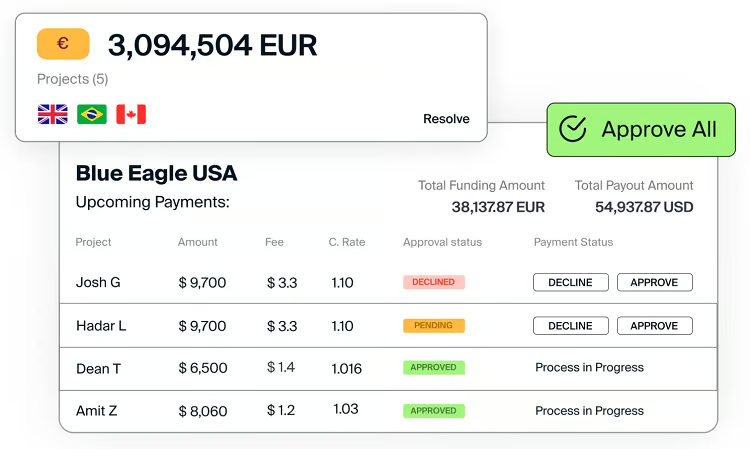
If you decide to partner with an EOR, it will handle the specifics of paying employees each pay period. Some international payroll providers, like Remote, can even create digital “bank files” that can be uploaded into banking systems for easy salary payouts. Papaya Global, on the other hand, has a secure “workforce wallet” you can use to fund overseas payroll and tax payments.
6. Identify the tools you need
If you will be paying employees on an hourly basis, you need to schedule shifts and track their work hours. Look for employee scheduling systems and time-tracking software that sync with your international payroll platform or find an HR enterprise software that includes both functionalities. If you require immigration support for employees relocating to another country for work, consider an EOR (like Deel) that offers visa and immigration services.
7. Run payroll and maintain accurate records
Once you have accomplished all of the steps above, you are ready to run payroll and pay international employees. Keep in mind that even if you have set everything up correctly, you must be diligent in maintaining accurate records and avoiding challenges with security, compliance, and other critical factors.
8. Keep track of local payroll and tax compliances
Be sure to keep track of all your documentation in case your company gets audited or an employee disputes their pay. It also helps if you have a payroll audit checklist so you know which documents to prepare and the key stakeholders involved in the audit.
Even if you partner with an EOR, it’s still a good idea to familiarize yourself with local employment laws so that everything remains aboveboard. Most providers offer free-to-use global hiring guides on their websites. These resources will help you stay on track with local compliances and labor laws — from the required minimum wages to expected working hours and standard payroll cycles.
Challenges to paying international employees
Global payroll processing presents a number of challenges for employers who hire international employees. The biggest areas of concern are cybersecurity, compliance, payroll schedules, currency fluctuations, and processing delays.
Cybersecurity
Paying employees across borders increases cybersecurity vulnerabilities and makes data protection even more important. Depending on where your international employees work, there may also be additional international data protection laws that your company needs to comply with.
Compliance
There are many laws and regulations you must follow to do business internationally. These include tax rates and deadlines, statutory employee benefits, minimum wages, and maximum weekly working hours. The regulations will be different for each country you do business in, and you need to make sure that you remain compliant in each nation.
Payroll schedules
Countries may have specific requirements regarding the length and frequency of pay schedules. You need to monitor the pay periods for each country you employ people in. Finding a global payroll software can automate reminders for this and streamline processes.
Currency fluctuations
Having distributed teams in various parts of the world means that you have to stay on track of currency fluctuations as this can impact your payroll budget. You may also need to pay extra processing fees to securely move money across borders to fund employee payroll.
Processing delays
It can take days or weeks to process an international money transaction due to the fraud prevention processes that banks have in place. You need to account for these delays to ensure that employees are paid on time and that your company remains in compliance.
Overseas payroll options
There are different ways to pay international employees. Here are some of the common options, including the pros and cons of each payment method.
| Method | Advantages | Drawbacks |
|---|---|---|
| Online payment providers | Good for fast, small transfers | Fees, employee account setup |
| Global wire transfers | Secure, widely accepted | Slower, higher transaction costs |
| International money orders | Best for employees without bank access | In-person only, may have delays |
Online payment providers
This allows you to send money to employees with just a few clicks. Popular options include Wise, PayPal, and Payoneer.
Pros
- Provides access to an online platform for quick payment transfers
- Offers fast processing times (instant to within 72 hours)
- Easy funding options, including credit card or linked business bank account
Cons
- Processing fees apply when using online payment services
- Some providers don’t send payments directly to employee bank accounts
- Employees may need to create an online account with the payment platform to receive funds
- Transfers to local banks can involve extra steps or delays
- Local banks may impose withdrawal restrictions (e.g., up to three working days before funds are accessible)
Global wire transfers
This is the most common way of paying international employees. Bank wire transfers, such as payments made through the Society for Worldwide Interbank Financial Telecommunication (SWIFT), allow you to directly remit payments to employees’ local bank accounts.
Pros
- Includes anti-fraud and anti-money laundering checks for secure processing
- Supported by the SWIFT network with 11,000+ member banks across 200 countries
- Widely recognized and convenient for global money transfers
Cons
- Slower processing compared to digital payment channels
- SWIFT payments typically take 1–4 business days (or longer, depending on bank and location)
- Transaction and currency exchange fees may apply
International money order
Unlike digital payments where you can process transfers online, you have to go to the bank, post office, or facilities like Western Union and MoneyGram to place an international money order. This is a paper document that shows the amount you want to send and is mailed to your recipient. Once the document arrives, the recipient can exchange it for cash via banks and other facilities that accept money orders.
Pros
- Useful for employees without access to digital payment platforms or local bank accounts
- Clears almost immediately, unlike paper checks
- Allows employees to access cash without waiting several days for bank or payment facility release
Cons
- Requires both sender and recipient to visit a physical location
- All transactions must be completed in person
- Involves transaction fees
- Delivery can take several days (up to five) before funds are available
Global payroll is becoming a strategic differentiator. As unified platforms and EOR services evolve, companies can pay international employees with greater accuracy, speed, and compliance than ever before. Investing in the right approach today lays the groundwork for your global growth tomorrow.
International payroll FAQs
How do I pay my employees working abroad?
You can pay international employees by setting up a local entity in the country where your team members can legally work. You can also use one of the overseas payroll options mentioned in this article. Or, you can partner with an EOR service provider who can assume all legal responsibilities for paying international workers and manage payroll compliances for you.
Can a US company employ and pay someone in another country?
A US company can employ and pay an employee in another country, but the process isn’t as simple as hiring and paying US-based workers. While knowing in-country tax and employment regulations is key, you also have to find an efficient and compliant way to recruit local employees and pay them. With EOR services, you don’t have to handle these yourself. Providers like Deel, Remote, and Papaya Global can manage international hiring and payroll for you.
How do I hire international employees?
To recruit international employees, you have to be aware of local labor and employment laws in the countries where you plan to hire. A good global compensation strategy and positive company values and work culture can also help attract qualified candidates. Plus, partnering with EOR providers who can find and hire international employees for you will simplify recruiting and onboarding processes. For more tips, check out our guide to hiring international employees.