Why employee engagement software matters
Employee engagement software gives companies better visibility into how your employees experience the workplace from day to day. It matters because disengagement rarely happens overnight. In most cases, it develops slowly due to a lack of recognition, burnout, or employees feeling that their feedback has no bearing. Without the right tools, it’s difficult for you to spot those issues early.
That’s why it’s best to use an employee engagement platform that gathers feedback, measures employee sentiment, and tracks trends across the organization. The most effective solutions help you connect engagement data to workforce concerns, like turnover risk, employee retention, and manager effectiveness. After reviewing 20 employee engagement solutions, these are the platforms that stood out:
Employee engagement solutions
Best for
Standout features
Starting price
Feedback and employee insights
- Pulse surveys and sentiment analysis
- Structured one-on-one meetings
- Employee recognition and feedback
$4,999/year
Recognition and connection
- Peer-to-peer and manager recognition
- Global rewards marketplace
- Employee communities and social feed
Custom
Engagement and performance
- Engagement and lifecycle surveys
- Performance reviews and competency frameworks
- Goals, learning, and people analytics
Contact sales for pricing
Global rewards
- Localized catalogs
- Recognition and milestone programs
- Employee surveys and social intranet
Contact sales for pricing
Engagement and development
- Engagement surveys and pulse checks
- Performance and 360-degree feedback
- Learning, skills, and talent mobility
Contact sales for pricing
Featured partnersFeatured Partners
Top employee engagement software recommendations
Methodology
To identify the best employee engagement software, I analyzed each platform based on the features that matter most to HR teams and business leaders. I also examined how effectively each platform supported real-world employee engagement efforts rather than simply collecting feedback. In addition to reviewing feature sets and pricing structures, I compared each provider’s strengths, limitations, and ideal use cases.
Engagement features
I evaluated each solution’s engagement features to determine how effectively it supported employee feedback, recognition, and overall workplace engagement. In doing so, I looked for tools like pulse surveys, peer recognition, employee check-ins, and sentiment analysis. I also considered whether the features felt practical and actionable for both employees and managers.
Ease of use
I tested each platform to determine its ease of use and efficiency. I looked for a clean interface that was easy to navigate. Then I checked step-by-step processes to see if they were intuitive and easy to complete in the system. I also considered how easy it would be to train a team.
Reporting and analytics
I reviewed each software’s analytics and reporting capabilities to determine how well it transformed employee feedback into actionable insights. I looked for customizable dashboards, engagement trends, manager-level reporting, and filtering options. Then I considered how clearly the data was presented and whether the insights could realistically support decision-making.
Customization and scalability
I evaluated each platform’s customization and scalability to determine how well it could adapt to different business needs and growth stages. I checked for flexible survey creation, configurable workflows, permission settings, and integration options. Then I considered whether the software could continue to support companies as their teams expanded and evolved.
Pricing
I reviewed the pricing for each provider to determine its overall value relative to the features offered. I looked at the starting costs, pricing transparency, feature availability, and whether the system delivered enough functionality to justify the investment. Then I checked to see how accessible each solution would be for small businesses compared to larger organizations.
As the market changes, this article is regularly updated so you always receive the best insight for your purchasing decision.
1. Workleap: Best overall for actionable employee insights
Overall Reviewer Score
4.20/5
User rating
4.75/5
Pricing
3.25/5
Platform/interface
4.75/5
Reporting and analytics
3.75/5
Employee engagement features
4.50/5
Pros
- Clean, modern interface that’s easy to use.
- Integrates with common workplace tools.
- Helpful manager insights and engagement analytics.
Cons
- Annual billing requirements may be restrictive for smaller businesses.
- Advanced customization features only available in Pro and Enterprise plans.
- Some analytics features are less developed than other platforms on this list.
Why I chose Workleap
Employee engagement software only works if employees and managers actually use it consistently, and that’s why I chose Workleap. Workleap does a good job of creating an experience that feels simple and easy to adopt. I was particularly impressed by how straightforward the platform made pulse surveys and feedback collection. The dashboards are easy to follow, and the platform surfaces engagement trends in a way that feels actionable instead of overly technical.
However, Workleap isn’t the strongest option for companies that need advanced reporting capabilities or highly customizable analytics and want to stay under budget. Those features are only available in the more expensive Pro and Enterprise plans.
Workleap is an employee experience platform designed to help organizations improve employee feedback, engagement, and manager effectiveness. The company focuses heavily on creating tools that are easy for employees and managers to use consistently.
The platform offers products that support pulse surveys, employee recognition, and performance conversations. Workleap is particularly known for allowing organizations to gather real-time insights into employee sentiment and workplace morale.
One area where Workleap stands out is usability. The platform’s interface is intuitive and designed to make engagement data easier to understand and act on.
- Pulse surveys: You can create pulse surveys with Workleap to gather employee feedback. The platform presents survey results through easy-to-read dashboards that help you quickly identify engagement trends, morale concerns, and communication gaps. It also focuses on making feedback actionable so you can respond to developing issues early.
- Employee one-on-ones: Workleap supports continuous employee feedback through structured one-on-one meeting tools and ongoing communication features. You can organize recurring check-ins, discussion topics, and follow-up actions directly within the platform. This encourages more consistent communication between you and your employees, instead of waiting for quarterly or annual reviews.
- Employee recognition: Workleap offers features that empower you to acknowledge contributions and celebrate achievements. The platform also encourages peer-to-peer recognition, which can boost collaboration and workplace morale.
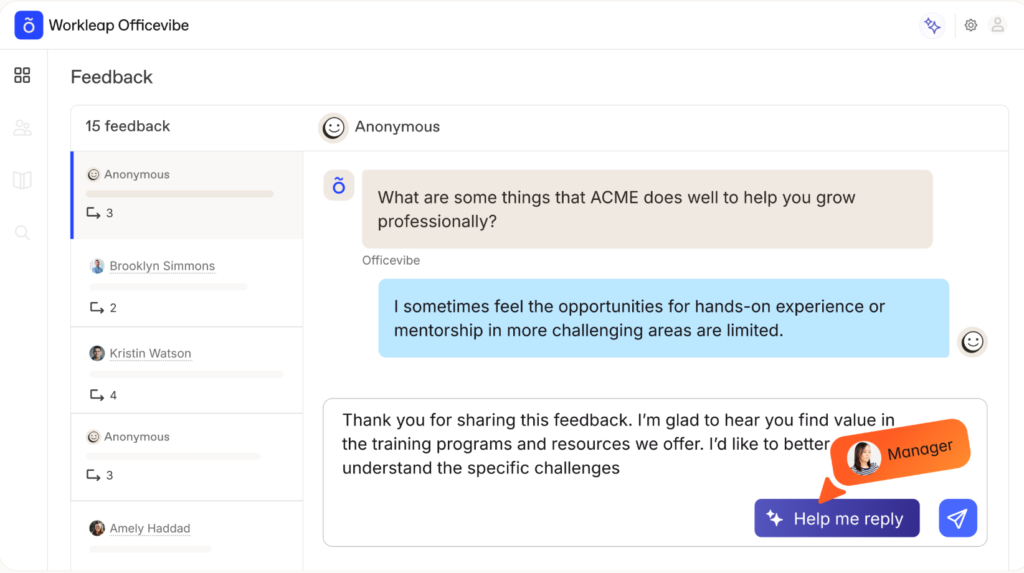
Workleap uses a tiered pricing structure that gives businesses three plans to choose from based on their engagement needs and company size. While the platform offers a polished user experience, organizations should still review how manager-based pricing and annual billing commitments may affect long-term costs as teams grow.
Standard: $4,999 per year
Includes:
- Automated pulse surveys
- Recognition and feedback
- Engagement reporting and sentiment analysis
- Self-review and 360 feedback
- Agentic analysis and review drafting
- Pay band management
- AI analyses and summaries
Pro: $11,999 per year
Includes:
- Everything in the standard plan
- Personalized onboarding
- API access
- Custom properties and segments
- Premium call support
Enterprise: Organizations over 250 employees, contact sales for a custom quote.
Includes:
- Everything in the Standard and Pro plans
- A sandbox environment
- Dedicated client success manager
If Workleap doesn’t sound quite right, check out some of our favorite silver medalists with comparable features:
Culture Amp: Culture Amp requires a minimum of 25 users, so it is best for larger teams looking for employee surveying, 360-degree feedback, and goal tracking. In particular, its employee development module stands out for its customizable employee career development plans.
Trakstar: Trakstar allows you to send pulse surveys and compare responses to identify improvement areas. Unlike Workleap, Trakstar’s engagement elements are tied to its performance module, so you can consolidate and view metrics from both arenas for more strategic company planning.
SurveySparrow: SurveySparrow is an advanced employee engagement platform that supports 360-degree feedback, onboarding, and exit interview surveys. All surveys are compatible with mobile devices and available in multiple languages. If you have a distributed and remote workforce, SurveySparrow is a great option.

2. Motivosity: Best for employee recognition and team connection
Overall Reviewer Score
4.30/5
User rating
4.75/5
Pricing
4.25/5
Platform/interface
4.50/5
Reporting and analytics
3.50/5
Employee engagement features
4.50/5
Pros
- Strong peer-to-peer and manager recognition tools
- Global rewards support across 238 countries and territories
- Social platform and employee spaces encourage connection
Cons
- $3,000 minimum annual investment may be high for very small teams
- Recognition-focused approach may not replace a full performance management system
- The social media hub may feel less useful if participation is low.
Why I chose Motivosity
I chose Motivosity because it makes employee recognition feel like an ongoing part of workplace culture rather than a separate HR task. Employees can recognize coworkers, celebrate milestones, interact through a social feed, join employee spaces, and redeem rewards through the same platform. This gives organizations several ways to build connection across departments, locations, and remote teams.
Motivosity is especially compelling for companies that want to expand recognition globally. It supports employees in 238 countries and territories, offers more than 70 languages, and provides localized rewards and currency conversion. However, its greatest strengths remain recognition, rewards, and culture-building, so organizations seeking a more comprehensive performance management platform may need additional software.
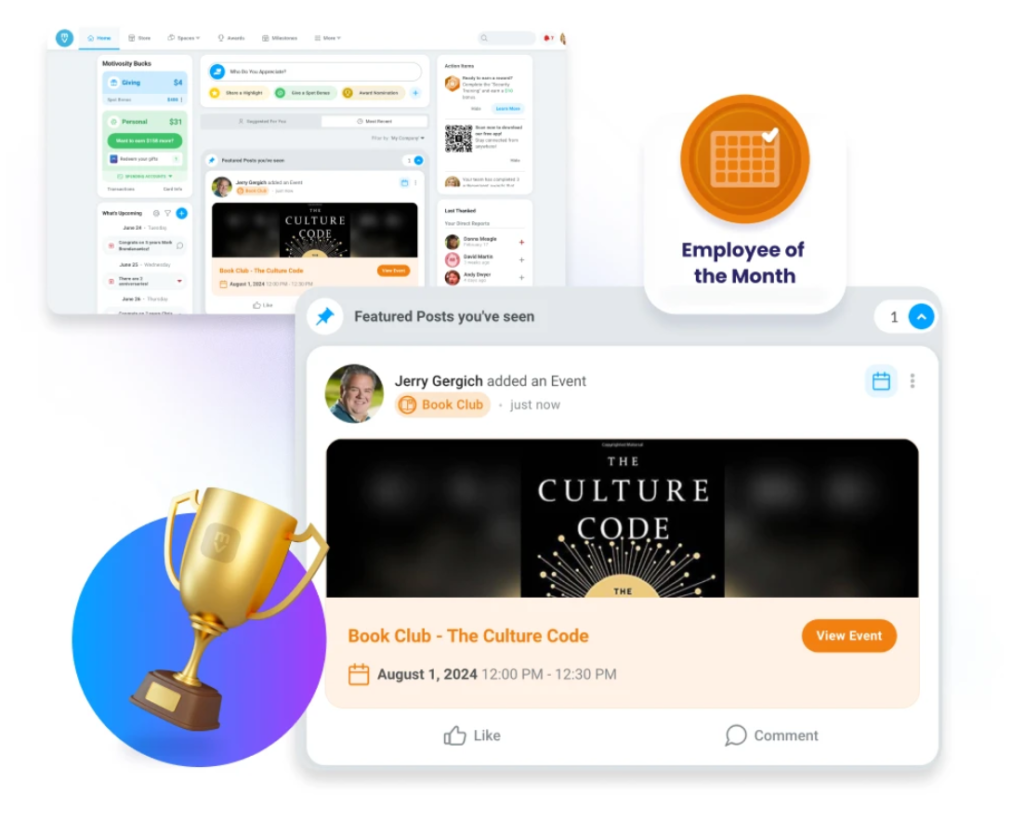
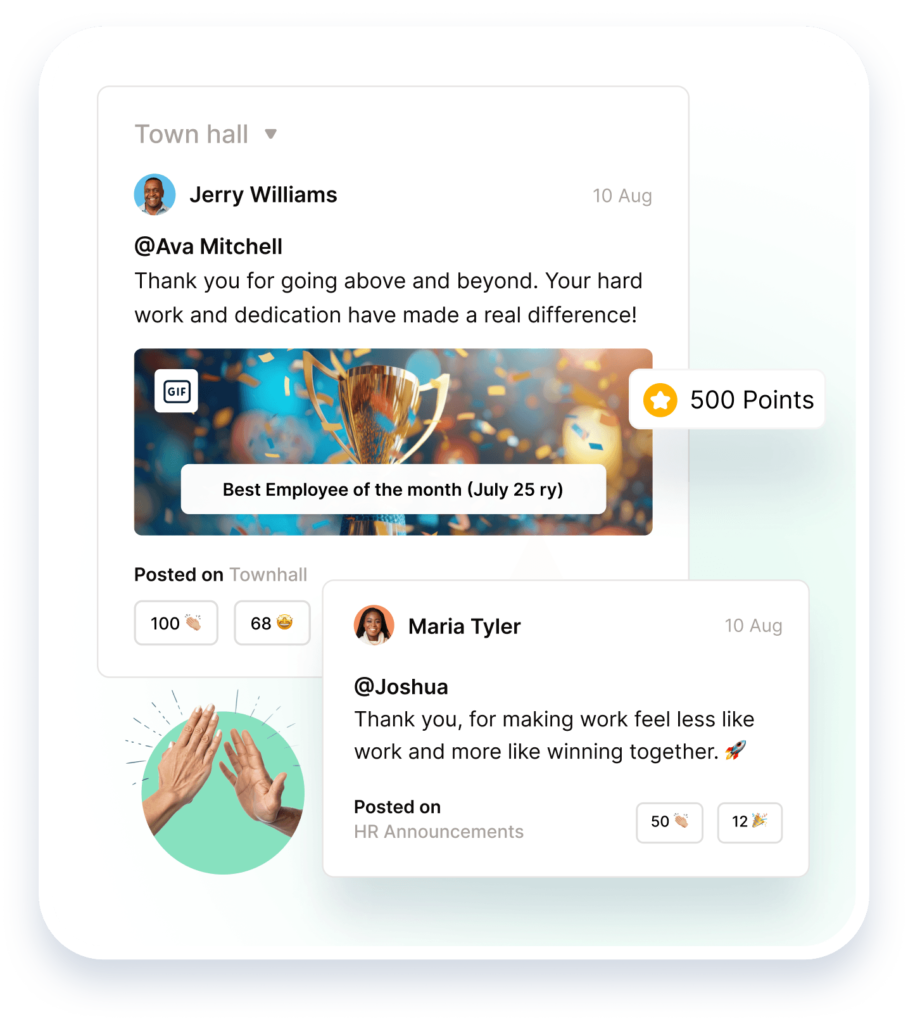
Motivosity operates like a social media platform, with a home feed where companies can make announcements and recognize employees for their achievements. Plus, employees can comment, like, and react to posted content. These fun elements encourage communication and help employees identify like-minded coworkers to nurture cross-departmental friendships.
Scaling organizations, in particular, can benefit from Motivosity’s modular pricing. Although all customers must start with its base plan, they can choose to add modules, like rewards and recognition, manager development, and employee insights, as their needs evolve.
- Peer-to-peer and manager recognition: Employees and managers can recognize contributions in real time, connect recognition to company values, issue spot bonuses, and participate in nomination or award programs.
- Global rewards marketplace: Motivosity offers built-in rewards that let employees redeem points for gift cards, merchandise, and other incentives. The reward system helps you turn recognition into something more tangible without an overly complicated reward process.
- Employee spaces and social platform: Employees can interact through recognition posts, announcements, profiles, interest-based spaces, employee resource groups, and other workplace communities.
Motivosity doesn’t publicly display its pricing on its website, and instead uses custom modular pricing based on employee count, selected modules, and contract structure. Its platform fee is approximately $0 to $2 per employee per month, while additional modules typically start at around $1 per employee per month. Volume discounts may apply as the number of users or modules increases.
That said, Motivosity requires a minimum annual investment of $3,000. According to its published pricing guidance, typical annual costs for an average two-module configuration are:
- 20 to 250 employees: $3,000 to $10,000 per year
- 250 to 5,000 employees: $7,500 to $75,000 per year
- More than 5,000 employees: $40,000 to $300,000 or more per year
Final pricing requires a custom quote. You should confirm which modules, implementation services, rewards costs, and support options are included before choosing Motivosity.
Assembly: Assembly is a strong alternative for organizations that want to combine peer recognition, rewards, and milestone celebrations. The platform supports employee shout-outs, custom awards and challenges, automated birthday and anniversary recognition, and integrations with Slack and Microsoft Teams.
Achievers: For global enterprises, Achievers is available to give employees control over recognizing their peers on a large scale. Available in over 29 languages, Achievers allows employees to learn about and collaborate with their peers without feeling limited to their direct team.
Connecteam: Similar to Motivosity, Connecteam offers a news feed, announcements, and an employee directory. Connecteam also includes an instant messaging feature so you do not have to connect with external communication platforms, like Slack or Microsoft Teams.

3. Leapsome: Best all-in-one engagement platform
Overall Reviewer Score
4.45/5
User rating
4.75/5
Pricing
3.75/5
Platform/interface
4.50/5
Reporting and analytics
4.75/5
Employee engagement features
4.50/5
Pros
- Combines engagement, performance management, learning, and analytics.
- Advanced surveys, benchmarking, sentiment analysis, and turnover prediction.
- Highly customizable reviews, competency frameworks, and workflows.
Cons
- Pricing can be expensive as organizations add more features and users.
- May be too complex for teams with simpler engagement needs.
- Certain workflows and review processes require more hands-on configuration during setup.
Why I chose Leapsome
I chose Leapsome because it connects employee engagement with the broader processes that influence performance and retention. HR teams can use the same platform to run surveys, analyze sentiment, manage reviews, track goals, support one-on-one meetings, build competency frameworks, and assign learning. This makes it easier to understand engagement in the context of employee performance and development rather than treating survey results as isolated data.
Leapsome also offers some of the strongest analytics in this roundup. Its survey tools support recurring pulse surveys, eNPS, industry benchmarks, anonymous conversations, AI-generated summaries, and recommended action plans. However, the platform may be more complex and costly than necessary for organizations that only need a straightforward feedback or recognition tool.
Also read: 8 Ways to Increase Employee Engagement With Your LMS
Leapsome is an employee engagement platform geared toward medium to large businesses. It’s designed to help you improve employee development, strengthen manager effectiveness, and create more consistent feedback and performance processes. Leapsome is also known for its balance between engagement tools and people analytics. This makes it a good fit for businesses wanting a more strategic approach to employee engagement.
Check out how Leapsome compares with its competitors in our Best Performance Management Software Guide.
- Employee surveys and AI analysis: Leapsome supports pulse, engagement, onboarding, exit, and custom surveys. Its AI tools summarize open-text responses, analyze sentiment, identify themes, and recommend follow-up actions.
- Competency frameworks: Leapsome lets you build structured competency frameworks tied to roles, departments, or career levels. This helps you define what success actually looks like for different positions. It’s also excellent for career progression planning and creating more consistent promotion criteria.
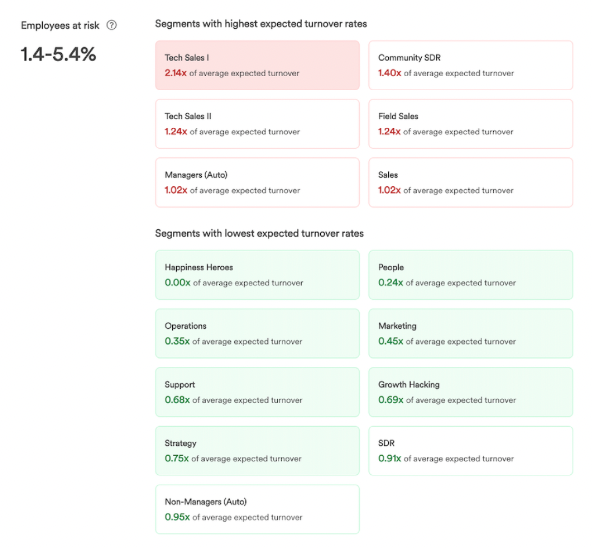
- Turnover prediction: Leapsome’s AI gathers survey data, assigns weight to comments based on how much time has passed, and uses the anonymized data to estimate how many employees will be leaving in the upcoming months. With this data, you can forecast workforce numbers and take proactive measures to reduce employee attrition rate or change recruitment strategies.
Leapsome uses a modular pricing structure so you can build a platform around the features you need. You can also access Leapsome’s core platform when selecting modules and add-ons. Pricing isn’t listed on its website. You’ll need to contact the sales team to get a custom quote based on your company size, the modules you need, and desired add-ons.
Modules to choose from:
- Recruiting: Hire new employees using AI-powered screening and candidate pipeline management.
- HRIS: Centralized employee data, advanced workflows, reporting and analytics, payroll preparation, onboarding, payroll and ATS integrations
- Reviews: Review automations, cross-cycle analytics, flexible templates, drag-and-drop calibration
- Surveys: Science-backed question library, post-survey action plans, DEI analytics, onboarding and offboarding surveys, industry benchmarks
- Goals: Automatic progress tracking, OKRs, goal tree, automated update reminders
- Compensation: Budget management, promotion reviews, pay gap analytics, salary and bonus bands
- Learning: Personalized learning, automated onboarding, LinkedIn Learning integrations, access to videos and quizzes
- Time tracking: Work schedules, timesheets, automatic issue detection, customizable policies
Add-ons to choose from:
- Compensation benchmarks: Offers scope by industry and geographic location.
- Learning content: Offers learning content for compliance, leadership, IT, data security, and essential soft skills.
What’s always included with Leapsome:
- Leapsome AI, meetings, instant feedback, Q&A boards, and competency and whistleblowing features.
BambooHR: BambooHR includes modules on employee wellbeing and detailed analytics to track employee sentiment over time by department, location, employee status, or length of service. And, because BambooHR is an all-in-one human resources management system (HRMS), you can easily compare this data with other metrics, like attrition.
Lattice: Lattice is a close Leapsome alternative for organizations that want employee engagement and performance management without adopting a broader HRIS. Its engagement tools include pulse, onboarding, exit, and eNPS surveys, industry benchmarks, and AI-generated analysis and recommendations. Lattice may be the better fit when surveys, performance reviews, and manager effectiveness are priorities, while Leapsome offers a broader mix of learning, compensation, and HR operations tools.
Workday Peakon Employee Voice: Like Leapsome, Peakon Employee Voice heavily emphasizes analytics to help shed light on employee engagement, including AI-powered sentiment analysis and benchmarking. It also integrates with Workday’s human capital management (HCM) suite to provide insights throughout the employee life cycle and suggest ways to improve your company’s employee experience.

4. Empuls by Xoxoday: Best for global rewards and recognition
Overall Reviewer Score
3.95/5
User rating
4.50/5
Pricing
4.00/5
Platform/interface
4.00/5
Reporting and analytics
3.25/5
Employee engagement features
4.00/5
Pros
- Extensive global rewards catalog across more than 100 countries.
- Supports localized currencies, languages, and cost-of-living adjustments.
- Combines recognition, rewards, surveys, and internal communication.
Cons
- Reporting and analytics are limited.
- Platform functionality leans more toward recognition and rewards.
- Public pricing is unavailable, making costs difficult to compare.
Why I chose Empuls by Xoxoday
Empuls by Xoxoday stood out to me because it approaches employee engagement from the employee experience perspective. The platform puts heavy emphasis on recognition, rewards, and perks. That helps make engagement feel natural and enjoyable for employees instead of feeling like another HR initiative they’re expected to participate in. Many employees genuinely enjoy using the platform.
Empuls also goes beyond reward distribution by combining recognition feeds, milestone celebrations, employee surveys, company announcements, and social communities. This makes it a strong choice for distributed businesses that want one platform for recognition and connection. However, companies should request a detailed quote because pricing is not publicly listed, and some advanced capabilities are limited to higher-tier plans.
Empuls by Xoxoday is an employee engagement and recognition platform designed for distributed and global workforces. It combines peer and manager recognition, automated milestone awards, global rewards, surveys, employee communities, internal communication, perks, and benefits.
Organizations can use Empuls to create companywide or regional recognition programs while controlling budgets by location, department, manager, or award type. The platform also integrates with collaboration tools, HR systems, identity providers, learning platforms, and other workplace software.
- Engagement chatbot: Empuls’s AI chatbot, Em, automatically celebrates employees for milestones, like birthdays or work anniversaries. Em also reminds employees about work events or if they need to respond to a survey. This ensures employees always remain updated and feel appreciated for their hard work.
- Awards and badges: Employees can award each other points or badges to show appreciation. In turn, employees can continue giving points to others or exchanging them for gift cards or physical items from Amazon. Doing so incentivizes good performance and fosters a community of giving.
- Recognition intranet: Empuls social intranet encourages consistent communication on company announcements and peer recognition. Employees can also develop their own interest groups to forge friendships with peers, even across continents. Gamified elements, like polls, quizzes, or contests, keep communication fun and promote platform use across the organization.
Empuls does not clearly publish current subscription pricing. Businesses need to contact the sales team for a custom quote based on factors such as employee count, selected features, geographic coverage, integrations, and implementation needs.
Kudos: If you are looking for a recognition-centered platform tailored to their workplace culture, Kudos supports peer-to-peer and top-down recognition, service milestones, nominations, rewards, incentives, employee Spaces, and gamified challenges. Choose Kudos over Empuls when recognition program design and cultural customization matter more than global employee listening and perks.
Reward Gateway: Although it includes modules like employee communication, a company directory, and engagement surveys, Reward Gateway is a suitable alternative for larger organizations. Its recognition tools include eCards, social recognition, instant manager awards, nominations, service awards, and options for frontline employees without regular computer access. It may be a better fit than Empuls when employee benefits and discounts are as important as rewards and recognition.
WorkTango: Besides a robust recognition and reward program, WorkTango offers peer recognition, automated milestones, unlimited surveys, anonymous conversations, and AI-generated recommendations. Choose WorkTango when you want a closer connection between recognition activity and employee sentiment analysis; choose Empuls when global reward localization and regional program management are the higher priorities.

5. Engagedly: Best for employee engagement and development
Overall Reviewer Score
3.95/5
User rating
4.50/5
Pricing
4.00/5
Platform/interface
3.25/5
Reporting and analytics
4.00/5
Employee engagement features
4.00/5
Pros
- Combines engagement, performance, learning, and talent mobility.
- Gamification supports recognition, learning, and goal participation.
- Extensive customization across surveys, reviews, goals, and development.
Cons
- Interface feels less polished and intuitive than other options on this list.
- Modular pricing can become expensive when combining several suites.
- Employee recognition features are functional, but less engaging.
Why I chose Engagedly
I chose Engagedly because it connects employee engagement with performance and professional development. Organizations can gather employee feedback, recognize contributions, manage reviews and goals, deliver learning, assess skills, and create career paths within the same platform. This makes it particularly useful for HR teams that want engagement initiatives to support measurable employee growth rather than operate as standalone programs.
Engagedly also uses gamification across multiple parts of the platform. Employees can earn badges or points for recognition, learning activities, goal progress, and participation in workplace discussions. At the same time, its modular structure and $7,500 annual minimum may be more than smaller businesses need, especially if they only want surveys or a basic recognition tool.
Engagedly is an employee experience platform that includes survey tools to gauge and track employee satisfaction. It also includes a well-being and reward system to incentivize positive behaviors. However, its approach to employee engagement differs from the others on this list by focusing on motivating employees through workplace gamification and learning.
Gamification, like Engagedly’s badges and leaderboards, encourages collaboration, colleague appreciation, and employee upskilling. For example, employees can receive an Engager badge every time they participate in the company by liking or commenting on posts. With each badge, employees earn points that can be redeemed for tangible rewards, like gift cards.
Engagedly’s gamified system also encourages employees to progress in their roles by rewarding them for completing training courses, achieving goals, or helping others. In addition to fostering a community of continuous learning and development, the software makes it easier for larger companies to fill skill gaps with current talent or optimize their teams during periods of economic uncertainty.
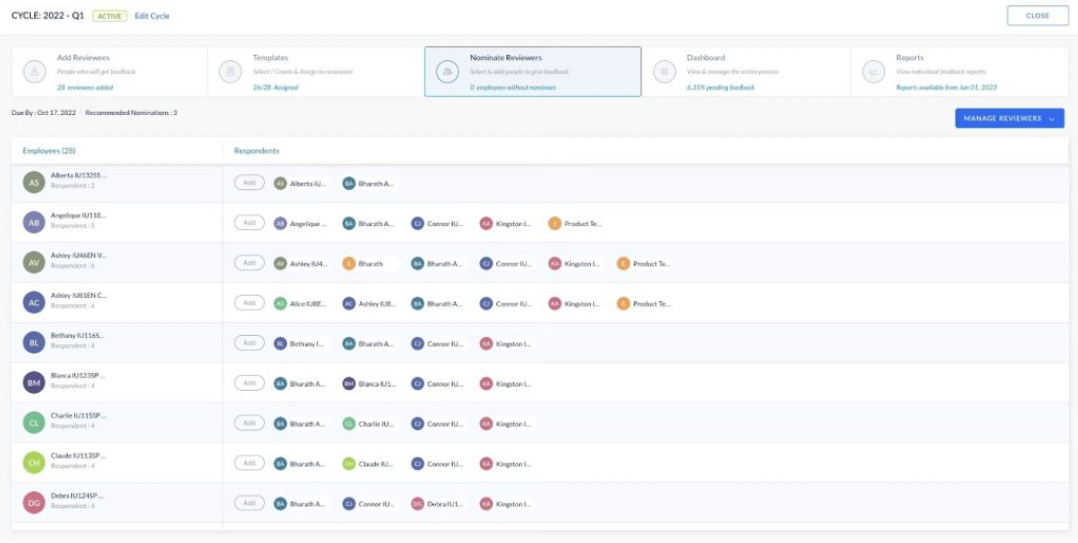
- Employee listening: Engagedly supports engagement surveys, custom employee surveys, recurring pulse checks, anonymous responses, live results, engagement indexes, and department- or team-level heatmaps.
- eLearning: Engagedly offers an LMS solution to streamline employee onboarding and skill development. You can create or integrate with third parties for courses and automate learning workflows based on specific parameters. Engagedly then assigns, tracks, monitors, and rewards employees upon completion, so you spend less time on administration and more on your talent mobility plans.
- 360-degree feedback: Employees can get feedback from their managers, peers, and external clients or customers. By receiving feedback from all relevant stakeholders, your employees can understand what areas need improvement and the tools they need to increase their productivity and efficiency.
Engagedly also uses a modular pricing structure. You can customize the platform by choosing from a selection of features and add-ons. Like Leapsome, you get the flexibility to create an experience tailored to your situation, but the costs can increase as you add on more modules, features, and users. Plus, there’s a base price of $7,500 per year.
Modules to choose from:
Manage Performance: $5-$8 per user per month (billed annually)
- Performance reviews
- Goals and OKRs
- Real-time feedback
- Check-ins
Learn & Grow: $3-$5 per user per month (billed annually)
- Learning experience platform
- Skill library
- 360 feedback
- Multirater assessment
Recognize & Reward: $2 per user per month (billed annually)
- Gamification and badges
- Reward storefront
- Praise Wall
Engage & Listen: $2 per user per month (billed annually)
- Engagement survey
- Employee surveys
- Team pulse checks
- Intranet
Talent Mobility: $2 per user per month (billed annually)
- Skill gap analysis
- Career paths
- Talent discovery
- Succession planning
All modules include:
- AI HR assistant
- Social Wall
- Playbooks and templates
- Talent analysis
- Engagedly Academy
- Mobile app
- Workflow automation
- Platform gamification
Add-ons to choose from:
Mentoring Suite: $8 per user per month (billed annually)
- Customizable templates
- Mentor-mentee precision matching
- Program management
- Progress tracking
- Scheduling
- Feedback and surveys
Manage Compensation: $10 per user per month (billed annually)
- Compensation planning
- Budget control and allocation
- Variable pay management
- Compliance and reporting
- Employee self-service
- Multi-currency and global support
- Customizable pay grades
Deskless Employee Communication: $5 per user per month (billed annually)
- Centralized communication hub
- Compliance tracking
- Personalized e-learning and training
- Employee recognition
- Surveys and polls
TINYpulse by WebMD Health Services: TINYpulse is a more focused alternative for organizations that primarily want employee surveys, recognition, and manager-employee conversations. It may be easier to evaluate than Engagedly when you do not need integrated performance management, learning, skills, or talent mobility. Choose Engagedly when employee development and performance processes are central to your engagement strategy.
15Five: 15Five is a feature-rich performance management and employee engagement platform. Of particular note is 15Five’s Transform module, which offers live coaching sessions with certified performance coaches. This is a great option if your organization lacks the internal resources to train someone on a particular skill set in your team.
Qualtrics XM: Qualtrics XM (Experience Management) is a stronger alternative for enterprises that prioritize sophisticated employee listening, experience analytics, and organization-wide action planning. It is generally better suited to organizations that need advanced survey design, benchmarking, and workforce analytics, while Engagedly offers a broader mix of performance management, learning, recognition, and career development.
Find your new employee engagement software
Employee engagement software benefits
Increases employee engagement
As its name suggests, employee engagement software provides organizations with various capabilities to enhance the employee experience. It makes workers feel more involved with the team, streamlining feedback, communication, and collaboration. Consistent feedback and communication can promote engagement, as employees feel they are an important part of the team.
Promotes productivity
Employee engagement solutions come with tools for tracking goals, recognizing employees, and boosting morale, so workers are inspired to perform better. These tools inspire employees to feel more dedicated to their duties. Inspired employees are more productive and driven to meet expectations.
Improves retention
An employee engagement platform can help employees realize the significance of their individual impact on company goals. It also fosters consistent communication between teams. Employee engagement software elevates worker experience by facilitating recognition and maintaining positive employee relationships, improving employee retention.
Ensures better communication and alignment
Many employee engagement platforms offer continuous check-in features. Employee check-ins enable effective one-on-one communication between managers and team members. They allow employees to raise concerns to their superiors, enhancing engagement and communication. Employees feel valued when their feedback is heard by management. Furthermore, check-ins let leaders ensure alignment across the entire organization.
Also read: Best Employee Onboarding Software
Facilitates business strategies
Employee engagement solutions gather and examine employee data through surveys, goal tracking, and performance monitoring. They deliver crucial reports that help HR departments understand trends and uncover obstacles to improvement. Companies can use these reports to adjust business strategies to meet employees’ needs and increase profitability.
Types of employee engagement software
Survey tools
Surveys increase visibility into the employee experience and reveal engagement opportunities. Advanced employee engagement solutions include annual, pulse, and lifecycle surveys for consistent employee sentiment monitoring. Surveys enable leaders to understand employee opinions, allowing them to optimize the working experience for every member of the organization.
Numerous employee engagement platforms also have customizable surveys that let management gather feedback about workplace issues.
One-on-one communication tools
These tools support meaningful one-on-one discussions between managers and staff. Aside from talking about workplace issues, leaders and their direct reports can have conversations about learning and development, performance, career goals, and job satisfaction. One-on-one communication is an essential part of employee engagement, giving clarity and ensuring workers understand their responsibilities and goals.
Feedback software
Employee feedback software gauges employee engagement and satisfaction. It allows managers to provide updates and suggestions for employee performance. Companies can utilize combined employee performance data to make plans for the growth of the organization.
Employee recognition software
Employee recognition platforms help companies make employees feel valued and motivated to deliver better work performance. Organizations can celebrate milestones and reward employees for a job well done.
How to choose employee engagement software
The best employee engagement software should address your most important workforce challenge without adding unnecessary complexity. Before comparing providers, identify whether your priority is gathering feedback, improving recognition, supporting manager check-ins, tracking performance, or combining several of these functions in one platform.
Identify your primary engagement goal
Start by defining the problem you want the software to solve. A survey-focused platform may be enough if you primarily need pulse surveys and sentiment tracking. However, a broader employee experience platform may be more appropriate if you also need recognition, performance management, learning, or goal-setting tools.
Compare the total cost
Employee engagement solutions may charge per employee, per manager, by module, or through a minimum annual contract. Look beyond the advertised starting price and account for implementation, premium support, rewards funding, integrations, and add-on features. You should also consider how costs may change as your workforce grows.
Evaluate usability and employee adoption
A platform only provides value when employees and managers use it consistently. During a demo or trial, review how easy it is to complete surveys, recognize coworkers, access reports, and manage follow-up actions. Mobile access, language support, accessibility, and integrations with tools like Slack or Microsoft Teams can also affect adoption.
Review reporting and privacy controls
Look for reporting that helps you turn employee feedback into action. Useful capabilities may include engagement trends, sentiment analysis, manager-level dashboards, benchmarks, and filters by department or location. You should also confirm how the platform protects anonymous responses, controls access to sensitive data, and manages minimum response thresholds.
Check integrations and scalability
Confirm that the software connects with your HR information system, payroll platform, communication tools, and identity provider. You should also consider whether the platform can support additional employees, locations, and modules without requiring a disruptive migration later.
Test the platform before committing
When possible, run a pilot with a representative group of employees and managers. Establish success measures, such as participation rates, ease of use, reporting quality, and follow-up completion. This helps you determine whether the platform fits your processes before signing a long-term contract or expanding it company-wide.
Frequently asked questions (FAQs)