

Dialpad is a unified communications (UC) platform offering a range of call management tools. However, users commonly note drawbacks such as metered international calling, minimum user requirements, limited video meeting capacity, and occasional issues with customer support.
These are important factors for businesses seeking a comprehensive or scalable solution. While my top choice is Vonage, the best Dialpad alternatives provide collaboration features, unlimited global calling, greater flexibility, and competitive pricing.
Based on my research of numerous providers, here are the 7 top competitors to consider:
Best Dialpad Alternatives | Best for | Key Features | My score(Out of 5) |
|---|---|---|---|
| Vonage | Overall Dialpad alternative |
| 4.81 |
| GoTo Connect | Global calling |
| 4.74 |
| Zoom Phone | Video conferencing |
| 4.73 |
| Nextiva | Customer communications |
| 4.49 |
| RingCentral | Unified communications |
| 4.44 |
| TalkDesk | Call centers |
| 4.29 |
| Quo | Small teams |
| 4.01 |
Methodology: How I evaluated the best Dialpad alternatives
To evaluate the best Dialpad alternatives, I compared each platform based on how well it addresses specific Dialpad limitations or buyer needs, including international calling, video conferencing, sales and support workflows, contact center scalability, small-team collaboration, integrations, and overall usability.
I scored each provider across these categories:
- Pricing and value: Monthly starting price, annual discounts, quote-based pricing, free trial availability, plan flexibility, and whether essential features require add-ons.
- General features: Business calling, messaging, voicemail, call forwarding, number porting, desktop and mobile apps, team collaboration, and phone number options.
- Core VoIP features: Auto attendants, IVR, call routing, call queues, voicemail transcription, call recording, extensions, and toll-free or international number support.
- Advanced features: AI tools, analytics, call monitoring, workforce management, contact center features, API access, call summaries, and automation.
- Integrations and compatibility: CRM integrations, productivity app connections, API availability, device support, and compatibility with existing business workflows.
- User experience: Setup complexity, admin controls, mobile and desktop usability, learning curve, and whether a small business can adopt the platform without heavy IT support.
- Security and reliability: Uptime language, compliance resources, encryption, permissions, redundancy, and trust signals relevant to customer-facing communication.
- Expert assessment: My judgment of each provider’s best-fit use case based on product research, feature comparisons, and how well the product addresses a clear Dialpad alternative use case.

Vonage: Best overall Dialpad alternative
Pros
- Offers 50+ default business phone features
- Provides desktop and mobile apps
- Supports video meetings and team messaging on higher tiers
- Offers add-ons and APIs for customization
- Strong fit for businesses with fluctuating communication needs
Cons
- Some standard call management features may require add-ons
- On-demand call recording is limited on lower tiers
- Promotional pricing and contract terms can make costs harder to compare
Why I chose Vonage over Dialpad
I chose Vonage as the best overall Dialpad alternative because it gives businesses a flexible unified communications system without forcing every team into the same setup. When I compare Dialpad alternatives, I look for providers that support calling, messaging, meetings, integrations, and customization without being overly rigid. Vonage stands out because it gives teams room to build around their specific communication needs.
I also like Vonage for businesses that want more control over how their phone system scales. Its plan structure covers mobile and desktop apps, video meetings, team messaging, desk phone support, and advanced call features, while add-ons and APIs make it easier to customize workflows over time. That makes Vonage a strong fit for teams that want more flexibility than Dialpad offers.
Gallery
Key features
- Auto-attendant: This feature automatically answers and directs calls based on your custom call management rules, such as business hours and holidays.
- Call blocking: Block incoming or outgoing calls based on details such as area codes and specific phone numbers. This can be configured through the admin or user portal and applied to your entire account or extensions.
- AI virtual assistant: Enable employees to use voice-driven self-service to handle customer interactions without live assistance. Deliver fast and personalized answers to questions and analyze customer sentiment to optimize client experiences.
- Call queue: Manage high-volume calls even with a lean team by allowing callers to stay on the line while waiting for an agent to become available.
- Conference call: Establish a three-way call and have seamless discussions between clients and team members.
Pricing
Vonage pricing varies by company size, billing term, and promotions. The monthly prices below are the standard listed prices for smaller online purchases:
- Mobile: $19.99/line/month, or $13.99/line/month with annual pricing
- Premium: $29.99/line/month, or $20.99/line/month with annual pricing
- Advanced: $39.99/line/month, or $27.99/line/month with annual pricing

GoTo Connect: Best for global calling
Pros
- Strong fit for businesses with international clients
- Offers custom dial plans and smart routing
- Combines phone, meetings, messaging, and customer experience tools
- Supports customer communication upgrades as teams grow
Cons
- Pricing is quote-based
- AI and customer experience features may require higher packages
- Can be too complex for small teams
Why I chose GoTo Connect over Dialpad
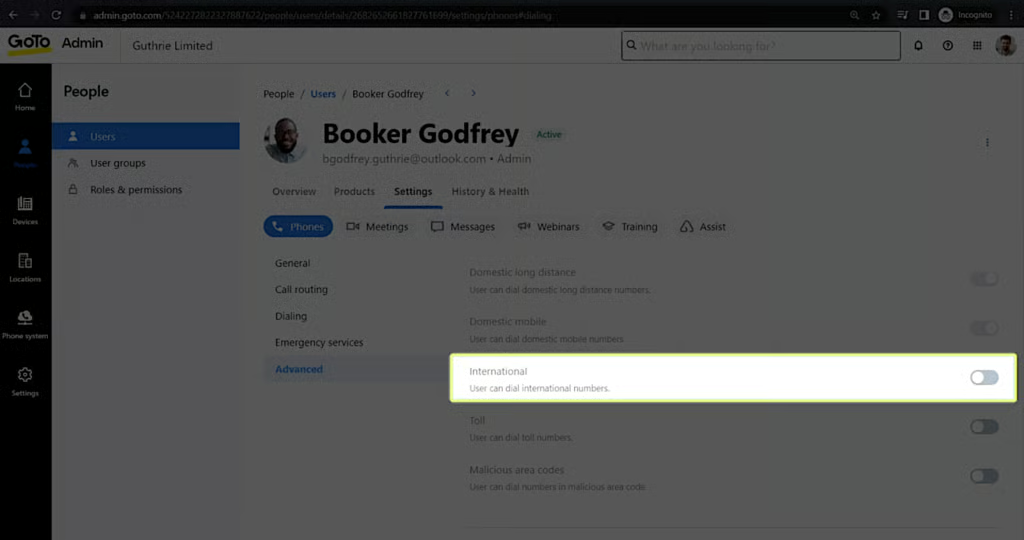
GoTo Connect is my pick for global calling because it is one of the clearest alternatives for teams that find Dialpad’s international calling limits restrictive. The source article positions GoTo Connect around international calling to more than 50 countries, shared toll-free minutes, custom dial plans, SMS/MMS, and customer communication features.
I would also choose GoTo Connect for teams that expect to grow beyond a basic phone system. Its current product page positions the platform as an all-in-one, AI-powered cloud communications system for small, mid-sized, and distributed businesses, with phone system, customer experience, and contact center paths.
Gallery
Key features
- Virtual voicemail: GoTo Connect lets you receive voicemails via email, text, web app, or transcript, eliminating the need to listen to messages manually.
- Text-to-speech greetings: Leverage AI to generate custom messages and greetings for your auto attendant system.
- Customizable dial plans: The visual call flow editor lets you design unlimited dial plans, tailoring call routing, scheduling, and auto-attendant settings to your needs.
- Smart call routing: Direct incoming calls to the correct department or team member based on predefined rules, ensuring efficient handling of customer inquiries. This feature helps minimize wait times and enhances overall call management for businesses.
- Paging: This method simultaneously broadcasts messages to different devices or extensions, which is particularly useful for company-wide announcements and reaching colleagues in real time.
Pricing
GoTo Connect pricing is quote-based:
- Phone system: Custom pricing
- Includes 1,000 toll-free minutes, video meetings, and a call management system
- Complete CX: Custom pricing
- Adds AI features, call reports, and digital channel support
- Contact center: Custom pricing
- Adds agent productivity tools and call center capabilities

Zoom Phone: Best for video conferencing
Pros
- Strong choice for teams already using Zoom
- Low monthly starting price
- Easy transition from phone calls to Zoom Meetings
- Supports metered, regional unlimited, and global calling plans
Cons
- An entry-level plan may not fit teams that need unlimited calling
- Advanced CRM integrations are more limited than some UCaaS competitors
- Not as strong as RingCentral or Talkdesk for advanced analytics and contact center depth
Why I chose Zoom Phone over Dialpad
I chose Zoom Phone for virtual meetings and video conferencing because its biggest advantage is the Zoom ecosystem. If a team already uses Zoom Meetings, Zoom Phone offers a familiar way to add business calling without forcing users to switch to a completely different communications platform.
In my evaluation, Zoom Phone is strongest for video-first teams that want calling, meetings, and collaboration to work together. Unfortunately, it is less compelling as a deep contact center platform, but it is a practical Dialpad alternative for teams that prioritize video meeting capacity, ease of adoption, and low-cost phone plans.
Gallery
Key features
- Auto-attendant: This feature automatically greets callers and directs them using tailored phone menus. It provides a professional experience and effectively routes calls to the right extensions or departments.
- Call delegation and shared lines: Delegate call answering to assistants or managers who can handle calls on behalf of executives or team members. Shared line groups allow multiple users to answer calls from a shared number, increasing accessibility and efficiency.
- Call recording: Users can record calls on demand or automatically for documentation, compliance, quality assurance, or training purposes. This allows authorized persons to quickly access or review conversations when needed.
- Plug-and-play VoIP phones: Zoom supports a range of ready-to-use VoIP desk phones, allowing teams to connect their devices with minimal configuration. This is ideal if you require quick deployment and hassle-free integration into existing office setups.
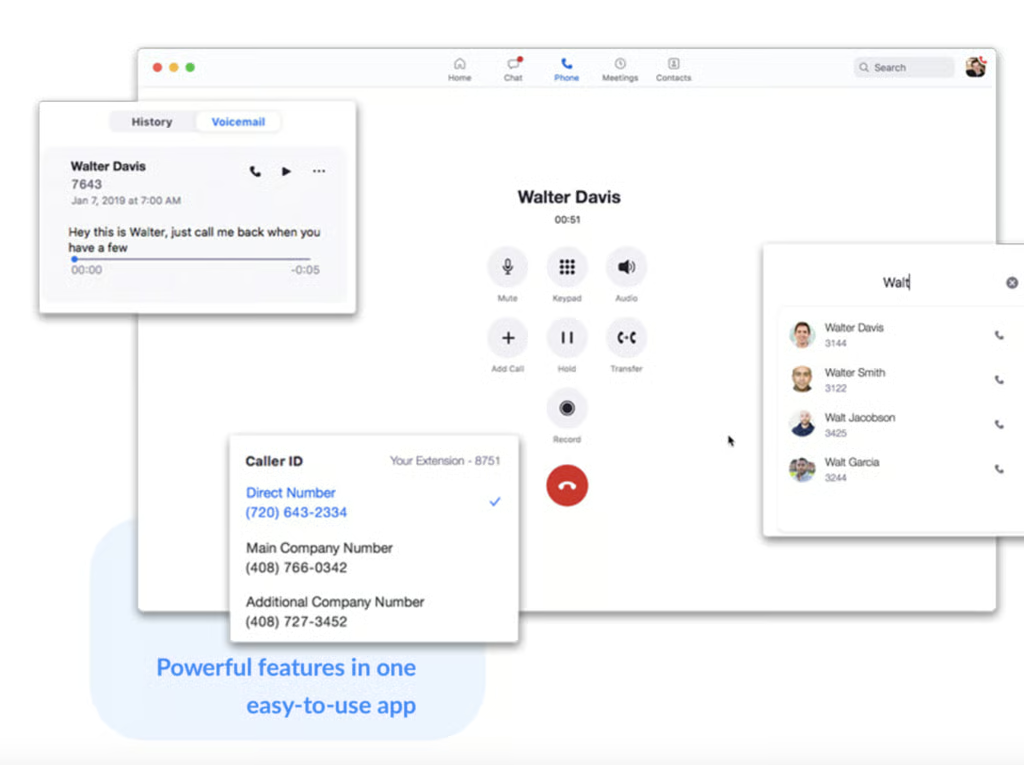
- Transfer calls to Zoom Meeting or Zoom Room: Shift an ongoing call to a Zoom Meeting or Zoom Room to enable a seamless transition from voice to video. This feature enhances collaboration by quickly escalating calls into interactive meetings.
Pricing
- U.S. & Canada Metered: $12/user/month
- U.S. & Canada Unlimited: $18/user/month
- Global Select: $25/user/month
Nextiva: Best for sales & support teams
Pros
- Strong fit for customer-facing sales and support workflows
- Includes voice, video, messaging, and team collaboration tools
- Offers 99.999% uptime language in the source article
- Higher tiers include toll-free minutes and analytics
Cons
- CRM integrations may require add-ons
- International phone number support is limited in the source article
Why I chose Nextiva over Dialpad
Nextiva is the alternative I would recommend for sales and support teams because it focuses on customer communication, not just internal calling. The source article highlights features such as smart IVR, customer video and screen sharing, live chat, call routing, voicemail transcription, team chat, and analytics, which make it a better fit for customer-facing teams than a bare-bones phone system.
I see Nextiva as a strong alternative to Dialpad for managing customer experience across channels. It is especially relevant for teams that want voice, messaging, video, social channels, live chat, and reporting to support the customer journey rather than simply replace a phone line.
Gallery
Key features
- Internet fax: Nextiva provides both standard and HIPAA-compliant internet fax services and can connect to traditional fax machines.
- Smart call routing: Leverage AI to reduce customer wait times and improve service efficiency. Use auto attendants to maneuver callers through menus while AI optimizes call routing to direct them to the right agent or extension.
- Visual voicemail: Automatically direct unanswered calls to voicemail, receive email messages, and record multiple greetings.
- Video conferencing: Nextiva’s video communications enable you to connect with customers and colleagues. Tools like live screen sharing, simultaneous text-based chatting, and multi-device support improve the quality of discussions.
Pricing
- Core: $23/user/month, or $15/user/month billed annually
- Engage: $50/user/month, or $25/user/month billed annually
- Scale: $75/user/month
RingCentral: Best for unified communication
Pros
- Strong unified communications feature set
- 500+ integrations
- 14-day free trial
- Unlimited U.S. and Canada calling
- International calling plans and bundles are available
Cons
- More complex than simpler Dialpad alternatives
- SMS and some advanced features vary by plan
- Can be more than very small teams need
Why I chose RingCentral over Dialpad
RingCentral is my choice for unified communications because it is one of the most complete Dialpad alternatives for teams that want phone, messaging, video, integrations, analytics, and admin controls on a single platform. I would especially consider it for growing teams that need more structure than a lightweight virtual phone system can provide.
What stands out to me is the depth of RingCentral’s ecosystem. Its pricing page confirms 500+ integrations, unlimited U.S. and Canada calling, international calling plans and bundles, and a 14-day free trial. It also describes RingCentral as having 99.999% reliability and broad integrations with platforms such as Salesforce, HubSpot, Zendesk, ServiceNow, and Microsoft Teams.
For more information on how these two providers stack up against each other across key phone system features, see our Dialpad vs RingCentral comparison.
Gallery
Key features
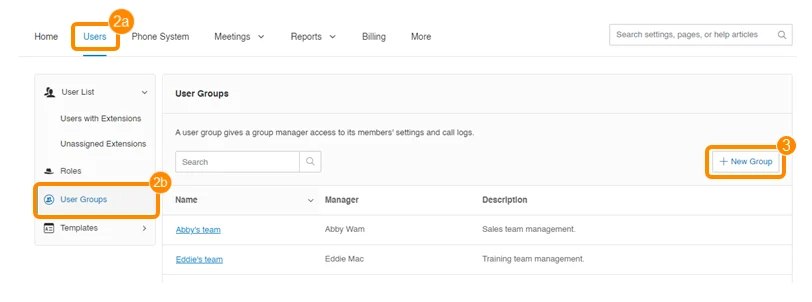
- Shared lines: Enable multiple users to answer and manage calls using the same phone number for greater accessibility and responsiveness. This is helpful for customer support teams as it ensures no calls are missed.
- Desk phone rentals: RingCentral offers high-quality desk phone rentals so you can scale and deploy devices without the high upfront purchase costs.
- Incoming caller ID: See caller information easily and prioritize or screen calls based on their origin.
- Audio conferencing: Users can host secure conference calls with up to 1,000 participants. Tools at your disposal include call recording and dial-in numbers.
- Cost center management: Businesses can organize and track expenses by department or team. Simplify budgeting and cost allocation for improved financial oversight.
Pricing
- Core: $30/user/month, or $20/user/month billed annually
- Advanced: $35/user/month, or $25/user/month billed annually
- Ultra: $45/user/month, or $35/user/month billed annually
- Customer engagement bundle: Contact sales for pricing.
Talkdesk: Best for call centers
Pros
- Built specifically for contact centers
- Strong AI, routing, dashboards, and workforce tools
- Offers industry-specific packages
- Includes digital, voice, omnichannel, and automation options
Cons
- More expensive than most Dialpad alternatives
- May be too complex for small teams that only need business phone service
- Best value is for formal support or contact center operations
Why I chose Talkdesk over Dialpad
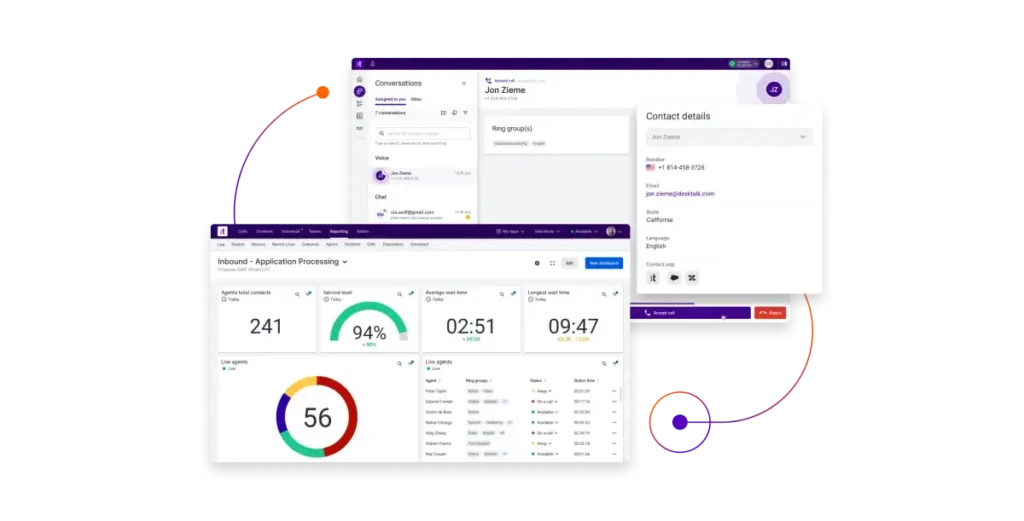
Talkdesk is the Dialpad alternative I would choose for call centers because it is built around customer experience operations rather than general business calling. If a team needs agent monitoring, real-time dashboards, routing, quality management, workforce tools, and industry-specific packages, Talkdesk is more purpose-built for that environment.
Compared with the other providers on this list, Talkdesk is less of a small-business phone system and more of a customer experience platform. That is exactly why it deserves a spot here: it covers a buyer need that Vonage, Zoom Phone, and OpenPhone do not fully address.
Gallery
Key features
- Disaster recovery and redundancy: Talkdesk’s geographic redundancy ensures business continuity during outages. The platform capitalizes on its strategically distributed nine data centers to eliminate single points of failure.
- Automated workflows: Establish a system for triggering specific actions based on customer interactions, such as automated follow-up emails after calls.
- Multilingual IVR: Talkdesk includes an IVR system that supports multiple languages, such as English, German, Spanish, and Indonesian. This is a crucial feature for businesses with a global customer base.
- Screen recording: This tool captures an agent’s on-screen activities during customer interactions, enabling supervisors to review both the conversation and the agent’s actions. It supports quality assurance, compliance, and training optimization.
- Workspace designer: A customizable interface that lets administrators tailor agent workspaces to specific roles or tasks. Create personalized layouts where agents and team members gain access to the most relevant tools, integrations, and workflows.
Pricing
- Digital Essentials: $85/user/month
- Voice Essentials: $105/user/month
- Elite: $165/user/month
- Industry Experience Clouds: $225/user/month
- Free trial: Talkdesk Express free trial available for eligible U.S. and Canada small businesses

Quo: Best for small teams
Pros
- Strong fit for startups and small teams
- Shared numbers and team collaboration features
- AI call summaries and transcripts on Business
- Lower starting price than many UCaaS providers
Cons
- Less advanced than enterprise UCaaS platforms
- Best features require Business or Scale
Why I chose Quo over Dialpad
Quo (formerly known as OpenPhone) is an excellent choice for small teams thanks to its cost-effective shared phone numbers feature. As one of the top Dialpad competitors in the market, Quo, unlike Dialpad, which can become expensive as team sizes increase, enables multiple team members to use the same business number.
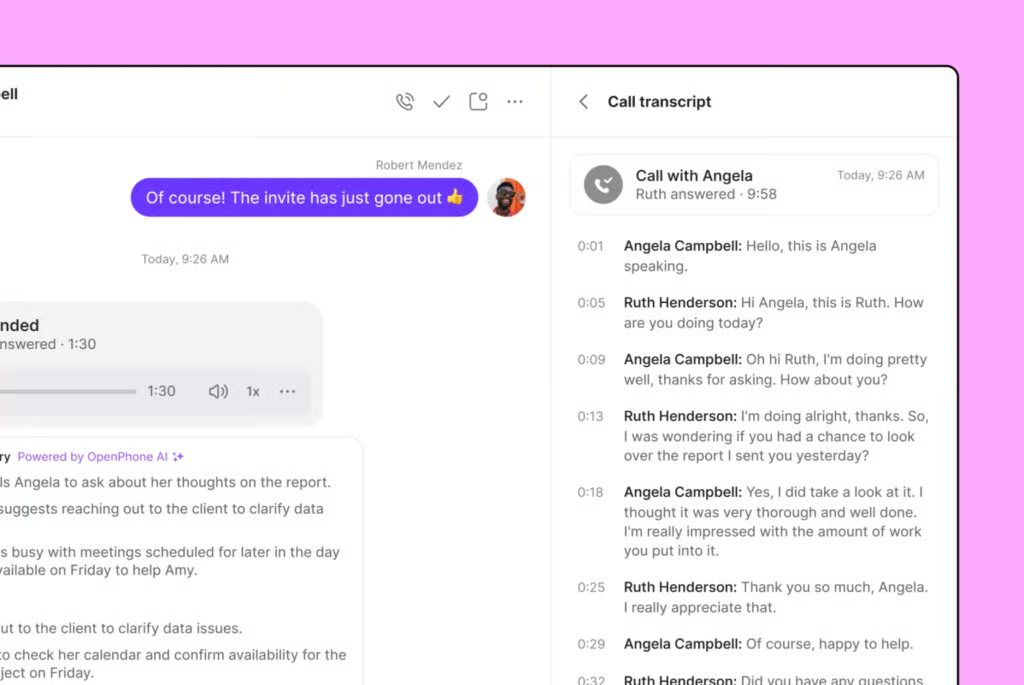
Additionally, features such as customizable voicemail, AI-powered responses and transcripts, auto-replies, scheduled messages, and ring order streamline communication and automate tasks, enabling smaller teams to significantly enhance productivity.
Gallery
Key features
- Call routing: Direct incoming calls to the appropriate team member or department and handle calls efficiently.
- Call analytics: Offers analytics that provides insights into call volume, duration, and performance metrics. Use this information to evaluate team and individual performance and understand customer sentiment and concerns.
- Shared phone numbers: Teams can share phone numbers, enabling multiple users to manage customer interactions.
- Scheduled messages: Let you plan and send text messages at a specific time without being actively available. Use this feature to send reminders, follow-ups, or announcements.
- Group messaging: Use this feature to communicate with multiple contacts simultaneously. For example, send team updates to ensure everyone is updated with the same information.
Pricing
- Starter: $19/user/month, or $15/user/month billed annually
- Business: $33/user/month, or $23/user/month billed annually
- Scale: $47/user/month, or $35/user/month billed annually
- Free trial: 7 days
What is Dialpad?
Dialpad is a cloud-based communications provider offering both Unified Communications as a Service (UCaaS) and Contact Center as a Service (CCaaS) solutions. The platform provides advanced AI-powered features such as bot-assisted live chat, AI-driven customer sentiment analysis, and intelligent call routing. The solution provides scalability for growing businesses through advanced contact center tools such as ACD and real-time analytics.
It offers three plans, including Dialpad, with pricing starting at $27 per user per month. The base plan includes essential communication tools such as unlimited domestic calling, a multi-level auto attendant, custom call routing, SMS/MMS, and team messaging.
Dialpad limitations
While Dialpad is an excellent VoIP phone system for businesses of all sizes, it has several drawbacks that can be deal-breakers for those who need niche communication tools. Here are some of the platform’s limitations:
Limited video meeting capacity
Dialpad includes video meetings, but teams that rely heavily on video conferencing may prefer Zoom Phone for its integration with the Zoom Meetings ecosystem.
Mid-range pricing
Dialpad may feel expensive for small teams that only need basic calling, shared numbers, or simple messaging. OpenPhone and Zoom Phone may be better fits for leaner budgets.
International calling limitations
Businesses with frequent international calling needs may prefer GoTo Connect, especially if global calling is a top priority.
Integration needs
Dialpad integrates with business tools, but teams that want a broader app ecosystem may prefer RingCentral for its 500+ integrations.
Contact center depth
Dialpad offers contact center tools, but support teams with more advanced routing, workforce management, quality assurance, industry-specific workflows, and customer experience automation may prefer Talkdesk.
How to choose the right Dialpad alternative
The best Dialpad alternative depends on why you are replacing or comparing Dialpad in the first place.
- Choose Vonage if you want the best overall mix of calling, messaging, meetings, integrations, and customization.
- Choose GoTo Connect if global calling is a priority and your business regularly communicates with international customers or teams.
- Choose Zoom Phone if your organization is already video-first and wants phone service connected to Zoom Meetings.
- Choose Nextiva if you need stronger sales, support, and customer communication workflows.
- Choose RingCentral if you want a full unified communications platform with extensive integrations, analytics, and administrative tools.
- Choose Talkdesk if you need a dedicated contact center platform with workforce, quality, AI, and reporting features.
- Choose OpenPhone if you run a small team and want shared numbers, business texting, AI summaries, and easy collaboration.
Before choosing, compare each provider’s pricing, call routing, number options, international calling, video capacity, integrations, analytics, support, free trial availability, and contract terms.
Frequently asked questions (FAQs)
What is the best Dialpad alternative?
Vonage is the best overall Dialpad alternative because it offers a flexible unified communications platform with business calling, messaging, video meetings, integrations, and customizable add-ons. However, the best choice depends on your needs. GoTo Connect is better for global calling, Zoom Phone is better for video conferencing, and OpenPhone is better for small teams.
Is there a free version of Dialpad?
No. Dialpad does not offer a full free plan. It offers a free trial and free online video conferencing, but paid plans are required for its business communications services.
Which Dialpad alternative is best for small teams?
OpenPhone is the best Dialpad alternative for small teams because it offers shared numbers, calling, messaging, voicemail transcripts, AI call summaries, call routing, CRM integrations, and a 7-day free trial.
What features should I look for in a Dialpad alternative?
Look for call routing, auto attendants, voicemail transcription, business messaging, video meetings, integrations, analytics, uptime language, international calling options, mobile and desktop apps, and transparent pricing. For support teams, also compare call queues, call recording, workforce management, and quality assurance tools.