Key takeaways
- Job descriptions shape a candidate’s first impression of your company and strongly influence whether they choose to apply.
- Clear, specific, and well-structured job descriptions help companies attract qualified candidates more quickly and reduce time-to-hire.
- Including transparent details—such as salary ranges, work location, and essential responsibilities—builds trust and helps candidates self-assess fit.
- Dec. 5, 2025: Hanna Sillo updated the article to refine the structure and examples throughout, refresh images and visual elements, add new data points , and expand the FAQ section.
A great job description includes a clear title, a concise role summary, core responsibilities, required qualifications, and salary details.
Job descriptions are often the first chance a company has to make a good impression on a potential applicant. It’s therefore imperative that hiring managers write effective job descriptions to attract qualified job candidates and reduce the time it takes to fill vacancies.
In this guide, we break down each component, share formatting best practices, and explain why structured, bias-free language attracts stronger applicant pools.
What are the components of a good job description?
A good job description includes a clear job title, information about the employer, a summary of the job, core job responsibilities, and minimum qualifications.
Job title
Choosing the right job title is one of the simplest ways to improve the visibility and quality of your applicant pool. Candidates rely on standard, searchable titles to understand a role quickly, and job boards use those same keywords to surface relevant postings. Here are examples of what works and what doesn’t.
Good job titles
- Marketing Manager: Uses standard terminology that aligns with how candidates search. Easy for job boards and LLMs to categorize.
- Senior Content Strategist: It’s a combination of clear level and clear function. This helps candidates quickly self-assess fit and improves search discoverability.
- Customer Support Specialist: Accurately describes the job family and reduces misaligned applicants and improving keyword matching.
Bad job titles
- Marketing Rockstar: Too vague and gimmicky. It also won’t appear in search results for “marketing manager” or “marketing specialist.” Plus, it might also deters candidates who associate “rockstar” with burnout culture.
- Content Wizard II: Job seekers won’t search for “wizard,” and Roman numerals obscure the role’s level. This fails basic keyword-matching on job boards.
- Customer Guru: While the “customer” gives you an idea of the department, it is unclear whether this is customer support, customer success, sales, or onboarding. Candidates can’t self-identify the role from the title.

Company information
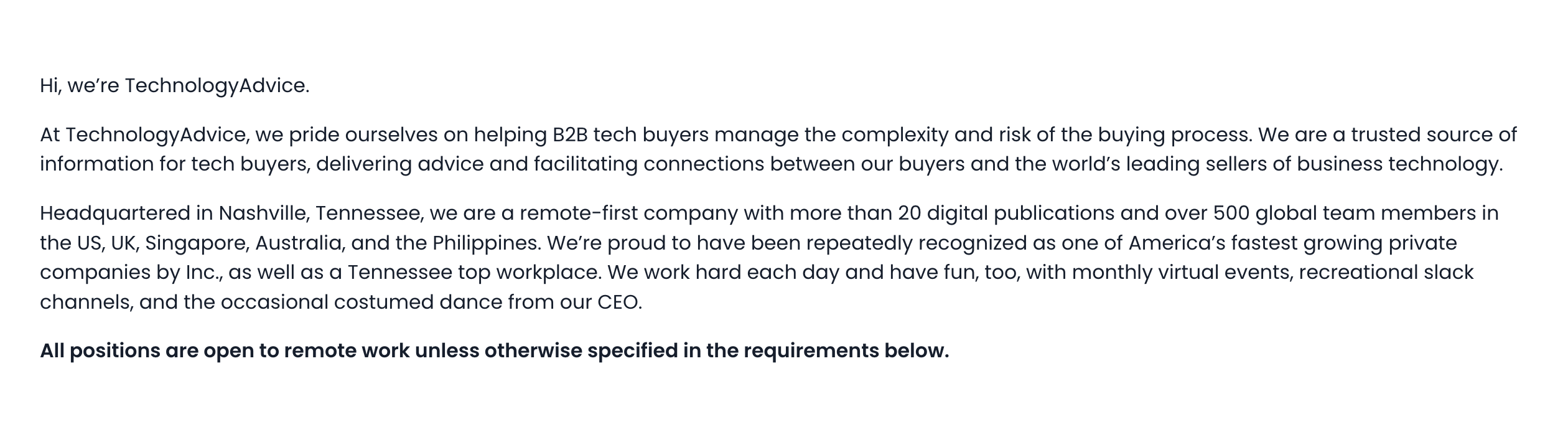
The company description helps candidates quickly understand who you are and why they might want to work for you. A clear, concise summary of your business, industry, and culture gives applicants context and can spark interest from the right people.
To be effective, briefly explain what your company does and the industry you’re in. Including something unique about your company or its culture helps grab candidates’ attention.
Good company description
“BrightPath Analytics is a healthcare data platform used by hospitals to forecast patient demand and improve care delivery. Our team of 120 employees is fully remote across the U.S., and we’re known for a collaborative culture, monthly learning stipends, and transparent leadership practices.”
Why it’s effective: It names the industry, the product, the scale of the company, and a few cultural attributes that help candidates quickly decide if the organization is a match.
Bad company description
“We’re a fast-growing company looking for passionate people to join our dynamic team.”
Why it’s ineffective: Too generic. It doesn’t say what the company actually does, what industry it operates in, or what makes it different from any other employer.
Summary
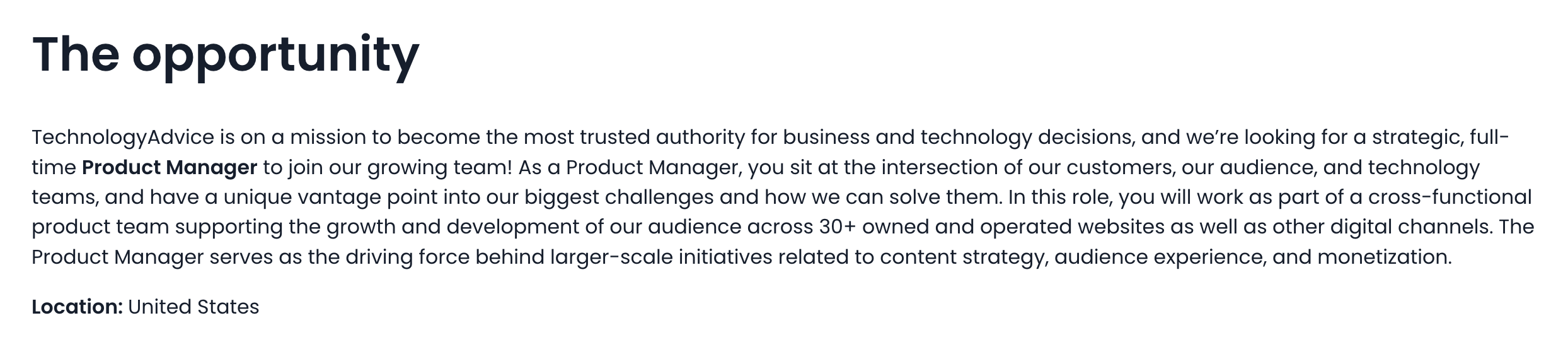
Without repeating specific responsibilities, give a high-level description of this job, who the candidate will work with and report to, and how the role fits within broader organizational goals. Giving candidates a sense of how the role contributes to the bigger picture appeals to candidates who desire purpose in their work.
For transparency, the summary is a good place to state the salary range and specify the role as remote, on site, or in person. If the role is hybrid, state how often the person needs to be on site.
Good summary
“The Marketing Operations Manager will oversee campaign reporting, marketing automation workflows, and funnel analytics to support our revenue team. This role reports to the Director of Demand Generation and collaborates closely with Sales and Product Marketing. The position is hybrid (2 days onsite in Austin), with a salary range of $95,000–$115,000.”
Why it’s effective: The summary provides a clear overview of responsibilities without duplication, identifies who the role works with, states reporting structure, clarifies hybrid expectations, and includes a transparent salary range.
Bad summary
“We’re looking for someone to join our team and help with various projects as needed. The role is hybrid and offers competitive pay.”
Why it’s ineffective: Vague, doesn’t explain the role’s purpose, doesn’t identify reporting relationships or team context, and “competitive pay” lacks transparency.
Responsibilities
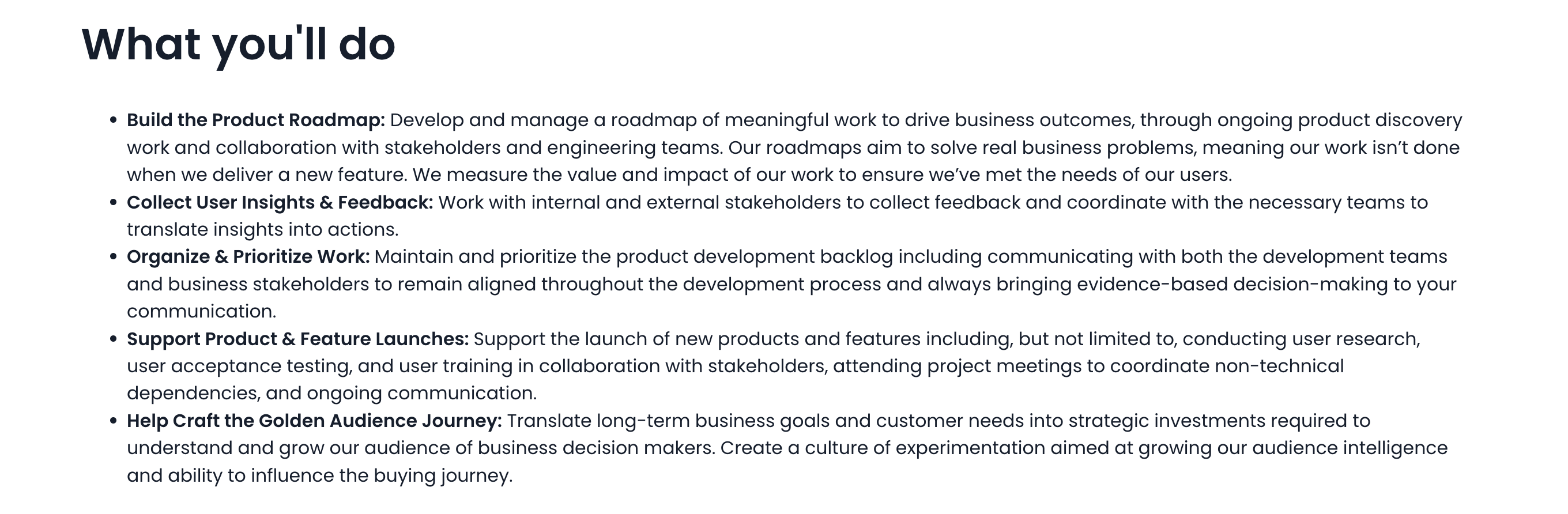
List the essential job duties only, so as not to overwhelm interested candidates. The list of responsibilities helps candidates envision themselves as a potential employee and what a typical day looks like in the role. The responsibilities section is another place where hiring managers can integrate information about the role’s supervisor and peers.
For this, list concrete and essential duties, shows daily tasks, and name key collaborators and reporting relationships. Providing these information upfront helps candidates assess fit and expectations.
For example:
Qualifications
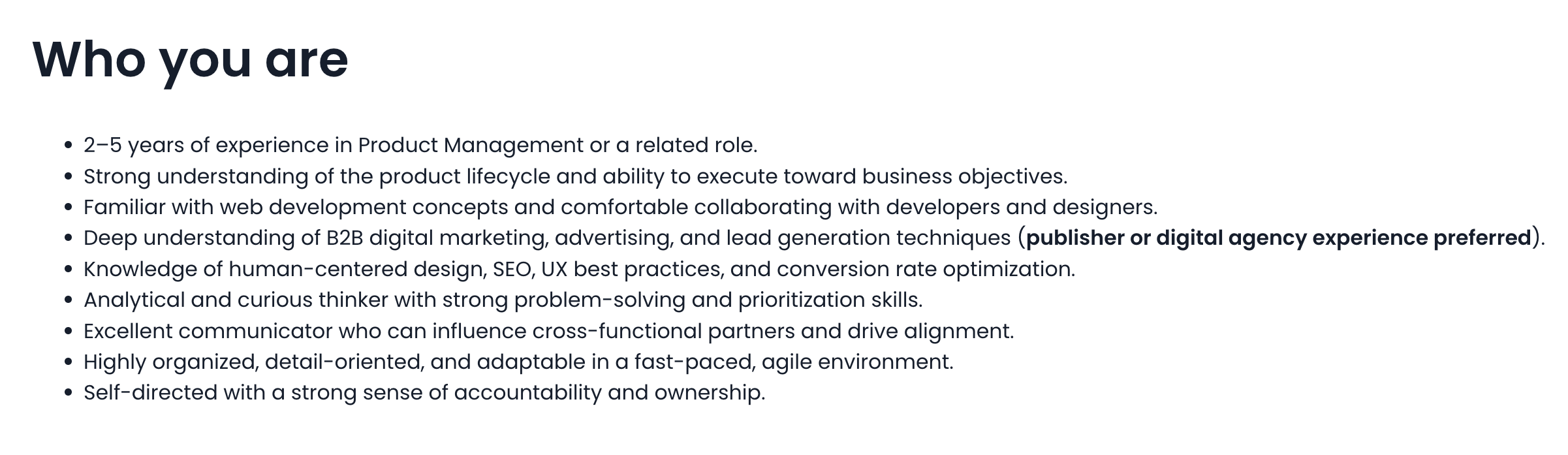
As with the responsibilities, include minimum required skills and experience for the role. Otherwise, candidates might think they have to meet all qualifications and won’t apply. A LinkedIn report reveals women are 16% less likely than men to apply for a job after viewing it because they feel pressured to meet 100% of the requirements.
As a best practice, list only the minimum required qualifications that candidates must have to succeed in the role, and separate them clearly from any preferred qualifications that are optional. This ensures you set realistic expectations, avoid unintentionally discouraging qualified applicants, and support a more inclusive applicant pool.
Example:
Compensation and benefits
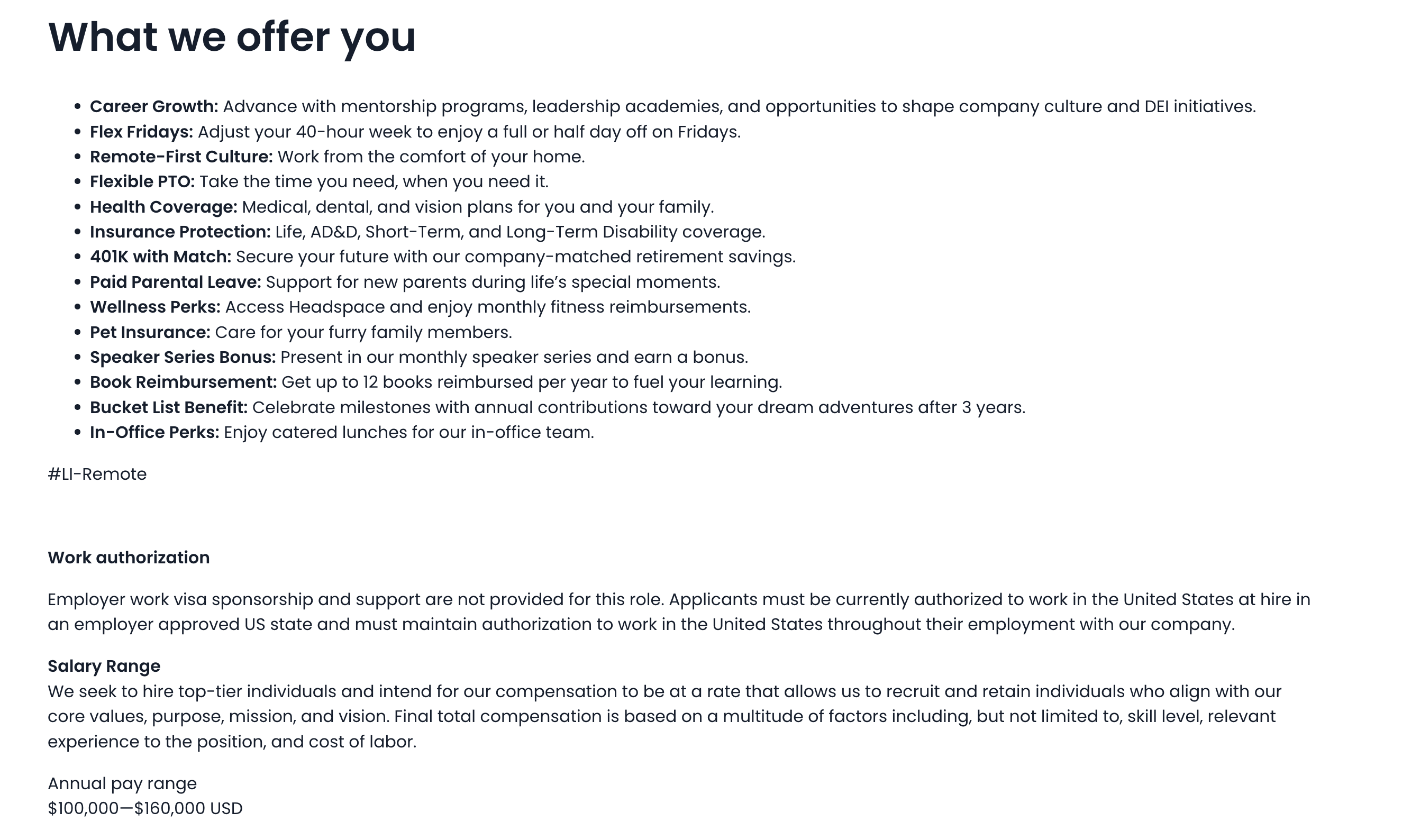
In some states, like California, Colorado, New York, and Washington, employers are required to list a salary range. However, even if an employer isn’t located in one of those states, adding a salary range helps attract applicants because salary is one of the most important aspects of the job ad to job candidates.
Recruiting isn’t a one-way process. Candidates evaluate companies just as much as companies evaluate candidates. It’s therefore important to state in the job description how the company helps employees do their best work by means of perks and benefits. Benefits convey company culture, so if a company’s benefits are one of its many strategies to retain employees, it may be worthwhile to list them all in the job description.
Don’t leave your description at just “We offer competitive pay and great benefits.” It’s vague, lacks transparency, doesn’t provide a salary range, and offers no insight into what benefits actually exist or how they support employees.
Instead, create something that provides a specific salary range, clearly outlines the benefits offered, and highlights cultural signals (flexibility, wellness support, financial benefits) that help candidates evaluate whether the company aligns with their needs.
For example:
Salary transparency improves application quality
A Seek study found that job descriptions that include salary receive around 36% more applications versus those without it. Including a salary range helps you build trust and reduce guesswork, especially since many candidates skip postings without clear compensation information. Transparent pay practices attract more qualified applicants and help filter out candidates whose expectations don’t align with the role.
Company culture
Job descriptions are a chance to showcase the company’s culture and unique brand. A company may share its vision, purpose, list of values, or some combination of these. This is also a good place to brag about any awards the company has received, such as the Fortune 100 Best Companies to Work For award.
TechnologyAdvice’s career page, for instance, highlights the company’s values, mission, and commitment to diversity, equity, and inclusion. Summarizing company culture in a job description emphasizes the most important ways the business differentiates itself from other employers.
Work authorization
Whether or not a company hires employees who are from other countries, candidates in or from other countries might see the job opening and be interested in applying. Employers should state the job’s location in the description to make it clear where the employee needs to be located. In addition, the company needs to be clear about whether it provides work visa sponsorship to candidates from other countries who reside in the U.S. The question of needing sponsorship now or in the future usually appears in the application process.
As for employment eligibility in the U.S., employers are required to ask all job candidates if they are legally authorized to work in the United States.
Example:

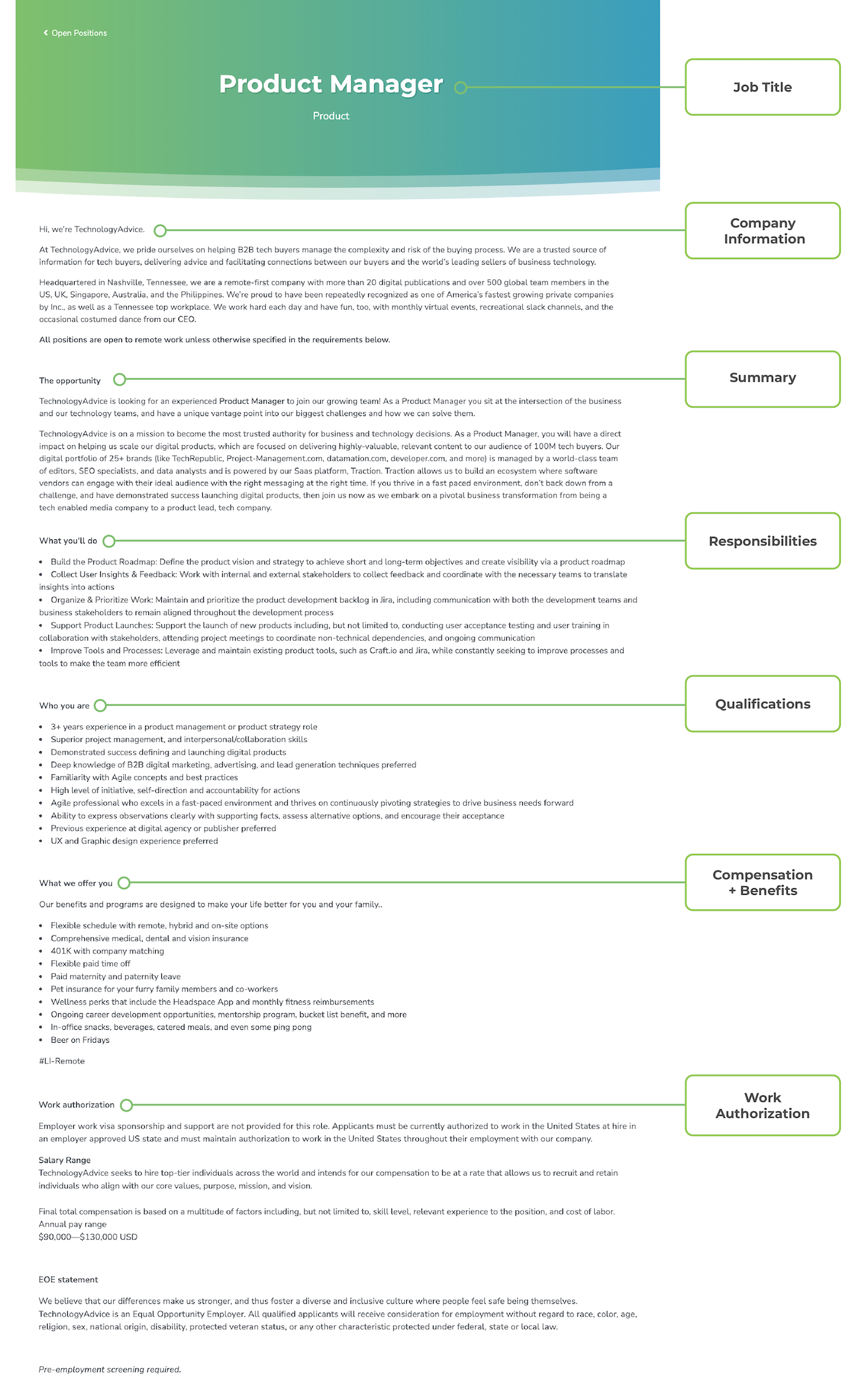
Sample job description
Putting the above example elements together, an effective job description will look something like this:
Best practices for job description format and style
Length
Various sources suggest a range of wordcount for job descriptions, but the sweet spot is around 700 words. The description shouldn’t be too short, or it may appear vague. Short job descriptions might not show up in a job seeker’s searches for certain keywords.
Conversely, lengthy job descriptions might scare off a potential candidate or give the impression that the company is disorganized.
Formatting
Nobody wants to read large blocks of text. Text-heavy job descriptions that don’t make good use of paragraph spacing and bullet point lists may pose an accessibility issue for vision-impaired candidates. Separating certain sections like core job duties and qualifications into bulleted lists to make them stand out more easily to job seekers and facilitate overall readability.
Language
- Elevate the action words: Describe how the ideal candidate will perform one of the key job duties. For example, expand the phrase “partner with a team of on-staff writers, freelancers, and SEO,” to include the purpose of that partnership: “…to ensure your content topic is covered appropriately on our sites.”
- Avoid jargon: The job description should be easy for candidates to understand. If special terminology is necessary, reserve it for the qualifications section.
- Avoid idioms, humor, and metaphors: These stylistic devices can confuse or, worse, turn away non-native speakers of the language as well as neurodivergent job seekers.
- Neutralize the language: Per the Equal Employment Opportunity Commission (EEOC), companies cannot solicit information about a candidate’s age, gender, religion, marital status, and other protected statuses in the hiring process. However, an employer can take further steps to neutralize subtle bias that creeps into the job description language. To arrive at more gender parity in the applicant pool, for instance, use gender neutral nouns and pronouns.
Planning to post your job vacancy on job boards? Check out our guide on how to create a job post on LinkedIn.
Why is it important to have a well-structured job description?
A job description is often the first impression job candidates receive from a company. What kind of impression is your job description giving job seekers? Candidates should be able to get a clear vision of what the role is, whether they might be a good fit, and what the company is like.
A good job description includes a clear job title, a summary of core job responsibilities, minimum qualifications, and company information. A great job description features a salary range, benefits, and a description of the company culture. And it’ll be approximately 700 words, separated into shorter paragraphs and bullet point lists to aid readability, and include neutral language that’s free of jargon.
Crafting a well-structured job description avoids wasting the company and candidates’ time and cuts through the noise of a competitive job market.
FAQs on writing job descriptions
A strong job description includes a clear job title, a concise role summary, essential responsibilities, minimum qualifications, and transparent details like salary range and work location. Adding benefits and a brief company overview also helps candidates assess culture and fit.
The ideal job description is around 600–750 words, long enough to provide clarity but not so long that it overwhelms candidates. Using short paragraphs and bullet points improves readability and makes key details easier to scan.
Review job descriptions at least once per year or whenever the role changes. Regular updates ensure accuracy and prevent misleading candidates about outdated duties or expectations.
The job summary provides a high-level overview of the role’s purpose, reporting structure, and organizational impact. Responsibilities describe the specific tasks and expectations the employee will handle
Featured partnersFeatured ATS partners