

Key takeaways
- Both Shopify and ClickFunnels are cost-efficient options and are excellent platforms for a secure shopping experience.
- Shopify is the go-to platform for building and scaling comprehensive online stores, featuring robust inventory management and multi-channel selling capabilities.
- ClickFunnels excels at creating high-converting sales funnels, making it ideal for marketers and creators focused on lead generation and conversions.
To help you decide which option is better for your business, I evaluated ClickFunnels and Shopify against key categories: pricing, campaign and creation management, audience and analysis, integrations, support and user experience, and security and reliability.
ClickFunnels and Shopify are both leading online business platforms, but they serve different purposes. Each has its strengths and weaknesses, making it better suited to other use cases. Here’s how these business tools compare.
 |  | |
Best for | Creating high-converting sales funnels | Building and scaling online stores |
Starting price | $81 per month, billed annually | $19 per month, |
Store builder | Basic, funnel-focused | Intuitive, global, POS-ready |
Funnel builder | Advanced, A/B testing, upsells | Limited |
Payment processing | Native, integrates with Helcim | Native, POS, Helcim integration |
For more information |
- ClickFunnels vs Shopify overview
- Pricing: ClickFunnels vs Shopify
- Best for campaign creation and management: ClickFunnels
- Best for campaign creation and management: ClickFunnels
- Best for audience and analytics: Shopify
- Best for integrations and extensibility: ClickFunnels
- Best alternatives to ClickFunnels and Shopify
- Review methodology: How I evaluated ClickFunnels and Shopify
- Frequently asked questions
- Bottom line: ClickFunnels vs Shopify
ClickFunnels vs Shopify overview

ClickFunnels: Best for creating high-converting sales funnels
Pros
- Best-in-class funnel and conversion tools
- Simple, intuitive webpage and landing page builders
- Built-in email and SMS automation
Cons
- Not ideal for large product catalogs
- Higher starting price for basic features
- Back end functionality can have a steep learning curve
ClickFunnels is a marketing software solution that helps businesses convert site visitors into leads and customers. If your main goal is to generate leads, sell products, or automate your marketing workflow, this platform is built for you. Create high-converting funnels with its visual drag-and-drop interface, landing page editor, email marketing, A/B testing, and more.
For coaches, course creators, or anyone interested in selling products and services online, ClickFunnels will make it easier for you to guide your audience from the first click to the final purchase. ClickFunnels has also recently introduced its own native CRM solution within the software, allowing businesses to target new customers and support them through the entire sales journey.
Read more: Leadpages vs ClickFunnels: Which Is Best for You?
Shopify: Best for building and scaling online stores
Pros
- Easy store setup and inventory management
- Multi-channel selling and POS support
- Wide range of app integrations
Cons
- Marketing automation often requires extra apps
- Subscription and transaction fees can add up
- Limited content management features
Shopify is a commerce platform that helps you sell online and in person. Think of it as an all-in-one e-commerce sidekick, whether you’re an entrepreneur, retailer, or part of a global brand that needs to process sales, run stores, and grow your business. Shopify’s tools and products work together as a unified system to help you sell to customers everywhere.
Whether you’re just starting out or scaling your business, Shopify makes building an online store straightforward. The platform is packed with tools, including its intuitive drag-and-drop builder, built-in payment options, real-time inventory tracking, and POS for selling in person.
Pricing: ClickFunnels vs Shopify
When it comes to pricing, ClickFunnels and Shopify take different approaches, so it’s important to select the plan that aligns with your business needs and growth stage.
ClickFunnels pricing
- Launch: $81 per month, billed annually; $97 per month
- Includes one workspace for two team members
- 10,000 contacts
- 50,000 emails per month
- Group onboarding calls
- Unlimited visitors
- Generate up to one million words with AI tools
- Scale: $164 per month, billed annually; $197 per month
- Unlimited funnels
- Includes five workspaces for five team members
- 75,000 contacts
- 300,000 emails per month
- Unlimited custom domains
- Generate up to two million words with AI tools
- Optimize: $248 per month, billed annually; $297 per month
- Includes 10 workspaces for five 10 members
- 150,000 contacts
- 750,000 emails per month
- Generate up to five million words with AI tools
- Up to 10 courses
- Dominate: $5,997 billed annually
- Includes 20 workspaces for 20 team members
- 400,000 contacts
- 1.2 million emails per month
- Up to 20 courses
- Generate up to 10 million words with AI tools
- VIP support
- Three-hour private onboarding
Shopify pricing
- Basic: $19 per month, billed annually; $25 per month
- Full-featured online store
- 10 inventory locations
- 24/7 chat support
- In-person selling by phone or a POS device
- Unlimited web hosting
- Grow: $49 per month, billed annually; $65 per month
- Everything in Basic
- Five additional staff accounts
- Full data access for custom apps
- Advanced: $299 per month, billed annually; $399 per month
- Everything in Grow
- Local storefronts by market
- 15 additional staff accounts
- Duties and import taxes
- Plus: $2,300 per month, billed annually on a three-year term
- Everything in Advanced
- 200 inventory locations
- Unlimited staff accounts
- Fully customizable, high-volume checkout
- Up to 200 POS Pro locations
- Priority 24/7 phone support
Shopify also offers pricing plans for businesses with different needs and budgets:
- Starter: $5 per month; $1 per month for the first three months
- Sell instantly through social media, messaging apps, or a simple online store
- Retail: $89 per month; $1 per month for the first three months
- In-person selling tools with advanced staff, inventory, and loyalty features
Best for campaign creation and management: ClickFunnels
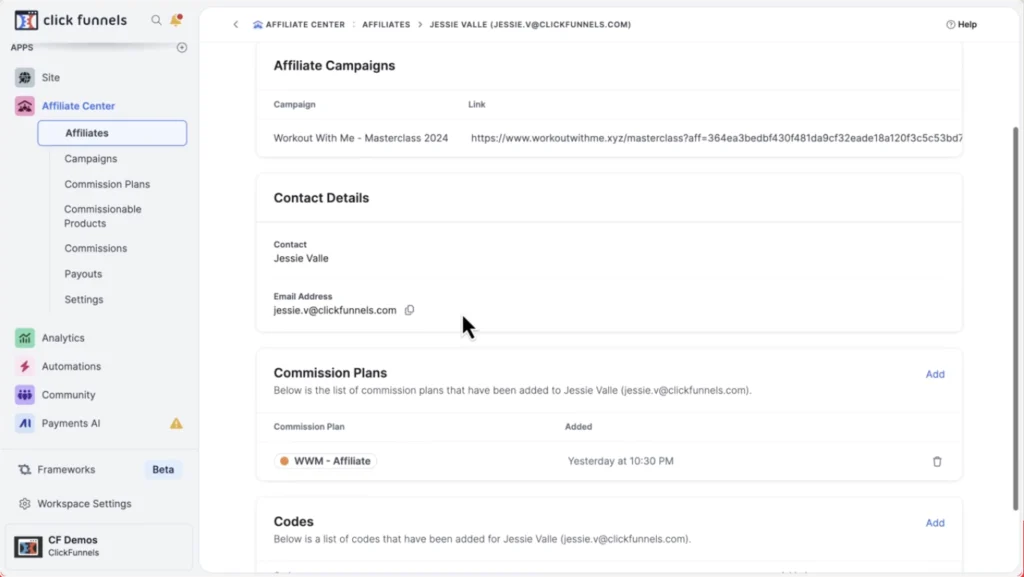
Verdict: ClickFunnels wins this category because it offers an all-in-one approach to simplifying campaign creation and management, helping you convert leads more efficiently without relying on third-party apps.
If you’re a solo creator or a small agency, ClickFunnels is a great tool to spend less time switching between apps to connect with your audience and focus on using ready-made funnels that convert. You can access everything you need to market, sell, and deliver your products or services online, even without an in-house tech team.
The platform offers a robust set of features, including pre-built funnel templates for sales, lead capture, webinars, and more. You can simply choose a funnel type, customize the template, and publish it. After launching your campaign, you can easily manage it by tracking your performance or automating email sequences to follow up with your leads or customers.
Best for campaign creation and management: ClickFunnels
Verdict: ClickFunnels wins this category because it offers an all-in-one approach to simplifying campaign creation and management, helping you convert leads more efficiently without relying on third-party apps.
If you’re a solo creator or a small agency, ClickFunnels is a great tool to spend less time switching between apps to connect with your audience and focus on using ready-made funnels that convert. You can access everything you need to market, sell, and deliver your products or services online, even without an in-house tech team.
The platform offers a robust set of features, including pre-built funnel templates for sales, lead capture, webinars, and more. You can simply choose a funnel type, customize the template, and publish it. After launching your campaign, you can easily manage it by tracking your performance or automating email sequences to follow up with your leads or customers
Shopify, on the other hand, focuses more on store-centric marketing. It provides solid tools for running promotions, abandoned cart recovery, and social media ad integrations, but the most advanced funnel and automation features require third-party apps. While Shopify’s tools are valuable for driving traffic and sales to your online stores, the platform doesn’t offer the same level of funnel customization or built-in marketing automation that ClickFunnels provides.
Best for audience and analytics: Shopify
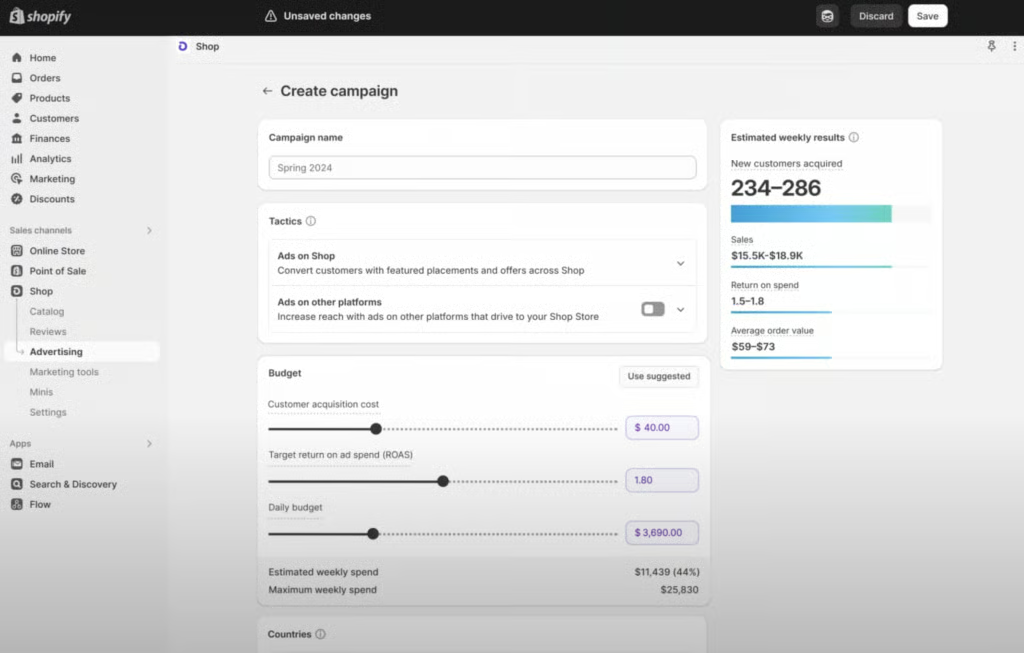
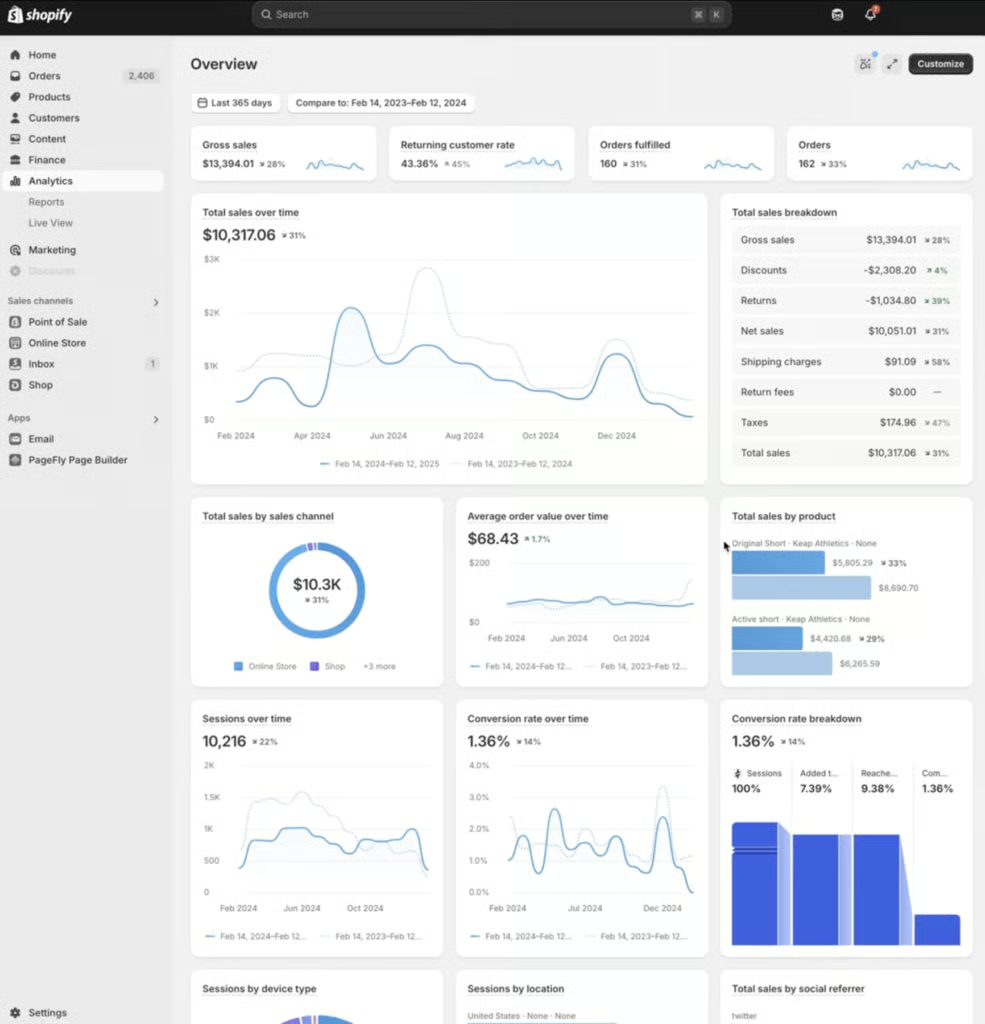
Verdict: Shopify wins this category because of its comprehensive analytics features that cover both marketing and product performance, giving you a holistic view of your business health.
Shopify shines in audience insights and analytics by offering detailed, customizable reports that give you a comprehensive view of sales, customer behavior, inventory, and marketing ROI. Tools like Shopify Audiences can help you find new customers by generating custom audiences for advertising platforms. Audiences are automatically exported to your digital advertising account, where you can use the data to launch ad campaigns that target that audience.
Shopify also integrates smoothly with Google Analytics and other third-party apps, allowing you to see how your store performs across multiple channels so you can optimize product offerings, marketing spend, customer retention strategies, and more.
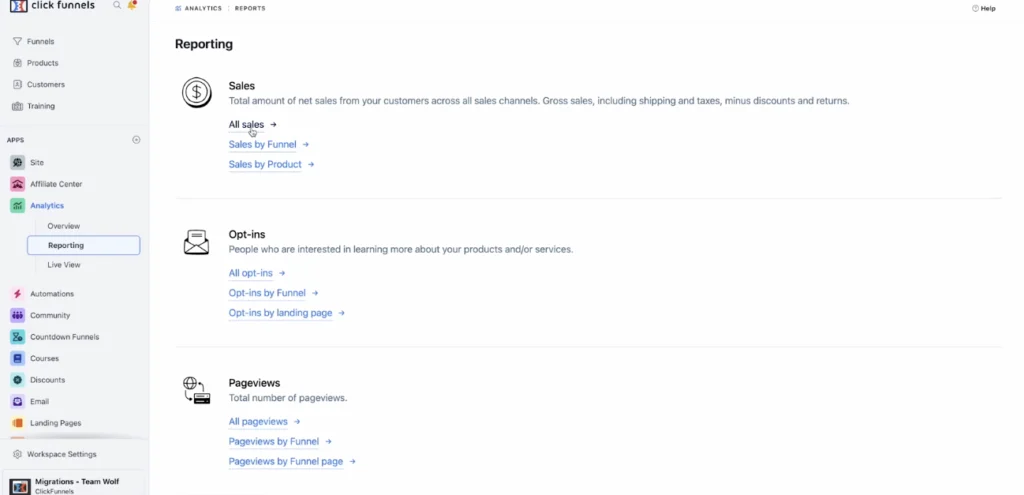
ClickFunnels provides tools for audience engagement and analytics, allowing you to track key performance indicators (KPIs) so you can optimize your sales funnels. It offers real-time funnel analytics focused on conversion rates, lead tracking, and split-testing results. This way, you can use the data to measure the effectiveness of your marketing funnels and sales processes. However, the platform doesn’t extend deeply into advanced product-level or inventory analytics.
While the platform is less suited for broad e-commerce insights, it’s still an excellent tool for tracking your campaign performance in real time.
Best for integrations and extensibility: ClickFunnels
Verdict: While Shopify offers a wide range of third-party apps for customization, ClickFunnels wins the integrations and extensibility category. If your priority is marketing automation, funnel efficiency, and CRM integration, ClickFunnels is a better fit for your business.
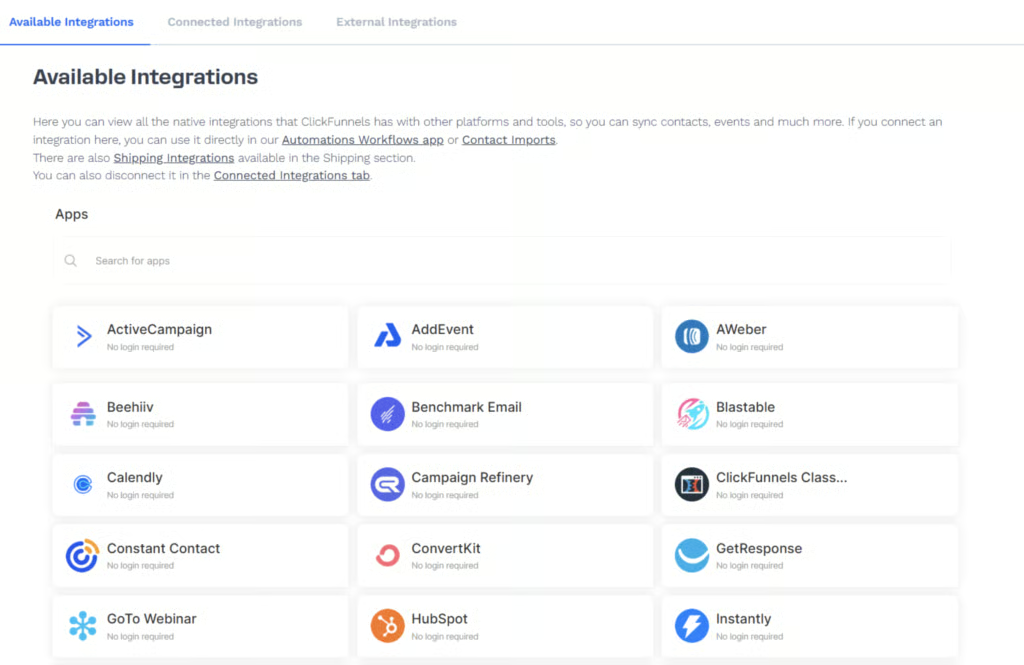
ClickFunnels is popular for its strong integration capabilities, making it an ideal choice for businesses looking to simplify their sales and marketing processes. It provides a growing ecosystem of third-party integrations focused on marketing automation and funnel optimization. The platform connects seamlessly with popular email marketing solutions, SMS providers, automation tools, and payment gateways like Stripe and PayPal. ClickFunnels also has a native CRM solution within its software, making it easier for you to integrate scheduling tools, events, and sales pipelines.
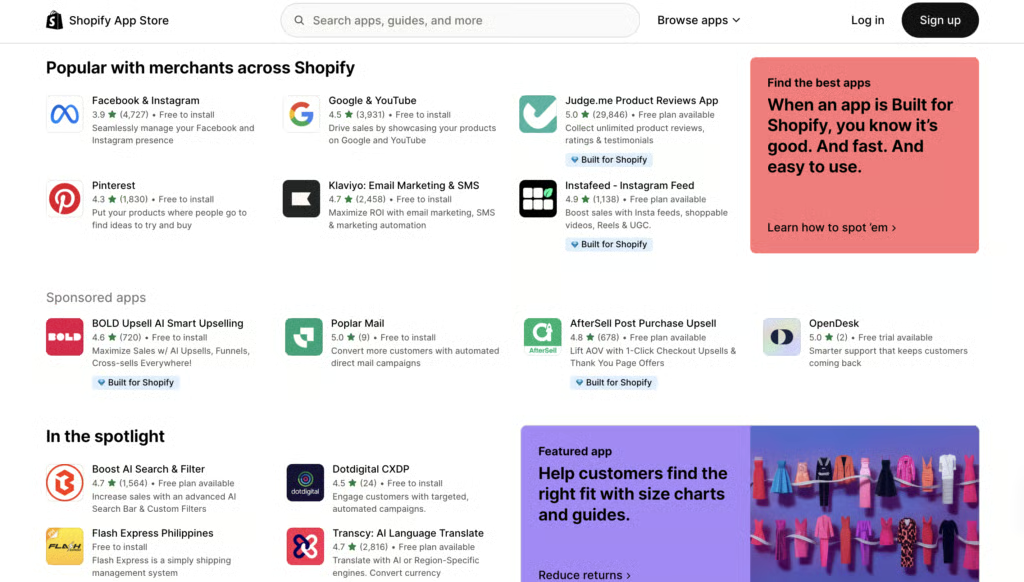
Shopify boasts a massive app marketplace with over 8,000 apps covering everything from marketing and shipping to accounting and customer service. This wide range of third-party app integrations makes the platform incredibly flexible for product-based businesses that need to customize their store and scale across multiple channels like Amazon, Instagram, Facebook, and physical retail with POS hardware. However, managing so many apps can sometimes be overwhelming, and integrating them seamlessly requires time and technical skills.
Best for security and reliability: Tie
Verdict: Both ClickFunnels and Shopify excel in this category because of their strong security measures and reliable performance suited to their respective use cases.
ClickFunnels is a SaaS platform, which means that the platform’s in-house team handles the security of your website. It uses SSL encryption and secure payment processing through trusted gateways like Stripe and PayPal. While its compliance certifications are not as extensive as Shopify’s, ClickFunnels provides reliable protection for funnel-based sales and marketing activities.
Shopify is a leader in e-commerce security, offering features like SSL certificates, two-factor authentication, fraud analysis, and advanced admin controls. The platform is also compliant with the PCI Security Standards Council, the General Data Protection Regulation (GDPR), the California Consumer Privacy Act (CCPA), and the Service Organization Control (SOC). Shopify’s global infrastructure ensures high uptime and fast load times, which are critical for maintaining customer trust and a seamless shopping experience.
Best alternatives to ClickFunnels and Shopify
While ClickFunnels and Shopify are leading platforms for sales funnels and e-commerce, there are other alternatives in the market that might better suit your needs.
WooCommerce

If you’re comfortable with WordPress and want full control over your store, WooCommerce is a flexible, open-source option with tons of plugins and themes. WooCommerce is a free, open-source e-commerce plugin that transforms your WordPress site into a fully-functional online store. However, because it’s self-hosted, you’ll manage hosting, security, and updates yourself. This requires a steeper learning curve but also offers greater flexibility and ownership.
BigCommerce

BigCommerce is a powerful e-commerce platform that provides a scalable solution for growing retailers. It combines ease of use and powerful built-in features for product management, multichannel selling, shipping options, and advanced analytics. Additionally, if you’re looking for a strong platform for B2B e-commerce, this platform can be a great option for you because of its native B2B functionality, buyer portals, account management, flexible payment options, and more.
Kajabi

Kajabi is an all-in-one platform that helps creators build and grow their online business by selling digital products and services. If you’re an entrepreneur focused on courses, coaching, and memberships, combining funnels, and content delivery, Kajabi is a great option for you. Kajabi’s native integration with tools like ActiveCampaign, Mailchimp, Stripe, and PayPal helps you simplify managing your sales funnels and marketing campaigns without the need to install extra plugins.
Review methodology: How I evaluated ClickFunnels and Shopify
I evaluated ClickFunnels and Shopify across six key areas: pricing, campaign creation and management, audience and analytics, integrations and extensibility, support and user experience, and security and reliability. These criteria reflect the needs of businesses looking for a robust sales funnel or e-commerce functionality.
- Pricing: I looked at each platform’s pricing structure, including the availability of a free plan, the length of the free trial, and the transparency of pricing tiers.
Winner: Tie
- Campaign creation and management: I tested both platforms’ tools for creating and managing email and sales campaigns, including the quality of the email editor, availability of templates, personalization options, A/B testing, automation workflows, and scheduling controls.
Winner: ClickFunnels
- Audience and analytics: I examined how each tool handles list building, segmentation, lead capture forms, and reporting. I also checked for compliance features (like GDPR), real-time analytics, and spam control tools.
Winner: Shopify
- Integrations and extensibility: I evaluated how well each platform integrates with CRMs, e-commerce systems, and third-party tools. I also reviewed API availability and developer support.
Winner: ClickFunnels
- Support and user experience: I assessed each platform’s user interface, onboarding experience, knowledge base, and the availability of live chat, email, or phone support.
Winner: ClickFunnels
- Security and reliability: I looked into each platform’s security framework, including data encryption practices, two-factor authentication, user role permissions, and backup systems.
Winner: Tie
Frequently asked questions
What is the difference between Shopify and ClickFunnels?
Shopify is an all-in-one e-commerce platform for building and managing online stores. Meanwhile, ClickFunnels is designed to create high-converting sales funnels and landing pages focused on lead generation and conversions.
Can you use ClickFunnels with Shopify?
Yes, you can integrate ClickFunnels with Shopify. With this integration, you can sell products Yes, you can integrate ClickFunnels with Shopify. With this integration, you can sell products through ClickFunnels while managing fulfillment and shipping directly through Shopify. Integrating these tools enables you to use ClickFunnels’ powerful sales funnel tool to enhance your e-commerce strategy while using Shopify’s reliable shipping and fulfillment process.
Can ClickFunnels replace your website?
ClickFunnels can replace some functions of a traditional website, but not all. The platform excels at building high-converting sales funnels, landing pages, and a basic website focused on lead generation and sales. However, ClickFunnels doesn’t fully replace the broader capabilities of a traditional website that most businesses use.
Bottom line: ClickFunnels vs Shopify
ClickFunnels and Shopify serve different use cases but complement each other. ClickFunnels is your go-to platform if your priority is building optimized sales funnels that drive lead generation and conversions through powerful funnel templates, upsells, and marketing automation. Shopify excels as a comprehensive e-commerce solution, offering robust store management, inventory control, multi-channel selling, and extensive app integrations, allowing you to build and scale your online store efficiently.
If you’re unsure which platform fits your business best, both ClickFunnels and Shopify offer free trials. Take advantage of these to explore their features firsthand, test what works for your goals, and make an informed decision that aligns with your growth strategy.