Key takeaways
- Blended learning formats, such as LMS modules, simulations, on-the-job training, and coaching—improve engagement and knowledge retention.
- Using gamification software is a simple but effective way to engage employees in training programs.
- Training programs should be structured but flexible enough to meet evolving organizational requirements and global workforce trends as they emerge.
- Nov. 25, 2025: Hanna Sillo updated page elements and structure for clarity and readability. She also added practical examples, an expanded matrix of effective learning resources, a new section on how to measure training effectiveness, and new stats to reflect current industry trends.
Creating an effective employee training program starts with clear goals, structured learning paths, and the right mix of tools, from LMS platforms to on-the-job training. Aside from closing skills gaps, a good program also improves retention, performance, and career mobility.
Despite the clear value of training, 60% of employees still report never receiving workplace training and say their skills are largely self-taught, according to ThinkImpact’s 2025 data. That gap is especially striking given that 94% of employees cite training and development as a key reason they would stay with their company, based on the same report.
Bridging this disconnect requires a structured approach to designing training that aligns with both organizational needs and employee expectations.
7 steps to create an effective employee training program
- Identify employee training goals
- Create a comprehensive training plan
- Invest in effective learning resources
- Design and share training paths with clear objectives
- Assess employee engagement and performance
- Seek out employee feedback
- Adjust training to meet emerging needs
1. Identify employee training goals
Before you can establish an effective employee training program, you must first identify the areas in which employees most need additional training.
From an organizational or departmental perspective, conducting needs assessments and skills gap analyses can help leaders identify important knowledge gaps in the organization and what training programs might address those gaps. For example, a customer support team might show low QA scores on product troubleshooting, signaling the need for a refresher module.
Individual employees should also be asked to share their personal training and career growth goals. Getting this input at an individual and departmental level will help leaders get a pulse on what matters most to their employees and may help them develop more tailored training plans that will hold employee interest. For instance, a marketing coordinator interested in analytics may request Google Analytics or SEO coursework to support their career path.
2. Create a comprehensive training plan
Now that you’ve set training goals with both leadership and employee input, it’s time to document those goals with a training plan. The training plan is a document that should, at a minimum, help your team prepare your training program in the following ways:
- Set measurable objectives and KPIs that align with greater company goals. For example, sales onboarding program might target a 20% faster ramp time by week eight.
- Determine learning tools and/or third-party resources that are needed to support employee training. This could include an LMS, compliance modules, or product-specific video tutorials.
- Delineate a reasonable training budget. A small team may budget for one annual workshop per employee, while a larger organization may fund certification paths.
- Identify who needs and is eligible for various training paths. For instance, only supervisors may be assigned to leadership tracks, while all new hires complete safety training.
- Define timelines for training completion. Compliance courses may require quarterly refreshers, while role-specific modules follow a 30–60–90-day schedule.
- Consider how training should be delivered to meet the needs of different individuals, departments, and initiatives. A remote team may need virtual simulations, while warehouse staff benefit more from hands-on, on-site demos.
Depending on how many different types of training courses and programs you intend to run, it may be helpful to create multiple training plans or a training plan database.
Consider your company’s maturity level
Organizations often mature through stages: moving from ad-hoc training, to structured LMS modules, to fully personalized learning paths. Knowing your current maturity level can help you create realistic timelines and expectations.
3. Invest in effective learning resources
While your team can certainly create its own learning resources, especially for training programs that are specific to your business, it’s often possible to reduce your workload with the help of third-party learning resources and programs.
Investing in learning management system (LMS) software, third-party experts and instructors, online training resources, certification programs, slide decks, informational books, and other digital and physical resources is a great way to build up your employee training program with minimal effort.
Here’s a breakdown of the most common programs and when to use them:
| Format | Best for | Pros | Cons |
|---|---|---|---|
| LMS modules | Scalable, self-paced learning | Consistent, trackable | Less hands-on |
| On-the-job training | Behavioral skills, manual tasks | Fast ramp-up | Quality varies by trainer |
| Workshops | Team skills, leadership | Collaborative | Harder to schedule |
| Simulations | Safety, compliance, customer service | High retention | Costly to produce |
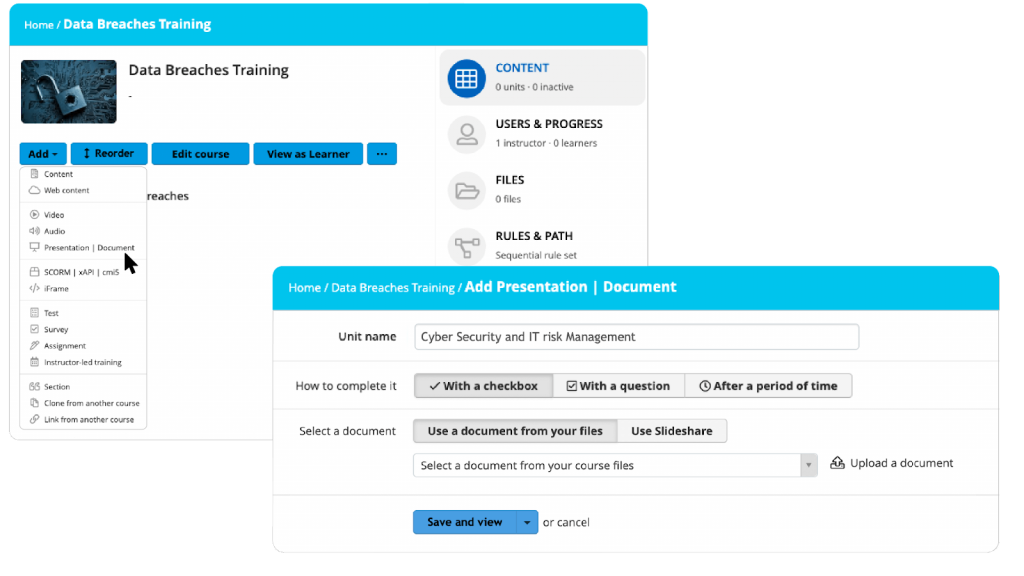
LMS software in particular can support organizations, whether they want to customize their training modules or use prebuilt training options. TalentLMS, for example, offers its own training courses and templates, but it also has a course editor that allows users to create content within the platform or upload pre-existing training resources so they can more easily track employee engagement.
4. Design and share training paths with clear objectives
Having a comprehensive training plan and useful learning resources may not be enough to engage your employees if they don’t clearly understand how this training will help their careers. To illustrate the importance of your training program and how it contributes to career growth opportunities, create training paths and visual roadmaps that align with different roles, departments, learning styles, and career trajectories.
Include clear objectives — preferably with SMART goals — and clearly state what skills employees should be able to demonstrate at each point in their training. Most importantly, make sure training paths are shared with all employees so they know what they need to do to achieve new career milestones.
Ultimately, always remember that not all employees learn the same way. Some employees process information best through hands-on activities, while others prefer visual modules or written guides. Offering multiple formats increases accessibility and learning retention.
5. Assess employee engagement and performance
Regardless of whether your training program is mandatory or optional, you’ll want to track employee engagement and performance so you can effectively improve and tailor the program over time.
For mandatory training programs, check for completion as well as accuracy on any quizzes or tests. For non-mandatory training programs, it will be most valuable to keep track of the number of employees participating — both those who start the program and those who complete the program.
In addition, consider incorporating live simulations and scenario-based exams to test how employees are able to apply their new knowledge to real workplace situations.
For most training programs, LMS software is the best way to stay on top of performance monitoring. These tools provide features like administrative dashboards and reports, real-time notifications, and automated course assignments, which help leaders more clearly identify training opportunities and employees who may need additional support.
6. Seek out employee feedback
During and after any kind of training course, employees should be encouraged to share their feedback on the program. You can collect this feedback through formal employee surveys, or it can be more informally gathered through 1:1 meetings with employees’ managers and mentors.
For more qualitative feedback, ask employees how they feel about their current training and if they have other training paths they’d be interested in completing. For a slightly more quantitative and contextualized approach, use the data you gathered in step five to frame the questions you ask employees.
If your data indicates that an individual started but never completed a leadership training seminar, for example, you can ask them if specific material in that course was irrelevant, dense, or otherwise unhelpful to their career goals.
7. Adjust training to meet emerging needs
Creating an employee training program is not a set-it-and-forget-it process. Your training program should evolve to meet the needs of your organization and individual employees — as well as global workforce demands — as they change over time. Plus, skills decay quickly without reinforcement. Micro-lessons, job aids, and periodic refreshers help employees apply new skills consistently.
Although there are many reasons why your organization may want or need to update its training programs, these examples illustrate some of the most common shifts that require training program adjustments:
- Responsive shift: Your content production team enjoyed the writing courses and seminars that were previously assigned to them and are now interested in receiving training on editing and SEO best practices.
- KPI-driven shift: Several employees started a regulatory compliance training module but never completed it, causing your organization to miss quarterly course completion goals. The program administrator has decided to assign a different but similar program that supports self-paced learning and more granular performance tracking.
- Cultural shift: Your organization has grown from a regional to a global business and needs to complete cultural sensitivity and other DEI training to create a more welcoming and inclusive work environment.
- Tooling shift: Your organization has decided to implement CRM software and needs to train marketing and sales professionals on how to use the software effectively.
- Role shift: A member of your IT team is shifting from an individual contributor to a team manager role and is interested in receiving leadership training.
- Global workforce shift: Artificial intelligence (AI) is seeping into business operations worldwide; it is important to your organization’s leadership that all employees develop basic AI usage skills and AI ethics knowledge.
How to know if the training is effective
Use a mix of quantitative and qualitative metrics to understand whether your training is working at both the employee and organizational level. Here’s one way to do it:
- Step 1: Track quantitative metrics like completion rates, assessment scores, time-to-productivity, and performance review data to understand individual progress.
- Example: If new hires complete role-specific modules a week earlier than the previous quarter, it signals stronger learning retention.
- Step 2: Collect qualitative feedback to evaluate the learner experience. Use short pulse surveys, post-module check-ins, and manager 1:1s to gauge confidence levels, skill readiness, and areas where employees still feel unsure.
- Step 3: Monitor on-the-job behavior changes to see if new skills translate into everyday work. Managers can look for improved decision-making, fewer repeated errors, or more consistent application of new processes.
- Step 4: Connect training outcomes to business results to measure real impact and ROI. Look for downstream indicators such as:
- Fewer customer support escalations after troubleshooting courses
- Reduced safety incidents following compliance refreshers
- Higher sales conversion after product-training updates
- Better audit performance after security or regulatory training
- Step 5: Use these insights to refine the program by expanding high-impact modules, redesigning low-performing ones, or adding supplemental coaching where needed.
Additional employee training program best practices
The steps listed above will get your training program up and running, but they may not be enough to help you hold employees’ interests and manage training at scale. For the best possible results when implementing an employee training program, be sure to incorporate the following best practices:
Learning management system software provides the building blocks most organizations need to get started with a training program. LMS features include prebuilt courses and training templates, automated workflows, performance monitoring dashboards, and other features that can increase the efficiency of training program development and management.
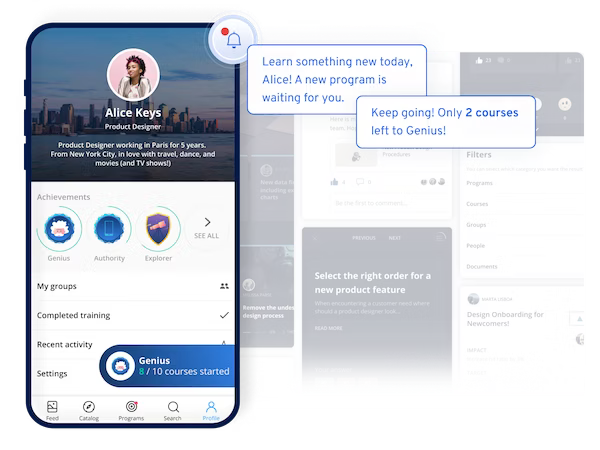
Game-based learning can be achieved with gamification software or with special features and customizable workflows in an LMS platform. Gamifying the learning experience with badges, contests, and other rewards may be what your employees need to get excited about training program content.
To encourage as many different types of learners as possible, make sure your training program offers a variety of training formats and topics. Having a mix of self-paced and more structured learning courses, role-based and skill-based training, text-based and multimedia training, and online and in-person training opportunities will help you reach employees across departments, geographies, and interests.
While broader organizational and cultural training may be necessary, it’s a good idea to also create individual training paths and opportunities that align with your employees’ goals and interests. They’re more likely to complete training programs and develop skills that are useful to their particular role if you offer specialized training options.
Getting buy-in and support from different business leaders will help you communicate the value of the training program to all employees. From the top down, be sure to explain why employee training is important and work hard to create a culture where learning and curiosity are valued and rewarded.
Training program FAQs
Featured partnersFeatured LMS partners