

If you are trying to understand AEO vs GEO, the first thing to know is that the difference is not as clear-cut as the acronyms make it sound. Answer engine optimization (AEO) and generative engine optimization (GEO) are both strategies that help brands appear in AI-driven search experiences.
Some marketers use AEO for direct answers and GEO for citations inside generative AI responses. Others use AEO as the broader term covering both. HubSpot, for example, uses AEO for all work aimed at improving visibility across answer engines such as ChatGPT, Gemini, and Perplexity, while acknowledging that GEO is another name used for the same emerging discipline.
For your business, the terminology matters less than the outcome. You need content and brand signals that AI systems can understand, trust, cite, and recommend when buyers ask questions related to what you sell.
Key takeaways
- AEO and GEO overlap heavily. There is no universal industry definition separating the two.
- AEO commonly focuses on direct answers, while GEO is often associated with generative responses that combine information from multiple sources.
- Both depend on many of the same signals, including clear content, consistent entities, original information, authority, and third-party validation.
- Most businesses do not need separate AEO and GEO strategies. One AI visibility strategy can cover both.
- Measurement matters more than the acronym. Track mentions, prompts, citations, competitor visibility, and AI-driven conversions.
What are AEO and GEO?
AEO and GEO are two terms marketers use to describe how brands can improve their visibility as search moves beyond traditional lists of links.
The industry has not settled on one universal way to define them. Some marketers separate the two while others use AEO as an umbrella term that includes GEO practices.
What is AEO?
Answer engine optimization (AEO) is the practice of improving how easily answer engines can understand and surface your brand or content when responding to a user’s question.
Under a narrower definition, AEO focuses on clear, extractable answers, including definitions, product information, comparisons, and other content that directly addresses a query.
HubSpot’s definition covers AEO more broadly. It says it helps improve brand visibility across AI answer platforms such as ChatGPT, Gemini, and Perplexity, including mentions, citations, prompts, and competitor visibility.
What is GEO?
Generative engine optimization (GEO) generally refers to improving the likelihood that generative AI systems use, synthesize, or cite your information when creating a response.
Instead of simply extracting one answer, generative engines may combine information from several sources to answer questions such as:
- What is the best CRM for a midsized sales team?
- Which accounting platform works best for multiple locations?
- What are the best alternatives to a specific software product?
- How do two vendors compare for a particular business need?
Adobe describes a similar distinction, separating direct-answer optimization from optimization aimed at generative systems that synthesize information from multiple sources.
Why are AEO and GEO defined differently?
Because AI search terminology is still being established.
Some experts use AEO for direct search result answers and GEO for AI chatbot citations, while HubSpot itself uses AEO for the broader category. There are also marketers advocating for AEO, GEO, AI SEO, and other labels for closely related work.
For this guide, I will use the common distinction of AEO for making information easy to surface as an answer and GEO for helping generative systems synthesize and cite it. Keep in mind that these are working definitions, not industry standards.
AEO vs GEO at a glance
The differences below are useful for understanding individual tactics, but they should not lead you to build two isolated marketing programs.
| Factor | AEO | GEO |
|---|---|---|
| Full name | Answer engine optimization | Generative engine optimization |
| Common focus | Direct answers and AI visibility | Generative responses and citations |
| Typical output | Brand or information surfaced in an answer | Brand or content referenced within a synthesized response |
| Content emphasis | Clear, direct, extractable information | Context, evidence, authority, and source-worthiness |
| Typical signals | Entity clarity, relevance, structured answers | Citations, corroboration, original information, third-party authority |
| Core metrics | Prompt visibility, mentions, citations | Citations, share of voice, source inclusion |
| Relationship to SEO | Builds on SEO fundamentals | Builds on SEO fundamentals |
| Industry definition | Not standardized | Not standardized |
| Best business approach | Use as part of one AI visibility strategy | Use as part of one AI visibility strategy |
AEO vs GEO: Where they differ
The easiest way to understand AEO vs GEO is to look at what each approach emphasizes. These are not competing disciplines. Think of them as different parts of improving your visibility across AI search.
- Direct answers vs AI generative responses
- Clear answers vs supporting evidence and context
- Your website vs third-party sources
- Measurement
Direct answers vs AI generative responses
AEO usually focuses more on making a clear answer easy to find and understand. If a buyer wants to know what your product does, how much it costs, or whether it supports a certain feature, your content should answer that question directly.
GEO tends to focus more on how your information contributes to a broader AI generative response. For example, an AI tool answering “What are the best accounting platforms for a growing retailer?” may pull from product pages, reviews, comparison articles, publisher coverage, and other sources before forming its response.
A useful way to think about the difference is this: AEO helps your information become part of the answer, while GEO focuses more on helping your brand or content become part of a broader AI-generated response.
Clear answers vs supporting evidence and context
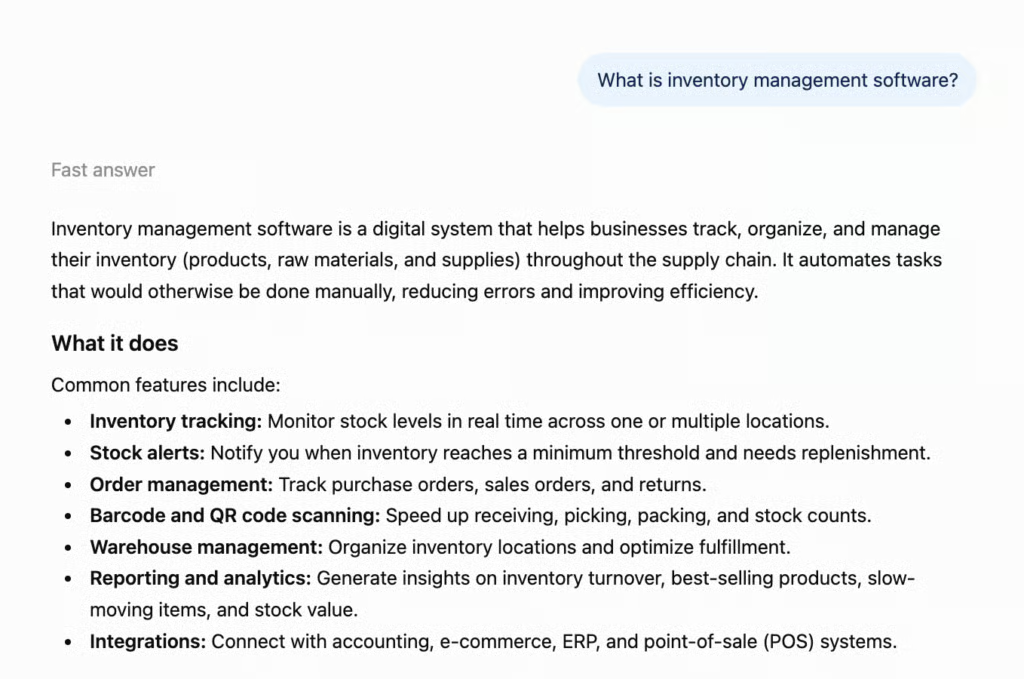
AEO puts more emphasis on making a direct answer easy for an AI system to identify and surface. For example, ask ChatGPT, “What is inventory management software?” and it can respond with a definition immediately. For businesses, AEO means structuring useful information clearly enough that an answer engine can understand it and potentially use it when answering that type of question.
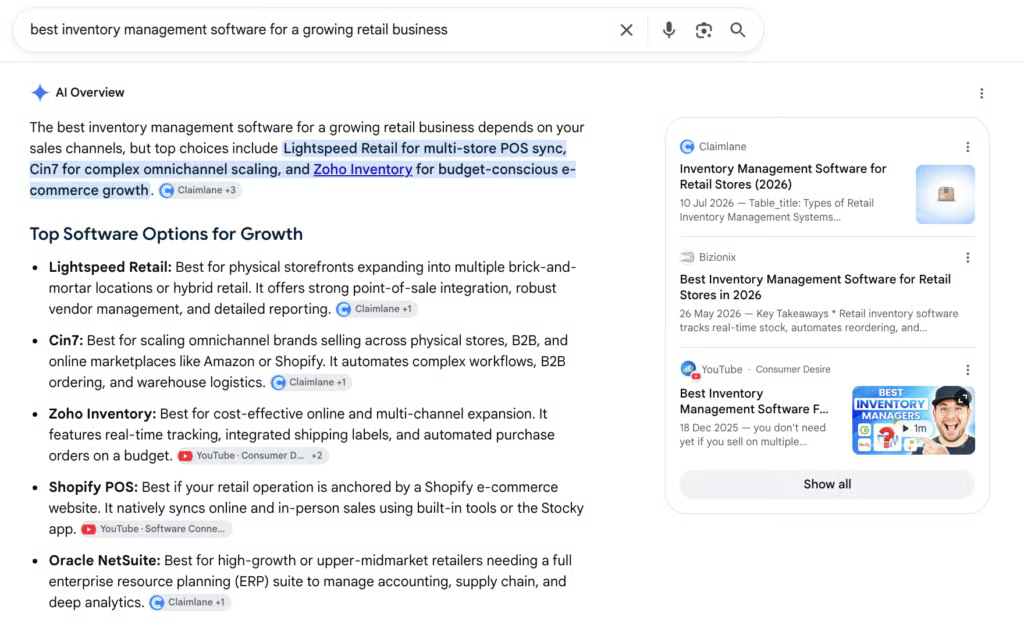
GEO focuses more on providing information that can contribute to a broader AI-generated response. For example, Google’s AI Overview for “best inventory management software for a growing retail business” compares several products and shows supporting sources alongside its recommendations. GEO aims to increase the chances that your content, data, expertise, or brand information contributes to responses like this.
The easiest way to remember the distinction is: AEO helps make your information answer-ready, while GEO helps make it source-worthy for broader AI-generated responses.
Your website vs third-party sources
Both AEO and GEO depend on useful information on your website, but AI systems can also rely on what other sources say about your business.
Your own product pages, guides, and documentation give AI systems information directly from your business. Third-party sources such as reviews, publisher articles, forums, Reddit discussions, social posts, and customer content can confirm those claims or provide another perspective.
This matters more with GEO-style optimization because broader AI-generated responses may draw from several sources at once. Think back to the Google AI Overview example: Google did not rely on one company’s website to recommend inventory management software. It brought together information from multiple sources to create the recommendation and showed those sources alongside the answer.
This is also where the line between AEO and GEO starts to blur. Whether you call it AEO or GEO, AI visibility depends on both what you say about your business and what credible sources across the web say about you. HubSpot AEO reflects this overlap by analyzing citations from owned websites as well as earned media, user-generated content, social platforms, affiliate sites, and other external sources.
Measurement
The difference between AEO and GEO gets even smaller once you start measuring performance.
Whether you call the work AEO or GEO, you will likely want to know:
| Metric | What it tells you |
|---|---|
| AI visibility | How often your brand appears in AI answers |
| Prompt presence | Which buyer questions include your brand |
| Brand mentions | How frequently answer engines mention you |
| Citations | Which sources AI systems reference |
| Competitor visibility | Who appears when your brand does not |
| Share of voice | Your visibility relative to competitors |
| AI referral traffic | How many visits come from answer engines |
| Influenced conversions | Whether AI-assisted discovery contributes to leads or sales |
Where AEO and GEO overlap
The differences between AEO and GEO are mostly about how AI uses your information. The work required to improve your chances of appearing in those answers is much more similar.
Both need clear answers
Whether an AI system is giving a quick answer or building a longer response, it first needs to understand what your content is saying. Clear answers, descriptive headings, and straightforward explanations help with both AEO and GEO.
Both need accurate, consistent information
AI systems may encounter information about your business across several sources. Keeping your product names, features, pricing, and company details consistent makes it easier to understand what is accurate and associate it with your brand.
Both benefit from original information
Original research, first-party data, customer examples, product insights, and expert commentary give AI systems useful information to work with. This can help your content stand out from pages repeating the same basic information.
Both depend on credibility beyond your website
AI systems can use reviews, publisher articles, customer discussions, industry sites, and other third-party sources alongside your own content. These sources can support what your company says about itself and strengthen your presence in AI-generated responses.
Both build on SEO fundamentals
AEO and GEO still depend on content that search systems can access and understand. Crawlability, site structure, internal links, and other SEO basics continue to support AI visibility.
Why the AEO vs GEO distinction matters for AI search
If AEO and GEO overlap so much, why does the difference matter? Because it helps you think about both ways your business can gain visibility in AI search: by providing a clear answer and by becoming a trusted source for broader AI-generated responses.
That means success is no longer just about rankings and clicks. You also need to know whether AI tools mention your brand, cite your content, recommend competitors instead, and describe your products accurately.
For most small businesses, this does not mean running separate AEO and GEO programs. The tactics overlap enough that it makes more sense to manage them as one AI visibility strategy.
When AEO or GEO matters more
You will often optimize for both at the same time, but the buyer’s question can help you understand which type of visibility matters more.
| If the buyer asks… | Focus more on… | Why |
|---|---|---|
| “What is X?” | AEO | The buyer needs a direct answer |
| “How much does X cost?” | AEO | Clear, accurate information matters most |
| “Does X have this feature?” | AEO | The question has a specific answer |
| “What’s the best X for my business?” | GEO | AI may compare several options and sources |
| “What are the best alternatives to X?” | GEO | AI may build a recommendation from multiple sources |
| “Which is better, X or Y?” | Both | The response needs direct facts and broader comparison |
| “Which vendors should I consider?” | Both | Your brand needs to be understood, supported, and included |
How to optimize for AEO and GEO together
Once you treat AEO and GEO as parts of the same AI visibility strategy, the work becomes much simpler. You can focus on improving the information and signals that support both.
1. Start with the questions your buyers actually ask
Identify prompts connected to real purchase decisions, such as “best X for Y,” “X vs Y,” “alternatives to X,” pricing questions, and product comparisons. Prioritize the questions most likely to influence whether your business makes a buyer’s shortlist.
2. Make the direct answer easy to find
Answer the main question early instead of burying it several paragraphs into the page. Clear headings, straightforward explanations, and accurate product information make your content easier for both readers and AI systems to understand.
3. Give AI something worth citing
Go beyond information that readers could find on dozens of competing websites. Add original data, expert insight, customer examples, product details, comparisons, or other evidence that makes your page useful as a source.
4. Keep your business information consistent
Check that important facts such as your company name, products, pricing, features, and positioning are consistent across your website and other places your business appears. Conflicting information can make it harder for AI systems to determine which information is accurate.
5. Build credibility outside your website
Your own content is only part of the picture. Reviews, publisher coverage, customer discussions, industry mentions, and other third-party sources can reinforce what your business says about itself.
6. Track where you appear and where you don’t
Monitor the buyer prompts that matter to your business and check whether your brand is mentioned or cited. Also look at which competitors appear instead and which sources AI tools rely on.
7. Fix the gaps that could affect a purchase
You do not need to chase every missing AI mention. Start with gaps around product comparisons, recommendations, alternatives, and other high-intent questions that could determine whether your business makes the buyer’s shortlist.
Make it easier to do both with HubSpot
HubSpot AEO gives you one place to track the signals that matter for both AEO and GEO, including brand mentions, prompt visibility, citations, and competitor share of voice across ChatGPT, Gemini, and Perplexity. You can start with a free trial that tracks 25 prompts, then move to the standalone $50/month plan if ongoing AI visibility monitoring makes sense for your business.
Should your business focus on AEO, GEO, or both?
The right mix depends on how your customers research and choose businesses like yours. Here’s where I would put the emphasis based on business type.
| Business type | What to use | Why |
|---|---|---|
| Local small business | Mostly AEO | Customers often ask direct questions about services, pricing, locations, and availability. |
| Ecommerce business | AEO + GEO | You need clear product information as well as visibility in AI comparisons and recommendations. |
| Professional services | AEO + GEO | Direct answers establish expertise, while supporting evidence and third-party authority help with broader recommendations. |
| B2B SaaS | AEO + GEO | Buyers ask feature questions but also use AI to compare vendors, alternatives, and use cases. |
| Publisher | Mostly GEO | Original reporting, expert sourcing, and research can make your content useful as a cited source. |
| Midsized business | AEO + GEO | Larger product lines and buyer journeys create opportunities for both direct answers and broader AI recommendations. |
Most businesses will need some combination of both, but thinking about how your customers use AI can tell you where to put more of your effort.
Frequently asked questions
Is AEO the same as GEO?
Not exactly. The terms overlap, but AEO usually refers to optimizing for answers, while GEO focuses more on visibility in broader AI-generated responses and citations.
What is the main difference between AEO and GEO?
AEO helps make your information answer-ready. GEO helps make your content source-worthy for broader AI-generated responses.
Why do marketers define AEO and GEO differently?
The terminology is still unsettled. Some marketers separate the two, while others use AEO as the broader term for AI search visibility.
Do I need separate AEO and GEO strategies?
Usually not. Most businesses can combine both under one AI visibility strategy.
Is AEO or GEO better for ChatGPT?
Neither is automatically better. What matters is whether ChatGPT can understand, mention, cite, and accurately represent your brand for relevant buyer prompts.
Does HubSpot AEO cover GEO?
Yes, in practice. HubSpot uses AEO as the broader term, and its product includes prompt tracking, citation analysis, competitor visibility, and share-of-voice monitoring.
How do I know if my business appears in AI search?
Track the buyer prompts that matter to your business and monitor mentions, citations, competitor presence, and share of voice. HubSpot AEO tracks these signals across major answer engines.