


AI brand visibility is whether your brand appears when someone asks ChatGPT, Gemini, or Perplexity about your category. If you are not mentioned, you are excluded before a user ever reaches your website. Tools like HubSpot AEO track exactly where you appear, where competitors are cited instead, and what to do about it.
That shift is happening because AI answer engines now synthesize information and deliver direct responses — no click required. Visibility is no longer about rankings alone. It is about whether your brand is mentioned, recommended, or cited inside AI-generated responses, and that is where buying decisions are increasingly being made.
Key takeaways
- AI visibility determines whether your brand appears in answers, not just search results
- Tracking requires monitoring prompts, platforms, and competitor mentions over time
- Metrics like presence rate, share of voice, and citation frequency show where you stand
- Tools like HubSpot AEO centralize visibility data and help turn insights into action
- What does AI brand visibility mean?
- Why should I track AI brand visibility?
- How do I track AI brand visibility?
- Where do I check for AI brand visibility?
- What are the best AI search visibility tools?
- Which prompts and brand signals to monitor?
- How to improve visibility in Google AI Overviews and AI search
- Frequently asked questions (FAQs)
What does AI brand visibility mean?
AI visibility is how often and how accurately your brand is mentioned, cited, or recommended in AI-generated answers across tools like ChatGPT, Google AI Overviews, Perplexity, and Gemini.
In simple terms, AI brand visibility is whether your brand shows up when someone asks AI about your category.
AI visibility is the modern version of share of voice. Instead of competing for clicks, you are competing to be part of the answer — and that is where decisions now happen.
Traditional search vs AI search: What’s different
The difference is simple: SEO ranks pages. AI visibility ranks brands inside answers.
| Before (traditional search) | Now (AI search) |
|---|---|
| A user searches on Google | A user asks a question in an AI tool |
| They see a list of links | The AI gives a direct answer |
| Your goal is to rank and get clicks | Your goal is to be mentioned, compared, or recommended |
A page can rank well in search but still not appear in AI responses if the system does not associate your brand with trusted signals. In practice, it comes down to four core signals:
- Mentions: How often your brand appears in AI responses (this is the strongest driver of visibility across AI systems)
- Citations: Whether AI references your content or trusted sources (mentions from trusted sites carry more weight)
- Recommendations: Whether your brand is suggested as a top option
- Sentiment and positioning: How your brand is described affects recommendations
A Search Engine Land study shows that only 7.2% of domains are cited across both LLMs and Google AI Overviews, highlighting how selective AI systems are with sources. Think of these signals as the new “positions” of search, just not on a Google search results page. AI visibility is not just about being mentioned — it is about how you show up in AI answers.
Why this shift matters
The way buyers discover brands has fundamentally changed. AI-powered answer engines now synthesize information and present it as direct responses, often without requiring users to click through. A 2024 study revealed that 60% of Google searches end without a click because of AI overviews. Gartner even predicts 25% of organic search traffic will shift to AI assistants by 2026.
This means visibility has moved from rankings to responses. It is no longer enough to rank in Google search, you need to be included in the answers now, too.
How AI decides which brands to show
AI tools do not rank pages the same way search engines do. They surface brands based on patterns across the web.
For example, if someone asks: “What is the best furniture brand?” AI is likely to mention IKEA. Not because it paid to be there, but because years of reviews, articles, and discussions consistently associate IKEA with that category.
This is how AI works in practice: It reflects what the internet has already reinforced.
Why should I track AI brand visibility?
You should track AI visibility because AI platforms are becoming a primary way people discover brands, evaluate options, and make decisions. In fact, AI is no longer a secondary channel. ChatGPT alone has over 900 million weekly users, and AI chatbot usage globally ranges from 1 to 1.5 billion monthly users, making it a major discovery platform — growing at a faster rate than social media and taking up a large share like search engines when it comes to product discovery.
If your brand is not included in AI-generated answers, you are excluded from consideration before users ever visit your website.
AI is becoming a primary discovery channel
Discovery is moving upstream — from search results to AI-generated answers. AI-driven discovery is already changing how buyers find and evaluate products. A Pew Research study shows 55% of consumers now use AI chat as a primary or frequent research tool. Approximately 80% of users rely on AI summaries regularly, with 55% of Google searches showing AI Overviews, driving 58% of searches to end without a click and reducing organic traffic by 15% to 25%.
And it’s clearly an age thing, too — 71% of Gen Z consumers use chatbots for product discovery, often starting their journey on AI tools or social platforms instead of traditional search.
AI traffic is growing and converts at a higher rate
Traffic from AI platforms is increasing rapidly and tends to be more valuable. AI-referred sessions have grown significantly in recent months. Visitors from AI search convert 4.4x better than traditional organic traffic. This happens because users arrive after already researching options through AI, making them more likely to take action.
AI answers replace clicks and act as a pre-filter for decisions
AI-generated responses often eliminate the need to visit websites. Instead of clicking through multiple pages, users receive:
- Direct answers
- Brand recommendations
- Shortlists of options
AI is also preferred for more complex decisions. Users rely on it to compare options, evaluate features, and refine recommendations in real time. For example, narrowing a list based on budget, use case, or preferences. This makes AI a decision-making layer that shapes which brands make it into consideration.
How do I track AI brand visibility?
You track AI brand visibility by monitoring whether and how your brand appears in AI-generated answers across LLM platforms like ChatGPT, Google AI Overviews, and Perplexity. Generally, the process is simple: define what to track, test consistently, and measure results over time.
1. Identify strategic topics and prompts
Start by identifying the queries that influence buying decisions. Focus on prompts that reflect how ecommerce buyers discover and compare tools:
- Core product categories (“best ecommerce platforms for small businesses”)
- Use cases (“AI tools for ecommerce personalization” or “inventory management software for online stores”)
- Comparison queries (“Shopify vs BigCommerce” or “Shopify alternatives”)
Build a standardized prompt set using consistent phrasing like:
- “What are the leading ecommerce platforms?”
- “What is the best tool for managing an online store?”
- “Which ecommerce platform is best for small businesses?”
- “What are the top alternatives to Shopify?”
Consistency matters. Even small wording changes can affect AI responses, so using a fixed prompt set helps isolate real performance changes.
2. Track across priority AI platforms
AI visibility is fragmented across platforms, so you need to monitor multiple engines. Tracking across them gives a complete view of your AI visibility.
Start with:
- ChatGPT (general discovery)
- Gemini (Google ecosystem)
- Microsoft Copilot (enterprise users)
- Perplexity (research-driven queries)
3. Run repeat tests
AI outputs vary by design. A single result does not reflect true visibility. Instead, I recommend doing the following so you can identify patterns instead of reacting to random variation
- Run each prompt multiple times (3 to 5 samples)
- Test across platforms
- Repeat on a regular schedule (weekly or monthly)
4. Measure visibility and benchmark competitors
Once you collect responses, track key metrics:
- Presence (is your brand mentioned?)
- Share of voice vs competitors
- Citation frequency
- Sentiment and positioning
- Placement in the answer
This data shows where your brand is visible, where competitors dominate, and where gaps exist.
5. Centralize data and track trends over time
Tracking only works if data is organized and comparable. Log results in a structured format (spreadsheet, dashboard, or tool), including:
- Prompt
- Platform
- Brands mentioned
- Citations
- Sentiment
Over time, this allows you to:
- Identify trends
- Measure improvements
- Prioritize content and PR efforts
Platforms like HubSpot AEO simplify this by centralizing visibility data — tracking mentions, citations, sentiment, and share of voice across AI engines in one place.
Where do I check for AI brand visibility?
Brands should use multiple AI tools to research, compare, and evaluate options, and each one can return different results for the same query. You need to look beyond one platform — checking visibility in one place is not enough. A complete view requires monitoring across chat-based tools, search-integrated AI, and specialized assistants.
This is where an AI search visibility tool or broader AI search visibility management tools become useful. They help centralize what would otherwise be fragmented checks across platforms.
Major AI platforms
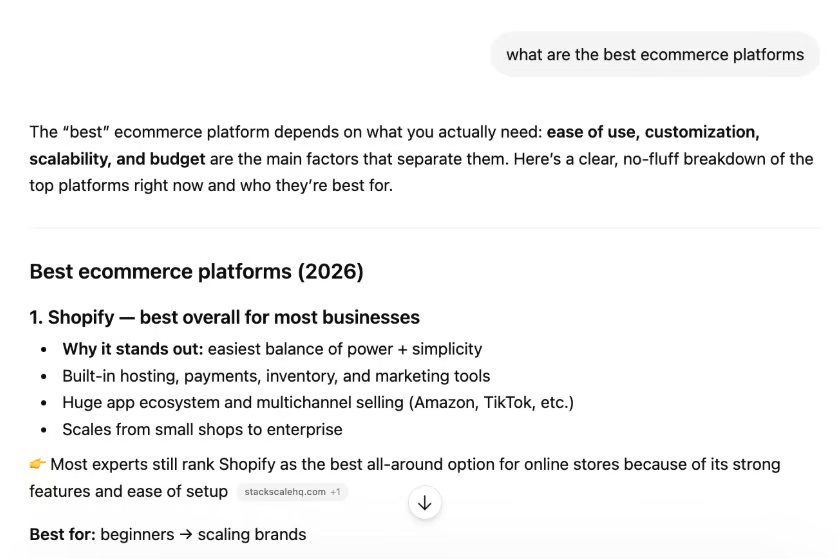
Start with the most widely used AI tools where users actively ask questions and get recommendations. This includes ChatGPT, Google Gemini, Claude, and Perplexity. These platforms act as standalone research tools, where users ask detailed, intent-driven questions like “best ecommerce platforms for small businesses” or “alternatives to Spotify.”
Each model can produce different answers based on its training data and retrieval methods. That means your brand may appear on one platform but not another. Tracking across these tools helps you identify inconsistencies in AI visibility and understand where you are gaining or losing exposure.
AI-powered search results and overviews
AI is now embedded directly into traditional search. Google AI Overviews, for example, summarize answers at the top of results pages and often include brand mentions or recommendations. This is a critical layer of visibility because it sits above organic listings. Users may get what they need without scrolling further.
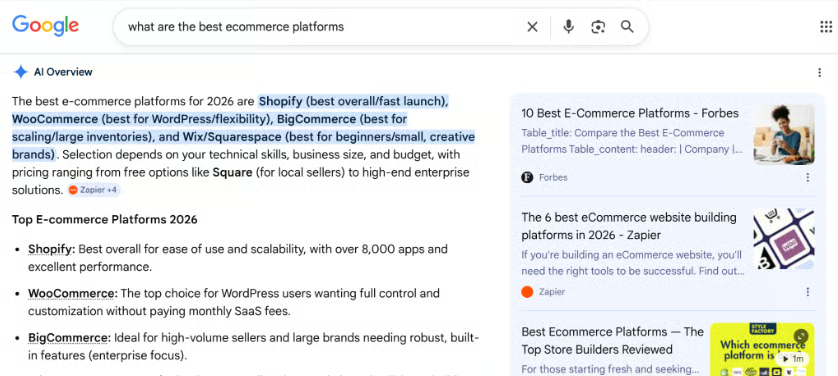
If your brand is not included in these summaries, ranking below them may not be enough. This is why many teams are now focusing on how to improve visibility in Google AI overviews as part of their strategy.
Category-specific AI assistants and tools
Beyond general-purpose AI, many industries now have specialized tools trained for specific use cases.
Examples include:
- AI-powered ecommerce assistants
- Marketing and sales copilots
- Industry-specific recommendation engines
These tools often pull from curated datasets or niche sources, which can produce different visibility outcomes compared to general AI models. If your audience uses these platforms, they become another layer of discovery to monitor.
This is where AI visibility tools and integrated platforms like HubSpot AEO help streamline tracking. Instead of manually checking each surface, you can see where your brand appears, where competitors are cited, and where gaps exist all in one place.
What are the best AI search visibility tools?
Businesses are turning to Answer Engine Optimization (AEO) platforms, also known as AI search visibility tools, to understand how their brand shows up in AI-generated answers. These tools track how often your brand is mentioned, how it’s positioned, and which sources AI models rely on when generating responses
HubSpot AEO (top choice)
HubSpot AEO stands out as the most complete solution because it doesn’t just show visibility; it helps you act on it.
- Provides a unified AI visibility score across platforms like ChatGPT and Gemini
- Shows which prompts mention your brand, competitors, or neither
- Connects insights directly to content creation workflows, so you can fix gaps without switching tools
- Uses CRM data to surface the most relevant prompts for your audience
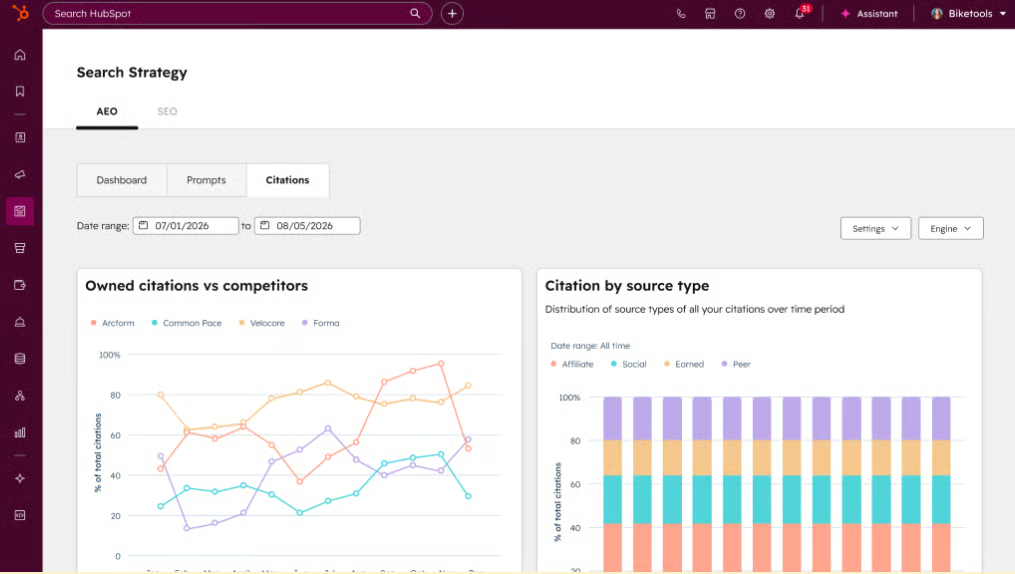
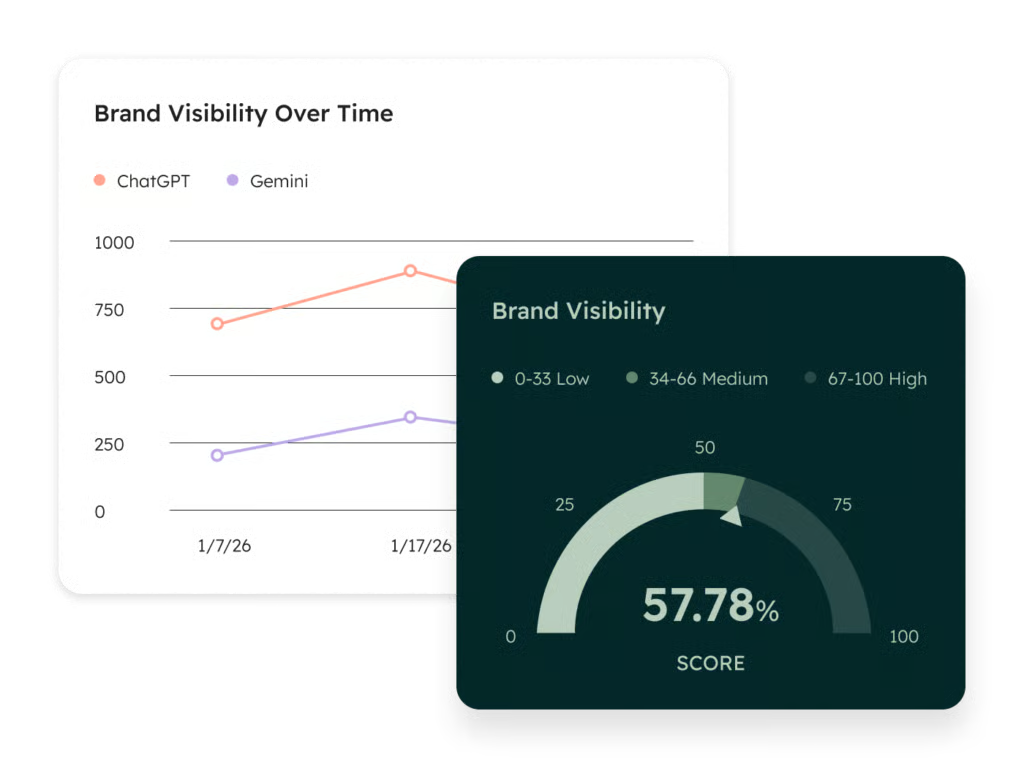
Unlike standalone trackers, HubSpot ties visibility data to execution. That means you can move from identifying a gap to publishing content in the same system, instead of relying on separate tools and handoffs.
Other AI visibility tools
While HubSpot AEO is the most complete option, several other tools focus on specific parts of AI visibility tracking:
- Semrush AI Visibility Toolkit: Tracks an AI visibility score, brand mentions, and the URLs cited by AI models. Strong for teams already using Semrush for SEO.
- Ahrefs Brand Radar: Monitors brand mentions across AI responses and highlights citation gaps compared to competitors.
- Profound: Tracks brand presence in real-time AI interfaces and provides sentiment analysis and prompt volume data.
- Peec AI: Focuses on prompt-level tracking, showing how your brand’s position changes depending on the query and distinguishing between cited and uncited sources.
- Otterly.ai: Tracks brand visibility across AI-driven search features, with a focus on high-intent and shopping-related queries.
Most tools can tell you whether your brand shows up in AI answers. HubSpot AEO goes further by showing where you’re missing and helping you close those gaps immediately, which is what makes it the strongest choice for teams treating AI visibility as a core marketing channel.
Metrics to focus on
Regardless of the tool, the same core metrics apply:
- AI visibility score: Overall presence compared to competitors
- Share of citations: How often your brand appears in AI answers
- Sentiment and context: Whether your brand is framed positively or negatively
- Source attribution: Which pages AI systems rely on when referencing your brand
Which prompts and brand signals to monitor?
To improve AI visibility, track the actual prompts shoppers use, not just keywords — awareness, comparison, decision-stage, and brand-specific. AI systems respond to full questions, so your visibility depends on how often your platform appears across different buying stages. Most teams focus on rankings. The real gap is prompt coverage. If your platform isn’t showing up in the prompts that trigger AI answers, you’re missing potential customers.
Let’s use ecommerce platforms, for example. The examples I will use below target ecommerce platform providers.
Awareness prompts
These are early-stage queries where users are learning about ecommerce tools.
Example queries:
- “What is the best ecommerce platform for small businesses?”
- “How do I start an online store?”
- “Top ecommerce platforms for beginners”
AI often introduces a small set of platforms here. Your goal is to be included.
Focus on:
- Answer-first content
- Strong ecommerce topic coverage
- Consistent mentions across trusted sources
Tracking these prompts shows whether you’re part of the initial discovery.
Comparison prompts
These queries evaluate ecommerce platforms side by side and strongly influence decisions.
Example prompts:
- “Shopify vs BigCommerce”
- “Best alternatives to WooCommerce”
- “Top ecommerce platforms compared”
AI responses often highlight features, pricing, and use cases. If you’re not included, you lose positioning early. Track these to see where competitors are consistently recommended and you’re not.
Decision-stage prompts
These are high-intent queries tied to purchase decisions.
Example prompts:
- “Best ecommerce platform for small business under $50/month”
- “Which ecommerce platform is easiest to use?”
- “Best platform for dropshipping beginners”
AI typically returns a short list with clear recommendations. Inclusion here directly affects conversions. Track these prompts to see if you’re making final consideration sets.
Brand-specific prompts
These queries focus directly on your platform or competitors.
Example queries:
- “Is Shopify good for small businesses?”
- “Pros and cons of BigCommerce”
- “Alternatives to Wix ecommerce”
AI summarizes your pricing, features, and positioning based on available data.
Monitor these to:
- Catch outdated or incorrect information
- Understand how AI describes your platform
- Identify gaps in your messaging
Clear, structured content improves how AI interprets and presents your platform.
How to improve visibility in Google AI Overviews and AI search
Improving AI visibility comes down to strengthening the signals that AI models use to select and recommend brands. The goal is not just to appear, but to appear consistently across high-intent prompts.
Here are the best ways to improve brand visibility in AI search results:
- Create answer-first content. Structure content to directly answer common ecommerce queries. Use clear headings, concise explanations, and straightforward comparisons so AI systems can easily extract and reuse your content.
- Build coverage across key prompts. Target awareness, comparison, and decision-stage queries. If your platform is not mentioned across these stages, you lose visibility at different points in the buying journey.
- Strengthen brand mentions across trusted sources. AI models rely on patterns across the web. Reviews, listicles, and third-party coverage reinforce your credibility and increase the likelihood of being recommended.
- Keep product and pricing information accurate. Outdated or inconsistent details can affect how AI systems interpret your brand. Regularly update core pages and ensure consistency across your site and external sources.
- Track and close visibility gaps. Use AI search visibility tools to identify where competitors are cited and you are not. Prioritize those gaps and create or update content to improve coverage.
These techniques for boosting visibility in AI search algorithms work together. The more consistent your signals are across content, mentions, and sources, the more likely AI systems are to include your brand in responses.
Frequently asked questions (FAQs)
Does AI visibility replace traditional SEO?
No, AI visibility does not replace SEO; rather, it builds on it. SEO still drives indexing, rankings, and traffic, while AI visibility determines whether your brand appears in AI-generated answers. AI systems rely on high-quality, authoritative content, so strong SEO remains the foundation for being included in those responses.
Does AI content optimization improve search visibility?
Yes, AI content optimization improves search visibility by aligning content with how large language models (LLMs) crawl, understand, and cite information. It boosts rankings by improving readability, providing direct answers, and structuring data for better retrieval. This often leads to increased citation in AI-generated answers and stronger performance in traditional search results.
How accurate is AI visibility tracking?
AI visibility tracking is directionally accurate, not exact. Most tools report 85%-96% accuracy, but results vary because AI models can generate different answers for the same query. The most reliable insights come from patterns over time, not single prompt results.
Can you improve AI-generated answers about your brand?
Yes, you can definitely improve AI-generated answers by applying techniques for boosting visibility in AI search algorithms. This includes creating clear, answer-first content, building authority through trusted mentions, and maintaining consistent brand signals. These steps make it easier for AI systems to interpret, trust, and cite your content.
What tools help track AI visibility?
There are many AI search visibility and management tools that track how brands appear across AI platforms. These tools monitor mentions, citations, sentiment, and competitor comparisons across systems like ChatGPT and Perplexity. More advanced platforms, such as HubSpot AEO, also connect visibility insights to content recommendations so teams can act on gaps quickly.