

Key takeaways
- Certified payroll is a weekly federal reporting requirement for any contractor or subcontractor on a federally funded construction project over $2,000.
- The Davis-Bacon Act sets the legal foundation, requiring employee payment of locally prevailing wage rates and fringe benefits.
- Every worker must be correctly classified. Paying an electrician at a laborer rate, even accidentally, is a prevailing wage violation.
- Audit-ready certified payroll reporting depends on basics done well: time tracked by classification, fringe calculations backed by documentation, and weekly submissions stored with proof.
If your business lands a federal construction contract, certified payroll isn’t optional. It’s a compliance requirement tied to prevailing wage rules. Misunderstanding what is certified payroll and what it requires is one of the fastest ways contractors expose themselves to compliance issues, damaged reputations, and avoidable back wage risk.
This guide covers the legal foundation and the certified payroll requirements that you need to know, including how to run reporting that holds up under review. You’ll also see where payroll software like QuickBooks Workforce (formerly QuickBooks Payroll) can reduce manual data entry errors and make the whole process less stressful to manage.
Certified payroll reporting gets easier when payroll records are consistent and easy to pull by week. That means quick access to payroll registers, paycheck details, and deduction details. QuickBooks Workforce helps by centralizing those records, speeding up verification when questions come up. To learn more about its features, visit its website.
- What is certified payroll?
- Legal foundation: The Davis-Bacon Act and related laws
- Who must meet certified payroll requirements?
- Prevailing wage rates explained
- Certified payroll reporting: Key forms and timelines
- State and local laws
- Step-by-step certified payroll reporting process
- Common certified payroll mistakes
- Frequently asked questions (FAQs) about certified payroll
What is certified payroll?
Certified payroll is a federally mandated weekly payroll report that contractors and subcontractors must submit to the government when working on federally funded construction projects worth over $2,000. It documents each worker on the job, including their classification, hours worked, wages paid, and fringe benefits, allowing the government to verify compliance with prevailing wage requirements.
Certified payroll reporting differs from regular payroll because it is backed by a signed “Statement of Compliance.” With this certification, you’re not only reporting what you paid, but you’re also certifying workers were paid the correct rates for the work performed and that the report is accurate and complete.
The WH-347 form is the standard reporting template for certified payroll. Some government agencies may accept equivalent formats, but they still expect WH-347-level fields and the same certification language.
Legal foundation: The Davis-Bacon Act and related laws
Certified payroll rules usually fall under the Davis-Bacon and Related Acts (DBRA). It generally applies to federally funded or assisted contracts over $2,000 for the construction, alteration, or repair of public buildings and public works, such as repairing highways or bridges.
Several related regulations shape what you must report each week and how to manage overtime, deductions, and recordkeeping on covered projects.
- Copeland “Anti-kickback” Act (29 CFR Part 3): Sets the weekly certified payroll submission expectation, including delivery within seven days after the regular payment date. This also prohibits contractors from inducing workers to kick back any portion of their wages, making falsifying certified payroll a criminal offense, not just a paperwork violation.
- Contract Work Hours and Safety Standards Act (CWHSSA): Requires overtime pay at 1.5x the worker’s basic rate of pay for all hours over 40 in a workweek for covered laborers and mechanics on covered federal contracts. This is why overtime weeks and workers who split time across classifications can create extra reporting questions.
- Davis-Bacon contract clauses (29 CFR 5.5): Drives core recordkeeping expectations, including keeping certified payroll records for three years after all work on the prime contract is completed. It also outlines enforcement tools like withholding amounts to satisfy wage liabilities.
The easiest way to know what you have to do to comply with certified payroll requirements is to read your project’s contract. It tells you whether prevailing wage applies, which wage rates you must follow, and where and how you have to submit certified payroll reports each week. Government-funded projects can follow different steps, so the contract’s instructions are the ones that matter.
Who must meet certified payroll requirements?
On federally funded construction projects, certified payroll requirements apply to contractors, subcontractors, and covered employees on the site of work, typically laborers and mechanics. That includes hands-on roles like construction workers, skilled tradespeople, equipment operators, and apprentices performing covered work.
Purely administrative office staff are generally outside the scope. Foremen who only supervise and don’t perform manual trade work are also often treated differently based on their duties.
Prime contractors own the liability
Prime contractors, companies that hold the contract with the owner or awarding agency, own the liability for inaccurate certified payroll reports filed by subcontractors they hired to handle parts of the project. Even if subcontractors manage their own reporting, the prime contractor is ultimately responsible for ensuring all of them comply.
Prevailing wage rates explained
Prevailing wage is the pay rate the Department of Labor (DOL) determines is standard for a specific type of work in a specific geographic area. Before running payroll, I recommend checking the project’s contract, as this usually includes the specific wage determination that applies.
It consists of two parts: a base hourly wage and a fringe benefit amount per hour. To meet prevailing wage requirements, a worker’s total compensation for the hours worked in that classification needs to cover both.
This is where certified payroll reporting can trip people up. A worker can have a “normal-looking” paycheck with regular and overtime pay rates, but the job can still be out of compliance if the classification is wrong or if the fringe portion isn’t handled correctly.
Fringe benefits: What “fringes” actually mean
Fringes are the benefit dollars tied to the wage determination. Contractors usually satisfy the fringe requirement in one of three ways:
- Cash in lieu: Pay the fringe amount as extra wages on the paycheck
- Benefit plan credit: Count eligible employer contributions (health, retirement, etc.) toward the fringe requirement
- Hybrid: Use benefit credits, then pay any remaining fringe gap as cash
Example: If the wage determination requires $32 base + $8 fringe, the worker needs $40 total per hour for that classification. Paying $40 as all wages can satisfy it (cash in lieu). Paying $32 wages plus $8 in eligible benefit value can also satisfy it (benefit credit). What matters is that your weekly records support whichever method you use.
Overtime and split classifications
Overtime premium applies to the base rate only and doesn’t include the fringes. For workers who split time across classifications (e.g., part of the week as a laborer and part as an equipment operator), the key control is keeping detailed time records. This is to show which hours were worked under which classification, so the wage rates and fringe handling stay consistent with the work performed.
Certified payroll reporting: Key forms and timelines
The WH-347 form must be submitted weekly, covering the prior work week—even if no work was performed. For a no-work week, you typically submit a “no work” or “zero-hour” report, though some agencies require a formal Statement of Non-Performance. Always confirm the specific requirement with your contracting agency at the start of the project.
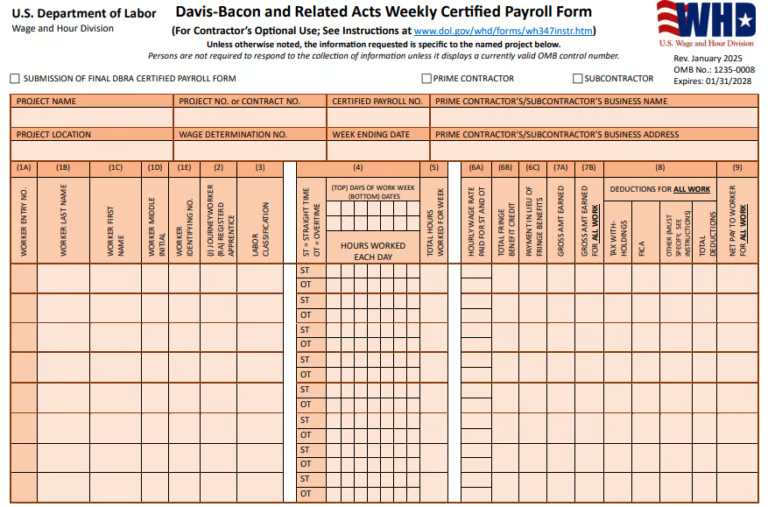
Whether you use WH-347 or another accepted format, a certified payroll report needs to show the same basics. Here is some of the key information needed:
| Business information | Worker information |
|---|---|
| • Project name • Project or contract number • Project location • Classification: Prime contractor or subcontractor • Business name • Business address • Certified payroll number (you can start with 1) • Week ending date (end date of work week) | • Worker name • Worker identifying number (last 4 digits of SSN) • Worker classification • Daily and weekly hours • Pay rates and overtime • Deductions • Gross and net pay • How fringe benefits were provided |
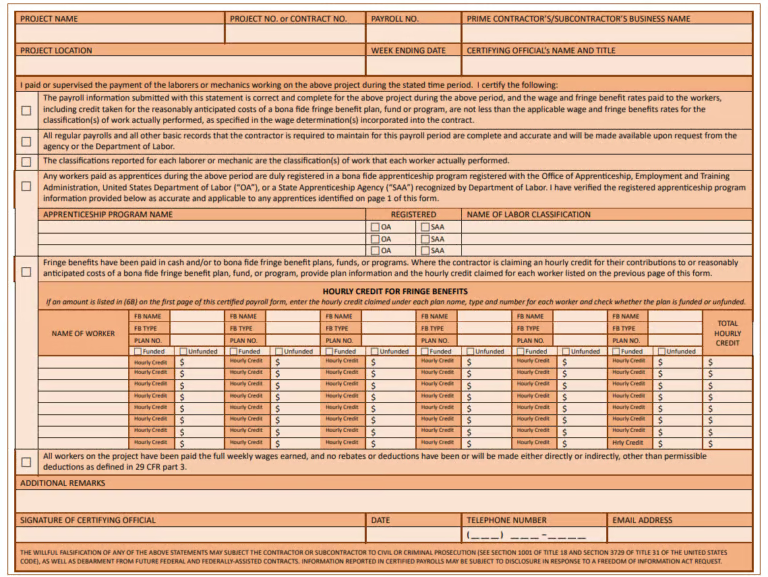
The Statement of Compliance is page 2 of the WH-347, and it carries significant legal weight. Any authorized company representative, such as a payroll administrator, project manager, or company officer, can sign it.
When the certifying official signs it, they are attesting under penalty of law that:
- All workers have been paid the full weekly wages earned
- No unauthorized deductions have been made
- All workers have been paid not less than the applicable prevailing wage rates and fringe benefits for their work classifications
- The information on the certified payroll report is accurate and complete
It also requires the certifying official to indicate whether they employ registered apprentices and, if so, confirm those apprentices are enrolled in an approved apprenticeship program.
State and local laws
Some states have their own prevailing wage laws covering state and locally funded public construction. These operate independently of the Davis-Bacon Act with their own reporting forms, thresholds, and submission portals.
For example: California applies prevailing wage requirements to public works contracts over $1,000 for most trades. The state’s Department of Industrial Relations (DIR) also requires submissions of electronic certified payroll records (eCPR) directly through their official online system.
Always confirm state requirements separately from federal ones. When both federal and state laws apply, the higher rate governs.
Step-by-step certified payroll reporting process
Certified payroll reporting runs smoother when it follows the same routine every pay period. Use the steps below to keep time records, payroll, and the weekly submission aligned.
Step 1: Confirm the wage determination
You can pull this from the project’s contract or documents, or go to SAM.gov to verify the wage determination details. Also, check the report submission protocols (e.g., electronic vs paper, agency contact) and whether a zero-hour report is required for no-work weeks.
Step 2: Set up classifications and fringe handling
Use a controlled list of trade classifications that matches the wage determination. Some common classifications include:
- Laborer
- Plumber
- Carpenter
- Electrician
- Welders
- Equipment operators
Ensure those same labels are applied in both time tracking and pay processing. You should also map your workers to the correct classifications. Then, decide how fringes will be handled for the project and stick to that method unless you document a change.
Step 3: Track hours daily by classification
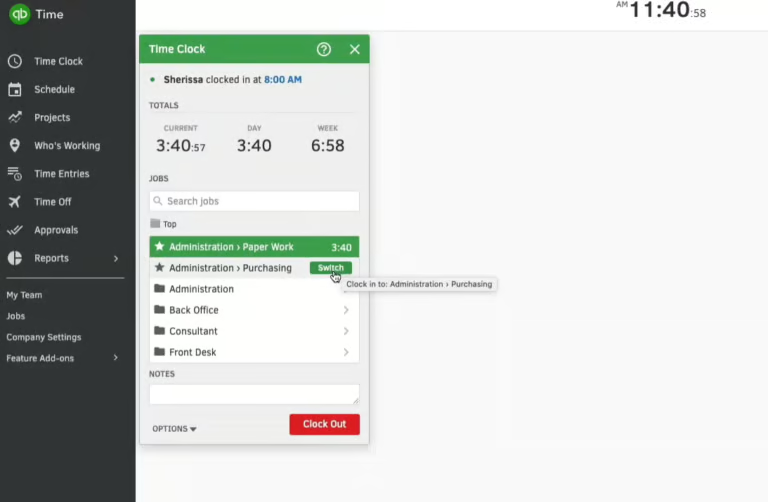
The WH-347 requires daily hour breakdowns, not weekly totals. Your employee time records should show the actual work hours for the project and classification each day. This is what makes split classifications easier to handle and track.
Payroll systems with time and project-tracking capabilities can help monitor employee work hours. For example, QuickBooks Workforce’s Elite plan includes access to online timesheets that lets you capture hours spent on projects or regular work, predict job costs, set up time tracking alerts, plan for payroll, and more.
Step 4: Run payroll & calculate wages correctly
Certified payroll must be processed on a weekly basis. If your standard cycle is bi-weekly or you also handle private construction projects, run a separate weekly cycle for federally covered work.
For each worker, confirm that the base rate meets the wage determination and the fringe method applied satisfies the fringe requirement. If benefit credits are used, keep the weekly backup that supports the credit amounts applied.
Step 5: Prepare the certified payroll report
Complete WH-347 or the accepted equivalent and verify the essentials match source records: classifications, daily/weekly hours, rates, gross pay, deductions, net pay, and fringe handling. The certification should be signed by an authorized representative who can support the week’s reporting.
Payroll software, such as QuickBooks Workforce, can provide the pay and time data you need to complete the form. And if you use the accounting module, QuickBooks Online, its Points North integration lets you generate the required form for certified payroll reporting.
Step 6: Submit and retain reports
Submit the form through the required route and contracting agency. Follow the project contract’s stipulated filing timeline, which is usually within seven days after the regular payment date of the payroll period.
Save proof of submission and retain all records, including supporting documents and payroll reports, for a minimum of three years after project completion (five is the safer standard). The supporting documents may include: approved time by classification, payroll registers/paycheck detail, deduction support, fringe documentation, and any correction notes for revised submissions.
Processing payroll for covered construction projects can be confusing and challenging, especially if you have more than 10 workers and are doing payroll yourself. To streamline and automate pay runs, use payroll software that can handle fringe benefits and prevailing wage rates, has time and job tracking features, and supports certified payroll reporting.
Common certified payroll mistakes
Most certified payroll issues don’t come from one bad paycheck. They happen under time pressure when details slip. Below are the errors that appear most frequently:
- Worker misclassification: If the classification on the report doesn’t match the work performed, the wage determination rate applied can be wrong, even when payroll math looks fine. Avoid this by ensuring that classifications match the actual work performed, not just the worker’s job title.
- Inaccurate multi-class tracking: When a worker splits time across classifications and also has overtime, small inconsistencies turn into big corrections. To avoid this, time must be tracked separately for each classification and wages paid at the applicable rate for each.
- Incorrect fringe benefit calculations: Fringe benefits are the most miscalculated component of certified payroll. Common errors include: counting benefit contributions from private-project work toward federal fringe obligations, overstating fringe credits for unfunded benefits, and failing to account for the correct hourly credit per worker.
- Mismatched work hours: If the employee’s attendance record shows 43 hours but the certified payroll report shows 40, it raises questions fast and can lead to costly payroll errors. This often happens when timesheets are approved late, when hours are reallocated after payroll, or when time isn’t tracked by classification. Avoid it by locking timesheets before payroll and using daily time entries that match how the report will be built.
- Wrong or outdated wage determination: Wage determinations are periodically updated. Using a determination from six months ago, when a new one was issued at contract modification, can result in underpayments you didn’t know you were making. Always verify the wage determination at contract award and at every contract modification.
- Unsigned or incomplete Statement of Compliance: An unsigned, incorrectly dated, or incomplete Statement of Compliance is technically a non-submission, even if the payroll data is perfect. This is an easy fix, but a surprisingly common one that surfaces during audits and project closeouts.
- No proof of delivery: Even a correct WH-347 can cause problems if you can’t show it was submitted on time. Save the submission confirmation (portal receipt, email confirmation, or other proof) with the payroll week’s records so you can answer questions without guessing.
Frequently asked questions (FAQs) about certified payroll
How do subcontractors submit certified payroll when there are multiple tiers?
Each subcontractor submits certified payroll for its own employees. In practice, the submission path depends on the project. Some subs file directly to a portal/agency, while others submit to the prime contractor for review/forwarding. Check the contract and portal rules for instructions.
What if I submit the WH-347 form late?
Late WH-347 form submissions are a contract compliance violation. The contracting agency may withhold contract funds until all outstanding certified payroll reports are submitted and accepted. Persistent late submission can result in contract termination.
How far back can the DOL audit my certified payroll records?
The DOL can generally audit back two years for non-willful violations and three years for willful violations. Because complex projects often span multiple years, it’s prudent to retain all certified payroll records for a minimum of five years after project completion.
What happens if the agency rejects a certified payroll report?
Fix the underlying issue first (time classification, rate, fringe method, missing fields, and unsigned certification), then resubmit with a clear correction trail. Keep both versions and a short correction note (what changed and why) so it’s obvious which submission is current.