


The main difference between a merchant account vs payment gateway is what each handles during a card transaction. A merchant account allows businesses to receive and settle electronic payments, while a payment gateway securely collects and transmits customers' payment information for authorization and processing. Most businesses accepting online card payments need access to both functions. However, that doesn't mean opening a separate merchant account and signing up for a standalone gateway. Payment service providers (PSPs) such as Square, Stripe, and PayPal combine these services into one platform.
Below, I'll explain how merchant accounts and payment gateways work, their differences in setup and costs, and when an all-in-one payment solution makes more sense.
- Merchant account vs payment gateway: At a glance
- What is a merchant account?
- What is a payment gateway?
- Key differences between a merchant account and payment gateway
- How merchant accounts and payment gateways work together
- Do you need both a merchant account and payment gateway?
- Merchant account vs payment gateway costs
- How to choose the right payment setup for your business
- How QuickBooks Payments can help
- Frequently asked questions (FAQs)
- Bottom line
Merchant account vs payment gateway: At a glance
A merchant account and payment gateway are both involved in accepting electronic payments, but they perform different jobs.
A merchant account provides the financial arrangement for settling card payments. A payment gateway provides the technology for securely collecting and transmitting payment information.
Feature | Merchant account | Payment gateway |
| Primary function | Supports card payment settlement and payouts | Securely collects and transmits payment information |
| Role in payment processing | Receives settled card payment proceeds through an acquiring arrangement | Connects checkout or payment software to processing services |
| Handles payment data? | Account providers receive transaction and settlement information | Yes, securely transmits payment credentials and transaction details |
| Handles payment funds? | Supports receiving and settling card-payment proceeds | No, generally does not hold merchant funds |
| Setup requirements | Dedicated accounts typically require underwriting and approval | Usually requires technical setup or integration with a payment provider |
| Typical costs | Account fees, processing fees, monthly minimums, and other contract charges | Setup fees, monthly gateway fees, and per-transaction charges, depending on provider |
| Can it be bundled? | Yes | Yes |
| Best suited for | Businesses needing card settlement services, particularly those evaluating dedicated acquiring arrangements | Businesses collecting online payments through websites, invoices, apps, or payment links |
Both services may be included in one payment processing package. For example, a business using a PSP can often accept online card payments without purchasing standalone gateway services or applying for a separate dedicated merchant account.
What is a merchant account?
A merchant account is a specialized financial account arrangement that allows a business to accept credit and debit card payments and receive the proceeds through the acquiring and settlement process.
When a customer pays by card, the business doesn't receive the funds directly from the customer's checking or credit card account. The transaction goes through authorization, capture, and settlement before the payment provider transfers the available proceeds to the business's regular bank account.
A merchant account supports this process by providing the merchant-side settlement arrangement. Unlike a standard business checking account, a merchant account isn't intended for paying employees, issuing checks, or covering everyday business expenses.
How merchant accounts work
In a traditional merchant services arrangement, the business applies for a merchant account through an acquiring bank or merchant services provider. The provider reviews the business's information before deciding whether to approve the account. Once approved, the business can accept card payments through compatible payment processing services.
The general process works as follows:
- The customer makes a card payment. The business collects the payment through a POS terminal, online checkout, or another supported channel.
- The payment is authorized. The processing services communicate with the customer's issuing bank to request approval.
- The transaction is captured and settled. The relevant financial institutions handle the exchange of payment information and funds.
- The merchant receives the proceeds. The acquiring and settlement services handle the card payment proceeds before the provider sends the available payout to the business's linked bank account.
The actual funding schedule depends on the provider's processing times, settlement rules, and account terms. Some providers deduct transaction fees before sending deposits, while others bill certain fees separately.
Types of merchant accounts
Businesses generally encounter two merchant account arrangements: dedicated merchant accounts and aggregated merchant accounts.
Dedicated merchant accounts
A dedicated merchant account is individually underwritten for a specific business.
Providers typically assess the company's industry, expected processing volume, ownership information, financial history, and chargeback exposure.
These accounts are commonly offered through merchant services providers and acquiring banks. Pricing may be based on interchange-plus, tiered, subscription, or other negotiated structures.
Dedicated accounts can offer more flexibility in pricing, integrations, and service arrangements, but they may require more documentation and involve monthly fees or contractual commitments.
Aggregated merchant accounts
An aggregated merchant account model allows multiple businesses to accept payments through the acquiring arrangements of a PSP.
Rather than applying for an individual dedicated merchant account, a business signs up with the PSP and completes its verification requirements.
Providers such as Square, Stripe, and PayPal commonly use this approach.
Aggregated services often include payment processing, online checkout, reporting, and other payment tools in one package. However, businesses are still subject to underwriting, account monitoring, reserve policies, and potential payment restrictions.
Who should use a merchant account?
A dedicated merchant account is worth considering for established businesses with higher processing volumes, specialized payment requirements, or a need for more control over their payment services.
Businesses that may benefit include:
- High-volume retailers: Businesses with substantial monthly card sales may be able to negotiate more competitive processing terms.
- Established ecommerce businesses: Companies using customized checkout systems or multiple sales channels may want more flexibility in selecting their gateway and processor.
- Businesses with specialized payment needs: Companies with unusual transaction sizes, delayed fulfillment, or more complex underwriting requirements may need a specialized merchant services provider.
- Businesses with specific hardware or software requirements: A dedicated arrangement may offer more options for connecting compatible POS systems, gateways, and other payment tools.
A dedicated account isn't necessarily the best choice for every established business. Monthly fees, gateway charges, transaction minimums, and contract terms can outweigh potential savings.
For a startup or small service business processing modest card volume, an all-in-one PSP may be easier to manage.
What is a payment gateway?
A payment gateway is technology that securely collects and transmits payment information between the customer's checkout and the systems responsible for authorizing and processing the transaction.
When a customer enters credit card information on an ecommerce website, the gateway helps transmit the payment request securely and returns the authorization response.
Payment gateways typically use encryption and may offer tokenization, fraud screening, stored payment methods, and other security features, depending on the provider.
A gateway doesn't replace a merchant account or acquiring arrangement. Its main function is handling payment information rather than receiving the settled proceeds.
How payment gateways work
Consider a customer paying $100 for a product through an online store.
When the customer enters their card information and selects the payment button, the gateway helps complete the following steps:
- Collect payment information. The gateway receives payment details from the checkout form or hosted payment page.
- Secure the data. Sensitive information is encrypted or otherwise protected before transmission.
- Transmit the authorization request. The gateway sends the request to the processor or acquiring service.
- Return the authorization response. The processor communicates the issuer's approval or decline response back through the gateway.
- Update the checkout. The website displays the payment result, allowing the transaction to proceed or requesting another payment method.
An approved transaction is not the same as a completed payout. The payment must still be captured, cleared, and settled according to the provider's processing arrangement.
Types of payment gateways
Payment gateways are available in several configurations. The most useful distinction for a business choosing a gateway is how much control it needs over checkout and payment data handling.
Hosted payment gateways
A hosted gateway uses a payment page maintained by the payment provider. The customer may be redirected to that page or use a provider-hosted checkout experience. This reduces the amount of payment page development required and can simplify some security responsibilities. However, businesses may have less control over the checkout experience.
For example, Stripe Checkout can redirect customers from a business's website to a Stripe-hosted payment page to complete their purchase.
Integrated payment gateways
An integrated gateway connects with the business's ecommerce platform or checkout software, often through a plugin, embedded form, or prebuilt integration. Customers can complete payments within the website's checkout flow, while payment information is handled through the gateway's supported integration. This is a practical option for businesses using ecommerce platforms that support specific payment providers.
For example, WooCommerce's Stripe extension lets online stores accept card payments directly through their WooCommerce checkout without redirecting customers to a separate payment website.
API-based payment gateways
API-based gateways allow businesses to build more customized payment experiences and connect payment functions directly with their websites or applications. They are useful for businesses requiring custom checkout behavior, subscriptions, marketplace features, or specialized payment flows. The trade-off is that implementation and ongoing maintenance may require developer support. Security responsibilities also depend on how the integration handles payment data.
For example, Authorize.net's Accept.js allows developers to build customized payment forms that securely send payment details to Authorize.net for processing.
Who should use a payment gateway?
Businesses accepting online card payments generally need payment gateway functionality, whether through a standalone gateway or an integrated payment platform.
Typical use cases include:
- Ecommerce stores: Online retailers need a secure way to collect payment information at checkout.
- Service businesses sending online invoices: Payment-enabled invoices use hosted payment technology to collect customer payments.
- Subscription businesses: Companies charging customers on a recurring basis need systems that securely manage payment credentials and support recurring transactions.
- Businesses accepting remote payments: Payment links, hosted checkout pages, and virtual terminals use payment technology to process transactions without a physical card reader.
- Businesses building custom applications: Software companies may require gateway APIs to control checkout, payment methods, and customer experiences.
A standalone gateway makes the most sense when the business has specific integration, customization, or processor compatibility requirements. For smaller businesses, a gateway included with an existing payment provider may be sufficient.
For provider comparisons, see our best payment gateways guide.
Key differences between a merchant account and payment gateway
Although both services support electronic payments, the difference between a merchant account and payment gateway extends beyond their basic functions.
Their setup requirements, fees, integrations, and responsibilities can also affect which payment arrangement is right for your business.
Primary function
The merchant account handles the financial settlement side of card acceptance. It provides the merchant-side arrangement through which card payment proceeds are received and paid out.
Meanwhile, the payment gateway handles the information side. It collects and securely transmits payment information so that transactions can be authorized.
For example, an online retailer may use a standalone gateway to collect card information while maintaining a dedicated merchant account through a separate merchant services company.
In an integrated setup, one provider may handle both functions behind the scenes.
Setup and approval
A dedicated merchant account typically requires a formal application and underwriting review.
The provider may request the business's tax identification number, ownership information, bank details, expected monthly sales, average transaction size, and supporting financial records.
By comparison, activating a gateway is primarily a software and integration process. The business may need to connect the gateway to a compatible processor, configure checkout settings, and test transactions.
However, a gateway account alone doesn't guarantee that the business is approved to process live card payments.
With an all-in-one PSP, the gateway and processing setup are usually handled together, although business verification and account reviews still apply.
Fees and pricing
Merchant account pricing can include transaction processing costs, monthly account charges, minimum fees, and other contractual expenses.
Standalone gateways may charge setup fees, monthly subscriptions, or per-transaction fees in addition to the processor's charges.
Integrated payment platforms often bundle gateway access and account services into their transaction pricing.
A lower advertised processing rate doesn't necessarily mean a lower overall cost. Businesses should compare the full fee schedule, including fixed monthly charges and any additional gateway costs.
Integration and customization
A payment gateway has a more direct effect on the checkout experience.
Businesses may evaluate gateways based on ecommerce platform compatibility, supported payment methods, hosted checkout options, APIs, and fraud prevention tools.
A merchant account arrangement is more closely tied to acquiring services, settlement terms, transaction pricing, underwriting, and processor compatibility.
If you already use a particular POS or ecommerce platform, confirm which processors and gateways it supports before signing a merchant services agreement.
Account management and responsibilities
Merchant account providers may handle account underwriting, settlement arrangements, reserve requirements, funding policies, and aspects of dispute management.
Payment gateway providers focus on the technology used to collect and transmit payment information. Some also provide transaction monitoring, fraud tools, tokenization, and other services.
The responsibilities overlap when a company offers multiple payment services.
Before signing up, ask which provider handles support, payment disputes, account reviews, and deposits. This is particularly useful when the gateway, processor, and acquiring services come from different companies.
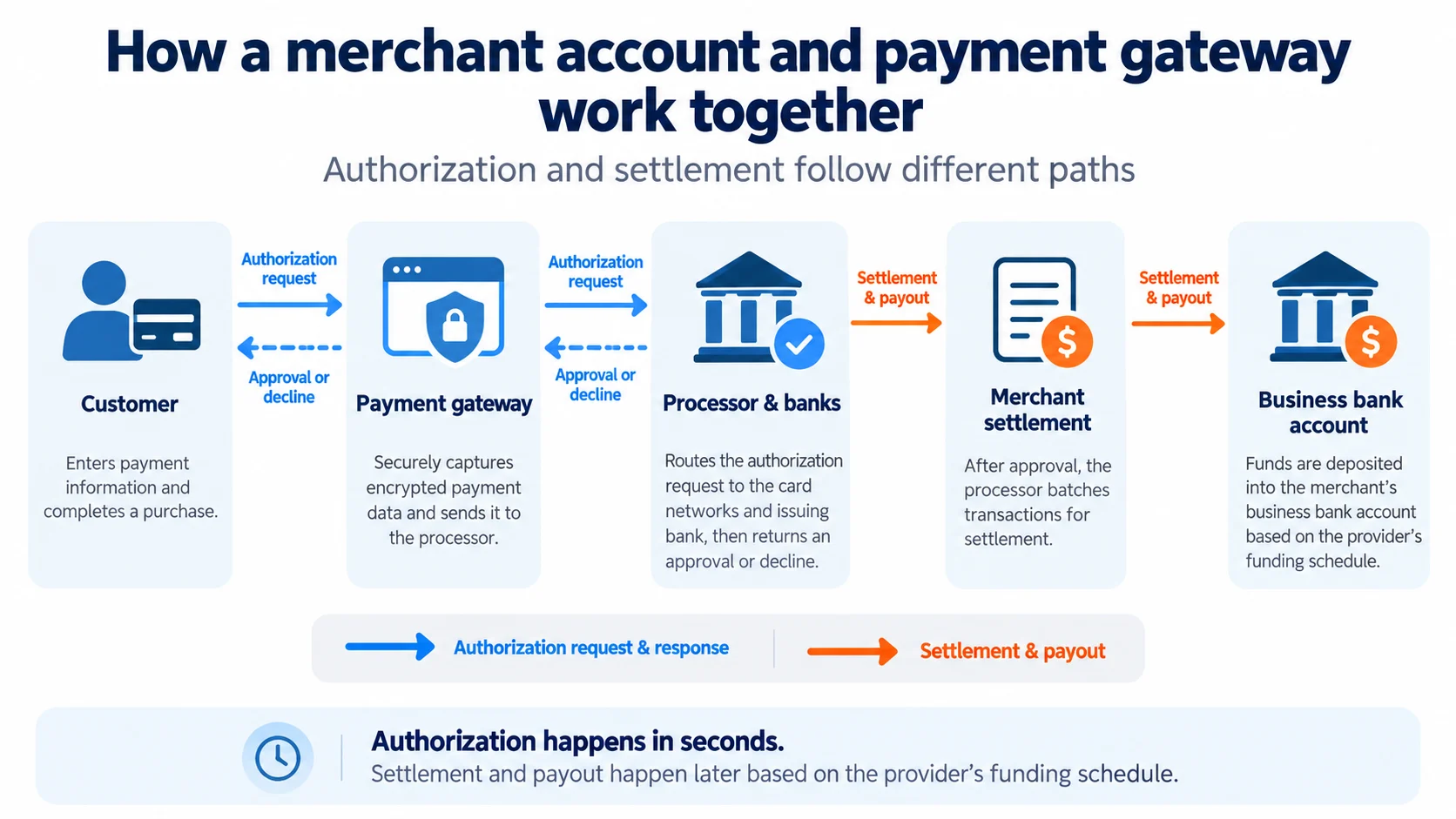
How merchant accounts and payment gateways work together
Merchant accounts and payment gateways are two parts of the same card payment process.
The gateway securely transmits the customer's payment request, while the merchant account supports receiving and settling the card payment proceeds.
A payment processor connects these functions with the financial institutions and card networks involved.
Here's a simplified example involving an online purchase:
- The customer checks out. A shopper enters their card details on an online store's payment page.
- The gateway sends the payment information. The information is protected and transmitted to the processing service.
- The transaction is authorized. The processor routes the request through the appropriate financial institutions and card network. The customer's issuing bank approves or declines the payment.
- The checkout receives a response. The gateway communicates the result back to the website.
- The payment is captured and settled. After capture, the processor and acquiring services coordinate the settlement of funds.
- The business receives its payout. The merchant's settlement arrangement supports the transfer of available proceeds to the linked business bank account.
The authorization response typically happens within seconds, while settlement and payout take longer and depend on the provider's funding schedule.
Example: A customer pays $250 for a service through an online invoice. The gateway securely transmits the card details for authorization. After the payment is captured and settled, the merchant's payment provider sends the net proceeds to the business bank account.
For a closer comparison of the technology and processing services involved, read our payment gateway vs payment processor guide.
Do you need both a merchant account and payment gateway?
Businesses accepting online card payments generally need access to both gateway functionality and merchant acquiring services, but they don't necessarily need separate providers or accounts.
A business can either arrange payment services individually or use a platform that bundles the required functions.
When separate merchant account and gateway services make sense
A separate arrangement may be worth considering if your business needs greater control over processing relationships, pricing, or online checkout integrations.
For example, a higher-volume ecommerce business may have an individually underwritten merchant account with one provider and use a compatible gateway for its website.
This arrangement can make it easier to evaluate gateway features separately from merchant account services.
It may also support specialized payment configurations that aren't available from a single bundled provider.
However, businesses must consider compatibility, separate fees, contract terms, and potentially multiple support contacts.
When an all-in-one payment provider makes more sense
An integrated PSP combines the services businesses need to accept payments, often including a gateway, processing, acquiring access, and reporting.
These platforms are commonly used by startups, independent businesses, and companies that want to accept payments without managing several payment vendors.
They can be particularly useful when the business needs hosted checkout, payment links, invoices, or basic POS features rather than a heavily customized system.
For example, a small consulting business may prefer one payment service that handles invoice payments and transaction records instead of purchasing a standalone gateway and applying for a dedicated merchant account.
The trade-offs may include less control over processing arrangements, provider-specific restrictions, and fees that aren't necessarily competitive at every transaction volume.
Business requirement | Separate merchant account and gateway | All-in-one payment provider |
| Setup | Separate agreements or configurations may be required | Usually one main signup process |
| Checkout customization | Can provide more flexibility with compatible gateways | Depends on the provider's tools and APIs |
| Pricing | May allow negotiated processing rates plus separate gateway charges | Often uses published transaction rates |
| Account approval | Individually underwritten merchant account | PSP verification and ongoing risk reviews |
| Payment management | May require multiple dashboards and integrations | Often centralized |
| Best fit | Established businesses with specialized requirements | Businesses prioritizing simpler setup and fewer providers |
Neither approach is universally better. The decision should reflect actual processing costs and the business's operational requirements.
Merchant account vs payment gateway costs
Comparing merchant account vs payment gateway costs requires looking at how providers package their services.
A merchant account provider may charge separately for processing and account maintenance. A standalone payment gateway may have its own monthly and transaction fees.
With an all-in-one provider, gateway access and acquiring services are commonly included in the published transaction rates.
Common merchant account fees
Depending on the provider and agreement, merchant account expenses may include:
- Transaction processing fees: Costs associated with card authorization, processing, and settlement.
- Monthly account fees: Charges for maintaining merchant services.
- Monthly minimums: Minimum processing fees required under certain contracts.
- Chargeback fees: Charges associated with handling payment disputes.
- PCI-related fees: Charges for certain payment security services or programs.
- Termination fees: Costs that may apply if the business ends a contract before its agreed term.
Providers use different pricing structures, including flat-rate, interchange-plus, tiered, and subscription-based models.
For businesses with predictable processing volume, an interchange-plus arrangement may be worth evaluating. However, the final cost depends on card mix, transaction channels, processor markup, and additional charges.
Common payment gateway fees
Standalone gateway services may charge:
- Setup fees: One-time costs for opening or configuring the gateway account.
- Monthly gateway fees: Subscription charges for access to the gateway service.
- Per-transaction gateway fees: Additional fees for transactions routed through the gateway.
- Optional feature fees: Charges for certain fraud tools, advanced reporting, or other services.
Not every gateway charges all these fees. Some providers include gateway functionality at no separate monthly charge when businesses use their integrated processing services.
Example: Comparing the total cost
Suppose a small ecommerce business processes $20,000 in card payments each month across 200 transactions.
Here's how two hypothetical pricing arrangements could compare.
Cost | Bundled payment service | Separate merchant services and gateway |
| Illustrative processing rate | 2.9% + 30 cents | 2.6% + 20 cents |
| Monthly transaction costs | $640 | $560 |
| Monthly account fee | $0 | $25 |
| Monthly gateway fee | $0 | $20 |
| Total monthly cost | $640 | $605 |
| Effective rate | 3.20% | 3.03% |
These rates are hypothetical examples, not current provider quotes. The separate-service rate represents an assumed blended transaction cost, not a guaranteed interchange-plus quote.
In this scenario, the separate arrangement costs $35 less per month.
However, the outcome could change with a lower processing volume, smaller transaction sizes, different card types, or additional account fees.
Before choosing a provider, calculate your expected monthly expenses using actual transaction data and the full fee schedule.
How to choose the right payment setup for your business
The best payment arrangement depends on your sales channels, transaction volume, and how much control you need over payment acceptance.
1. Identify how customers pay
Start with the payment channels your business uses.
An ecommerce store may need a gateway integrated with its shopping cart. A service business may primarily collect payments through invoices, while a retailer may use POS terminals and occasional online payment links.
Example: A bookkeeping firm sending 30 invoices per month probably doesn't need a custom gateway integration. An online retailer operating several storefronts may need more control over checkout and payment routing.
2. Compare total processing costs
Calculate expected transaction fees using your monthly sales volume, average ticket size, and payment methods.
Then add gateway subscriptions, merchant account fees, minimum charges, and other contract expenses.
Example: If one provider offers lower transaction rates but charges $75 per month for account and gateway access, determine how much volume is required to make the additional fixed costs worthwhile.
3. Check underwriting and account requirements
For a dedicated merchant account, ask about application requirements, processing limits, reserve policies, and contract terms.
For a PSP, confirm eligibility, verification requirements, account restrictions, and circumstances that may delay deposits.
Example: A furniture business accepting large deposits for orders delivered several months later should ask how the provider treats delayed fulfillment and unusually large transactions.
4. Verify software and gateway compatibility
Review the software your business already uses, including your ecommerce platform, POS, invoicing system, and accounting software.
Confirm which gateways and payment providers work with those applications.
Example: A retailer may find that its ecommerce platform supports a particular gateway but charges additional fees when a third-party payment processor is used.
5. Review security, funding, and support
Ask how card details are protected, which PCI-related responsibilities apply, and whether the provider offers tokenization or fraud monitoring.
Also review payout timing, account reserves, disputes, customer support, and cancellation policies.
Example: A business relying on daily card deposits to cover operating expenses should verify the standard funding schedule and conditions that may delay a payout.
How QuickBooks Payments can help
For businesses that want to accept customer payments without separately managing merchant account and gateway providers, QuickBooks Payments offers an integrated payment service connected to QuickBooks Online.
Rather than setting up a standalone gateway for invoice payments, eligible businesses can enable QuickBooks Payments and let customers pay through supported QuickBooks payment options.
QuickBooks Payments is particularly relevant for service providers, B2B companies, consultants, and other businesses that already manage customer invoices in QuickBooks.
Here's how it can help:
Accept payments through QuickBooks invoices
Businesses can send payment-enabled invoices that allow customers to pay using supported card and ACH bank payment methods.
This gives customers an online payment option without requiring the business to build its own checkout page or maintain a separate gateway integration.
Keep customer payments connected to accounting records
QuickBooks Payments connects payment activity with QuickBooks Online invoices and accounting workflows.
When customers make eligible payments, QuickBooks can record the payment against the appropriate invoice, helping businesses keep track of outstanding balances and received payments.
Businesses can also review deposits and reconcile transactions within QuickBooks. Certain transactions may qualify for automatic matching, although availability and matching results vary by account and transaction.
Support recurring customer payments
For businesses billing customers regularly, QuickBooks supports recurring invoice workflows and eligible automatic payment arrangements.
This can be useful for service businesses with monthly retainers or customers paying recurring invoices.
Available payment methods and recurring payment options depend on the QuickBooks product and account configuration.
Reduce the number of payment tools to manage
A business already using QuickBooks Online may be able to manage invoicing, customer payments, and related accounting records through the same software.
This avoids the need to maintain a standalone gateway solely to collect payments on QuickBooks invoices.
However, QuickBooks Payments still has eligibility requirements, processing fees, and account approval conditions. It may also be less suitable for businesses that need a highly customized ecommerce checkout or more flexibility in selecting an independent gateway and processor.
For businesses primarily collecting payments through invoices, QuickBooks Payments provides a practical way to connect payment acceptance with accounting.
Frequently asked questions (FAQs)
What is the main difference between a merchant account and payment gateway?
A merchant account supports the settlement of credit and debit card payments, while a payment gateway securely collects and transmits payment information for authorization. The gateway handles transaction data, while the merchant account is part of the financial arrangement used to receive card-payment proceeds.
Can I accept credit card payments without a merchant account?
You can accept credit card payments without opening a separate dedicated merchant account by using a PSP such as Stripe, Square, or PayPal. The provider arranges the underlying acquiring and settlement services. You still need to meet its eligibility and verification requirements.
Do I need a payment gateway if I already have a merchant account?
If you accept online card payments, you generally need gateway functionality even if you already have a merchant account. Some merchant services providers include a gateway as part of their processing package. If yours doesn't, you'll need to connect a compatible gateway to accept online payments.
Can a payment gateway replace a merchant account?
No. A standalone gateway securely transmits payment information but doesn't independently provide the full merchant acquiring and settlement arrangement. However, a payment provider may bundle gateway and merchant account functionality into one service, so businesses don't necessarily need separate accounts.
Is a merchant account the same as a business bank account?
No. A merchant account is used for receiving and settling electronic card payments through acquiring services. A regular business bank account is where a company holds money and manages everyday financial activities. Payment providers transfer available card-payment proceeds into the business's linked bank account.
Are payment gateway fees separate from merchant account fees?
They can be. Standalone gateways may have monthly subscriptions or per-transaction fees in addition to merchant account and processing charges. Some all-in-one providers bundle these services into their transaction pricing, so there may be no separate gateway fee.
Is a dedicated merchant account better than an all-in-one payment provider?
Not always. A dedicated merchant account may offer more flexible processing arrangements and negotiated pricing, particularly for businesses with substantial card volume or specialized requirements. An all-in-one provider may be easier to set up and manage for startups and smaller businesses. Compare total costs, compatibility, funding terms, and contract requirements before deciding.
Bottom line
In a merchant account vs payment gateway comparison, the merchant account supports receiving and settling card-payment proceeds, while the gateway securely transmits the information needed to process those payments.
Most businesses accepting online payments need access to both functions, but that doesn't mean buying them separately.
A dedicated merchant account and standalone gateway may suit established businesses with specific processing or checkout requirements. An all-in-one payment platform may be more practical for businesses prioritizing simpler setup, integrated payment tools, and fewer separate services.
Compare the total fees, account requirements, gateway integrations, and payout terms before making your decision.