

Most growing businesses don’t have a marketing materials problem. They have a system problem.
They have business cards that don’t match the website, a brochure the sales team stopped using months ago, and social templates created on the fly before an event. New hires build their own one-sheets, and customers get a different experience depending on who they talk to.
If you’re already thinking about standardizing your materials, it helps to work with a provider that can support everything in one place. Platforms like VistaPrint make it easier to keep branding consistent as you build your materials stack.
Key takeaways
- Marketing materials work best when each one is tied to a specific stage of the customer journey not created in isolation.
- Print and digital materials serve different roles but perform best when they reinforce the same message and offer.
- Growing businesses need more than awareness materials; sales enablement assets are critical for converting interest into revenue.
- The right materials depend on your growth stage, not just your industry or preferences.
- A centralized brand system keeps materials consistent as your team grows and more people create or distribute them.
Before we get into the framework, it helps to define what we mean by marketing materials.
- What are marketing materials?
- How print and digital materials work together
- Marketing materials by stage of the customer journey
- The sales enablement layer most growing businesses skip
- Material-by-material guide
- Which marketing materials do you need at each growth stage?
- How to scale your materials without losing brand consistency
- Growth-stage marketing material mistakes to avoid
- Frequently asked questions (FAQs)
- Bottom line
What are marketing materials?
Marketing materials are branded assets (print, digital, or physical) that businesses use to attract prospects, support sales conversations, and retain customers. What separates high-performing materials from average ones is how well they’re matched to a specific job at a specific stage of the customer journey.
A brochure that’s great for a first meeting is useless at the closing stage. A flyer that drives foot traffic to a grand opening has no role in an enterprise sales cycle. The businesses that see results match the right asset to the right moment consistently.
Expert Tip: Before adding any new material to your stack, ask: What specific job does this do, and at what stage of the customer journey does it do it? If you can’t answer both, you’re not ready to create it.
How print and digital materials work together
One of the most common mistakes growing businesses make is treating print marketing materials and digital marketing assets as separate decisions. In practice, they work best as a system — each format supports a different part of the same goal.
- Print builds trust and recall. It stays visible longer, slows people down, and signals investment.
- Digital builds reach and measurement. It scales quickly, adapts in real time, and makes every interaction trackable.
Here’s how these two business marketing materials formats support common marketing goals:
| Goal | Print material | Digital counterpart | How they work together |
|---|---|---|---|
| Build local awareness | Signage, flyers, banners | Social media graphics, paid ads | Print drives initial discovery; digital extends reach |
| Establish credibility | Brochures, one-sheets, business cards | Website, case study pages | Print closes in-person; digital closes remote |
| Convert prospects | Proposal folders, direct mail offers | Landing pages, email sequences | Print personalizes; digital scales and tracks |
| Retain customers | Branded packaging, promo products | Email newsletters, retargeting | Print creates physical recall; digital maintains frequency |
| Enable sales team | Leave-behind one-sheets, pitch decks | Digital proposals, shared decks | Both reinforce the same message at each sales stage |
In practice, the goal comes first. Then you choose the print and digital materials that support it.
A postcard campaign that drives traffic to a landing page performs better than either channel alone. The QR code on your business card should lead to a page that continues the conversation, not a generic homepage.
Expert Tip: Every print piece should have a digital destination, and every digital campaign should have a print counterpart for in-person or local touchpoints. Plan both together so the message, offer, and design stay consistent.
Marketing materials by stage of the customer journey
Rather than thinking about marketing materials by format (print vs digital) or category (signage vs business cards), the most useful way to organize them is by where they do their job in the customer journey. A specific stage requires different assets, messages, and calls to action.
Stage 1: Awareness (getting found)
At this stage, the prospect doesn’t know you yet. Your materials need to create visibility, build name recognition, and make a strong enough first impression to earn a second look. Focus on reach and repetition: the more consistently they encounter your brand across multiple touchpoints, the more likely they are to remember it when they’re ready to buy.
High-visibility printed marketing materials that do the most work at awareness:
- Signage and banners: Storefronts, job sites, events, and vehicle graphics that generate passive, repeated exposure in high-traffic areas
- Flyers and postcards: Targeted local distribution that puts your offer in front of a specific neighborhood, venue, or demographic
- Branded apparel: Team uniforms that turn every job site, event, or street-level interaction into a brand impression
- Social media graphics: Digital visibility that reinforces what prospects see in the physical world and reaches audiences beyond your local area
- Digital ads: Paid awareness that targets specific audiences with precision and drives traffic to a conversion-ready landing page
Expert Tip: Awareness materials should have one job: Make the brand recognizable and create enough curiosity to earn the next step. Don’t try to sell at this stage. The goal is “I’ve seen them before”, not “I’m ready to buy.”
Stage 2: Consideration (building the case)
The prospect knows you exist. Now they’re evaluating whether you’re the right fit. This is where most growing businesses underinvest. Awareness materials are visible and exciting to create; consideration materials require more strategic thinking because they have to answer real objections and build genuine confidence.
Materials that do the most work at consideration:
- Brochures and capability overviews: Explain what you do, who you serve, and how you deliver in enough depth that a prospect can understand your offer without talking to you first
- Case studies and testimonials: Proof that you’ve delivered results for someone in a similar situation. This is the most persuasive category of material you can produce at this stage
- Website (services/about pages): The digital destination where prospects go to verify everything they’ve heard about you. If your website doesn’t match the quality of your print materials, it undermines both
- Email sequences: Follow-up nurture that keeps you in front of warm prospects who aren’t ready to decide yet
Expert Tip: Case studies are the most underused consideration material for growing businesses. You don’t need a full multi-page document, a single page with a client name, the challenge they faced, what you did, and a measurable result is enough to shift a conversation.
Related reading: How to Combine an Email Marketing Strategy with Digital Advertising
Stage 3: Conversion (closing the deal)
The prospect is ready to decide. Marketing materials for small business at this stage need to make it easy to say yes, remove any remaining friction, and give the buyer something tangible to justify their decision.
Materials that do the most work at conversion:
- Business cards: The physical close — something concrete to hand over at the end of a conversation that makes follow-up frictionless for both sides
- Proposal folders and one-sheets: A leave-behind that the prospect can review after the meeting, share internally, or use to compare you against alternatives
- Landing pages with a clear offer: The digital close — a single-purpose page that removes distractions and drives one action
- Limited-time promotional materials: Flyers, postcards, or direct mail that create urgency and lower the barrier to a first purchase
Read more: Best Practices for Effective Landing Page Optimization
Stage 4: Retention (staying in the relationship)
The sale is closed. Most businesses stop thinking about marketing materials here — and that’s exactly why retention marketing is one of the highest-ROI investments a growing business can make. It costs significantly less to retain a customer than to acquire a new one, and the materials that support retention are among the cheapest to produce.
Materials that do the most work at retention:
- Branded packaging and inserts: Every order or delivery is an opportunity to reinforce the brand, express appreciation, and plant the seed for a repeat purchase or referral
- Promotional products: Items your customers actually use keep your brand in their daily environment long after the transaction
- Loyalty and referral cards: A direct mechanism to reward repeat behavior and generate word-of-mouth at a fraction of the cost of paid acquisition
- Email newsletters: Consistent, value-driven communication that keeps you relevant without requiring the customer to seek you out
Expert Tip: Build a retention materials kit before you need it. Once a customer churns, it’s too late for a thank-you insert. The packaging, the follow-up card, and the referral offer should be ready before the first order ships.
Related: Customer Retention Management: Strategies & Solutions
The sales enablement layer most growing businesses skip
Awareness materials get you noticed. Sales enablement materials get you paid. This category sits between consideration and conversion and is consistently the most underbuilt part of small business marketing materials.
Sales enablement materials give your team something consistent to work with at every stage of a sales conversation. Without them, every rep is improvising: pulling together their own one-sheets, emailing PDFs they’ve modified themselves, or walking out of meetings with nothing to leave behind. The result is an inconsistent buyer experience that quietly undermines close rates.
| Material | When to use it | What it does | Maintenance note |
|---|---|---|---|
| One-sheet | Discovery call follow-up | Summarizes your offer in one page | One per core service or product |
| Capability brochure | First in-person meeting | Shows full scope of what you do | Update annually or when services change |
| Case study card | Proposal stage | Proves results with a real client story | One per industry or use case you sell into |
| Comparison sheet | Competitive situations | Positions you against alternatives | Update when competitors change pricing or features |
| Proposal folder | Closing stage | Houses your full pitch as a leave-behind | Branded folder + tailored one-sheets inside |
| Pitch deck (print) | Boardroom or high-value presentations | Visual narrative for complex sales | Print for exec audiences; digital for remote |
Expert Tip: The single highest-leverage sales enablement material for most growing businesses is a one-sheet per core service. It takes one afternoon to write, one designer session to produce, and it immediately gives every person on your team the same story to tell.
Material-by-material guide
Here’s a practical breakdown of each major category of promotional marketing materials, with guidance on what it does, when it pays off, and what to get right when you create it.
Business cards
Funnel stage: Conversion
Best for: Networking, in-person sales, client meetings, referral conversations, and any interaction where you want to be remembered
Business cards are a conversion and credibility tool, not an awareness tool. Their job isn’t to get you discovered — it’s to make the step after a conversation frictionless. A well-designed card signals that you take your business seriously, gives the other person something to act on, and when done right, bridges the in-person interaction to a trackable digital touchpoint.
What to get right:
- Keep it to the essentials: name, title, company, phone, email, and one URL — ideally a QR code that links to a campaign-specific page, not your homepage
- Match the quality of the card to the quality of your offer. A premium card signals premium service before a word is said
- If you have a team, standardize the template. Different designs across your team create a fragmented impression at exactly the moment consistency matters most
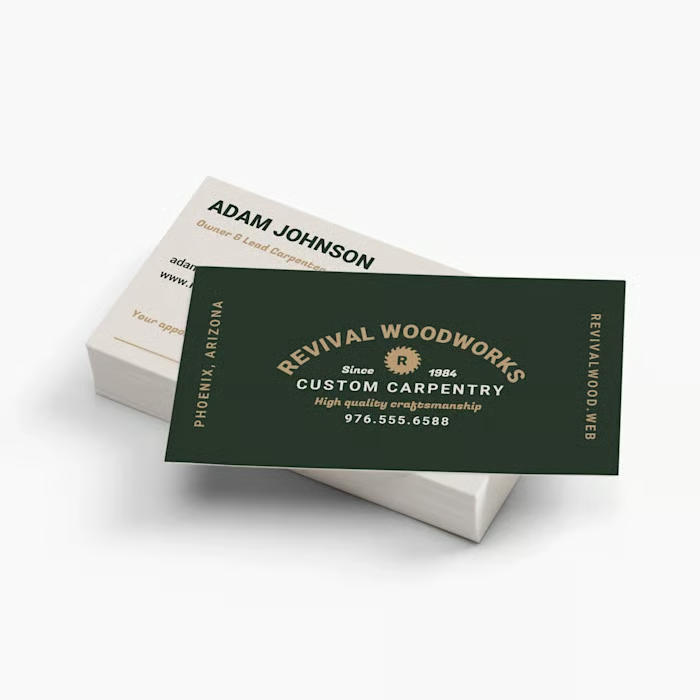
Expert Tip: For growing teams: treat business cards as a brand governance issue, not an individual preference. Every card should come from the same template, ordered through the same vendor. VistaPrint’s team ordering tools let you enforce a single template across employees, which is critical once multiple people represent your brand.
Signage and banners
Funnel stage: Awareness
Best for: Local visibility, event presence, and any situation where consistent physical brand exposure drives recognition over time
Signage is your highest-reach, lowest-cost-per-impression marketing material. Once it’s up, it works continuously without additional effort or spend. A banner at a job site, a window decal on a storefront, or a retractable banner at an industry event all generate passive brand exposure that compounds over time.
The question isn’t whether to invest in signage. It’s where it goes. Match the format to the context:
- Storefronts and permanent locations: window decals, A-frame signs, and indoor branded signage for daily ambient exposure
- Events and trade shows: retractable banners and table displays for professional presence in competitive environments
- Job sites and service areas: yard signs and vehicle graphics that turn active work into neighborhood-level advertising
- Campaign-specific locations: vinyl banners for grand openings, seasonal promotions, or new location launches
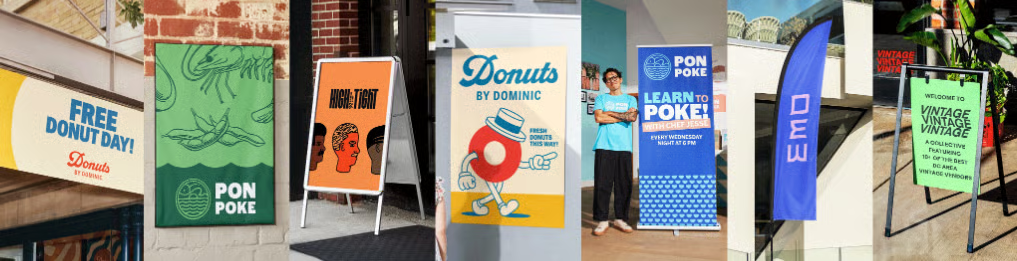
Expert Tip: The ROI on signage compounds. A yard sign at a job site doesn’t just reach the homeowner, it reaches every neighbor who drives or walks past. Home service businesses often report that a single yard sign generates one to two leads per job site. Track it with a unique phone number or QR code.
Flyers, postcards, and direct mail
Funnel stage: Awareness
Best for: Local promotions, event-driven campaigns, direct mail sequences, and any time-sensitive offer that benefits from a physical touchpoint
Flyers and postcards are campaign tools, not permanent fixtures. They work best when they carry a specific offer, a defined deadline, and a single call to action — and when they’re part of a multi-touch strategy rather than a standalone effort.
The key difference between a flyer campaign that works and one that wastes money is specificity. Generic awareness flyers (“We’re open!”) rarely move the needle. Offer-specific flyers (“20% off through Friday — scan here”) tied to a trackable landing page give you data to act on.
Where flyers and postcards earn their place in a growth-stage marketing system:
- Hyperlocal campaigns: Targeting specific streets, buildings, or neighborhoods where your ideal customer lives or works
- Campaign sequencing: A postcard in the mail followed by a retargeted digital ad to the same audience is more effective than either alone
- Time-sensitive offers: Promotions, seasonal sales, or event invitations where urgency is part of the message
- Re-engagement: Reaching lapsed customers with a specific reason to come back

Expert Tip: Pair every flyer or postcard campaign with a digital counterpart. Use the same headline, the same offer, and the same visual on your social ads. Prospects who see the message in both formats convert at a meaningfully higher rate than those who only see one.
Brochures, one-sheets, and sales materials
Funnel stage: Consideration
Best for: Sales meetings, proposal conversations, trade show follow-up, and any situation where a prospect needs more depth than a conversation alone can provide
This is the most strategically important category for a growing business with a sales team, and the most commonly underbuilt. Awareness materials get prospects interested. Sales materials get them across the line.
The distinction between a brochure and a one-sheet matters in practice. A brochure is an overview; it explains your business to someone who doesn’t know you yet. A one-sheet is a sales tool; it makes the case for a specific service to a specific buyer at a specific stage of the conversation. You need both, and they serve different moments.
How to think about your sales material stack:
- Company overview brochure: For first impressions — trade shows, reception areas, initial outreach packets
- Service or product one-sheets: One per core offering, focused on outcomes (not features), used as leave-behinds after discovery calls
- Case study cards: One per key industry or use case, used at proposal stage to demonstrate relevant proof
- Comparison sheets: For competitive situations where the buyer is evaluating alternatives; position your differentiators clearly and honestly
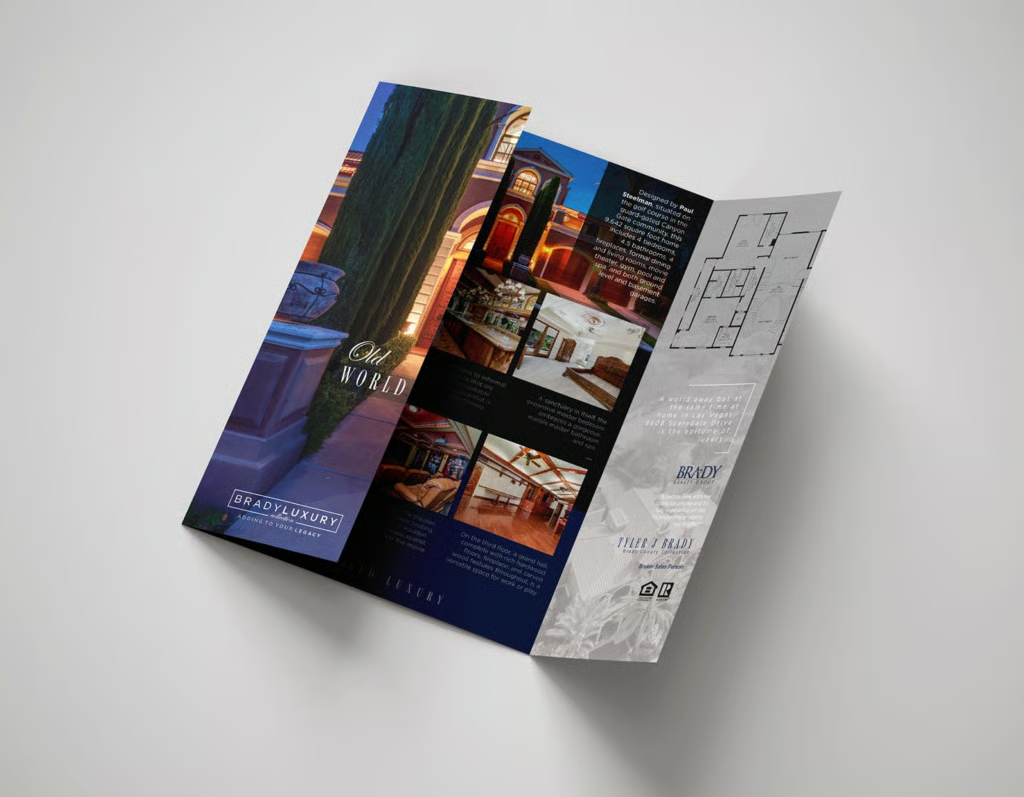
Expert Tip: One-sheets go stale. Set a quarterly calendar reminder to review pricing, results, and messaging. An outdated one-sheet in a prospect’s hands is worse than no one-sheet at all, it signals that you’re not paying attention to your own business.
Promotional products
Funnel stage: Retention
Best for: Client gifts, employee recognition, event giveaways, and post-purchase retention programs
Promotional products are a retention tool first and an awareness tool second. Their value comes from staying power: the right item sits on a desk, gets used daily, or travels with your customer, keeping your brand visible long after the initial interaction.
The most common mistake is optimizing for cost per unit instead of cost per impression. A $2 pen that breaks in a week delivers almost no value. A $12 notebook used daily for months generates thousands of impressions at a lower cost over time.
How to choose:
- Prioritize daily-use items: drinkware, notebooks, tech accessories, and apparel generate the most consistent exposure
- Match the item to the audience: a tumbler for regular customers, a quality pen for professional services, stickers for creative brands
- Align value with the relationship: low-cost items for events; higher-quality items for key clients and milestones
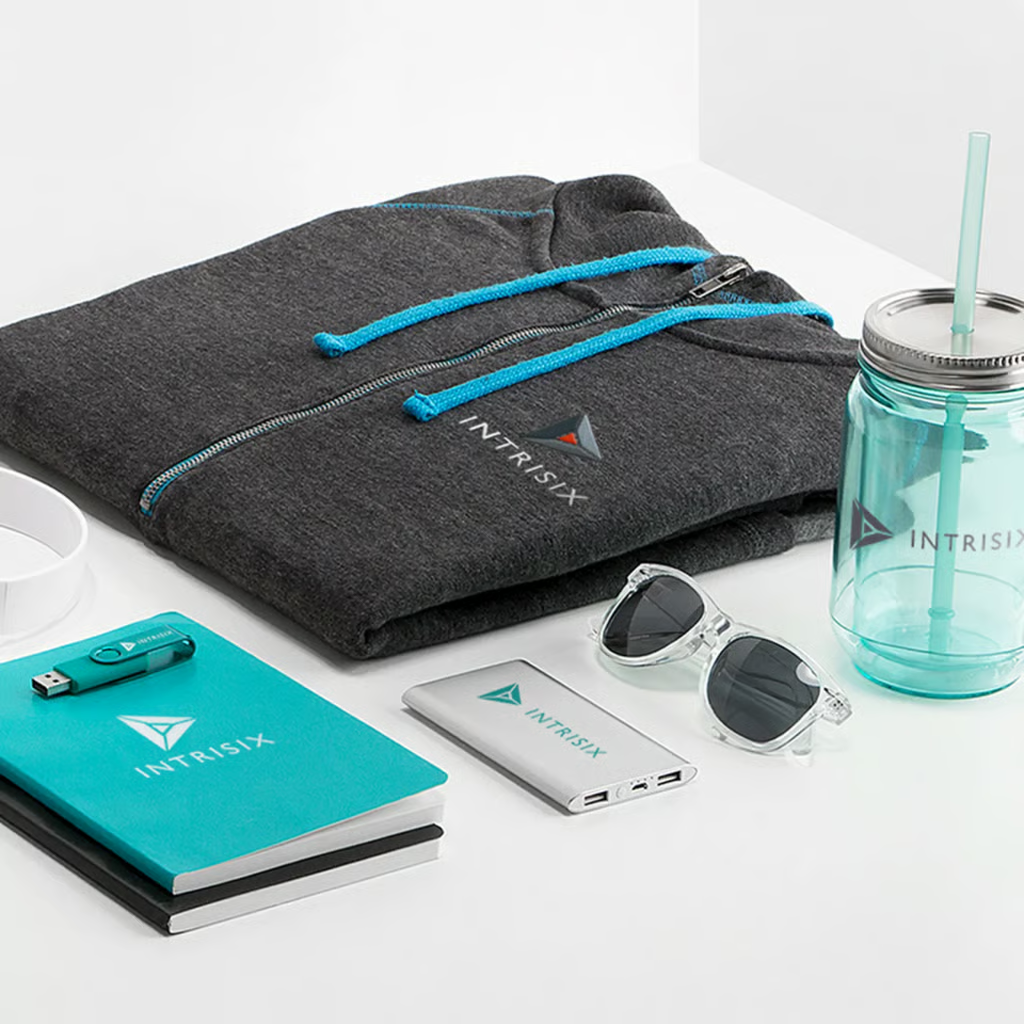
Expert Tip: Test promo products in small batches before scaling. Start with 25–50 units, see what actually gets used, then invest in the items that stay in rotation.
Branded apparel
Funnel stage: Awareness
Best for: Service businesses, field teams, event marketing, and any business where in-person interactions are a primary sales channel
Branded apparel turns your team into mobile marketing. Every service call, market visit, trade show appearance, or neighborhood errand becomes a brand impression when your team is consistently dressed. For service businesses especially, this is one of the highest-reach and most credibility-building investments available.
For growing businesses, the challenge is standardization. As soon as you have more than two or three people representing your brand in person, apparel needs to come from the same source and follow the same brand guidelines. Inconsistent logo placement, slightly different colors, or mismatched quality across team members sends a signal that isn’t intentional.
Apparel by role:
- Field and service teams: branded polo or t-shirt for every customer-facing interaction
- Trade show and event staff: coordinated outerwear or button-down for a polished, consistent look
- Leadership and sales: elevated options (vests, jackets) for client meetings and presentations

Expert Tip: Ordering apparel, signage, and business cards together through a provider like VistaPrint ensures color and logo consistency across every format without extra coordination.
Packaging and branded inserts
Funnel stage: Retention
Best for: Ecommerce, local delivery, retail, and any business where the post-purchase experience influences whether a customer comes back
If your business delivers goods, customized marketing materials like packaging are essential. The moment a customer opens your delivery is a high-attention moment where your brand identity should shine.
Packaging doesn’t require a large investment to make an impact. A branded label on an otherwise plain box, a thank-you card with a personal message, or a referral offer on a simple insert can meaningfully shift repeat purchase rates and review volume.
Retention-focused packaging elements worth building:
- Branded labels and stickers: the lowest-cost way to add visual identity to any package
- Thank-you cards: a short, personal message increases perceived care and sets up the ask for a review or referral
- Referral or loyalty inserts: the best time to ask for a referral is immediately after a successful delivery, when enthusiasm is at its peak
- Reorder or upsell cards: a targeted next-step offer relevant to what the customer just purchased

Expert Tip: Track the impact of packaging inserts with a unique promo code or QR code. If your referral insert has a code, you can measure exactly how many repeat orders and new customer referrals it generates. Most businesses are surprised by how high the ROI is.
Digital marketing materials
Funnel stage: Consideration
Every print material in this guide points somewhere. That “somewhere” is your digital layer. Digital materials aren’t a separate channel; they’re the connective tissue that links every other part of your marketing system. The QR code on your business card goes somewhere. The URL on your flyer goes somewhere. The testimonial on your brochure should also live online.
When your digital materials are built to complement your print stack, the whole system becomes more effective than either part alone.
Website
Best for: All business types. The website is the non-negotiable hub that every other material feeds into.
Your website is the destination everything else points to. It’s where print-driven curiosity either converts or dies. A business card, flyer, or brochure that earns someone’s attention is wasted if the website they land on doesn’t match the quality, message, and brand identity of the material that sent them there.
For growing businesses, the most important thing about a website isn’t how it looks; it’s whether it does a job. Every page should have a clear purpose and a clear next step. If a prospect lands on your homepage from a yard sign, can they figure out what you do, who you serve, and how to contact you in under ten seconds? If not, the yard sign investment is partially wasted.
Email templates
Best for: Sales teams, customer success, and any business with a repeat purchase cycle or referral program
Branded email templates serve two purposes in a growing business: they make communication faster by eliminating the need to write from scratch, and they make every email a brand impression. A sales follow-up, a post-purchase check-in, or a monthly newsletter all reinforce your identity when they arrive in a consistent, polished format.
Templates worth building early:
- Sales follow-up sequence (2–3 emails for post-meeting nurture)
- Post-purchase confirmation and thank-you
- Review or referral request (triggered 7–14 days post-purchase)
- Monthly or quarterly newsletter
Expert Tip: Use the same logo placement, headline font, and color scheme in your email templates that appear in your print materials. A prospect who receives a follow-up email after a trade show interaction should feel like they’re hearing from the same brand they encountered in person.
Social media graphics
Best for: Brand awareness, audience engagement, and digital reinforcement of offline campaigns
Social media graphics are your most visible digital asset for new audiences. Growing businesses shouldn’t necessarily aim for a high volume of content, but to produce consistent content that looks like it comes from the same brand every time. A set of five to seven templates for the most common post types (promotions, testimonials, tips, announcements, behind-the-scenes) is more valuable than 50 one-off designs.
Landing pages
Best for: Campaign tracking, lead generation, and any marketing material that includes a QR code or custom URL
A landing page is the most measurable marketing material you can create. Unlike a homepage, which serves multiple audiences and purposes, a landing page is built around a single offer and a single action. It removes every reason to leave before converting.
For growing businesses, the most important use of landing pages is as the digital destination for offline materials. The QR code on a flyer, the URL on a postcard, or the link in a sales email should all go to a page specifically built for that audience and that offer — not to a generic homepage that makes the visitor do all the work.
Which marketing materials do you need at each growth stage?
The right marketing materials depend on where your business is, not just what industry you’re in. A solo founder needs a different stack than a company with 25 employees and a dedicated sales team. Use this matrix to identify what to prioritize at your current stage — and what to build toward next.
| Material | Pre-launch / Solo | Early growth (2–10 staff) | Scaling (10–50 staff) | Established (50+) |
|---|---|---|---|---|
| Business cards | ✓ Must-have | ✓ Must-have | ✓ Must-have | ✓ Must-have |
| Brochures / one-sheets | — | ✓ Add now | ✓ Must-have | ✓ Must-have |
| Flyers & postcards | ✓ Must-have | ✓ Must-have | ✓ Must-have | Selective |
| Signage & banners | Selective | ✓ Add now | ✓ Must-have | ✓ Must-have |
| Promo products | — | Selective | ✓ Add now | ✓ Must-have |
| Branded apparel | — | Selective | ✓ Add now | ✓ Must-have |
| Packaging & inserts | — | ✓ Add now | ✓ Must-have | ✓ Must-have |
| Email templates | ✓ Must-have | ✓ Must-have | ✓ Must-have | ✓ Must-have |
| Social media graphics | ✓ Must-have | ✓ Must-have | ✓ Must-have | ✓ Must-have |
| Landing pages | — | ✓ Add now | ✓ Must-have | ✓ Must-have |
| Case studies / one-pagers | — | — | ✓ Add now | ✓ Must-have |
| Pitch decks / proposals | — | — | ✓ Add now | ✓ Must-have |
Expert Tip: The most common growth-stage error is an awareness-heavy, conversion-light stack. If you have signage and flyers but no one-sheets, case studies, or proposals, you’re generating interest you can’t close. Add the sales enablement layer before you invest more in awareness.
How to scale your materials without losing brand consistency
Brand consistency is easy when one person manages marketing material design. It becomes a challenge the moment multiple departments are creating their own assets.
Growing businesses need a materials system, not just materials. That means:
A centralized brand asset library
Every person who creates or orders marketing materials should pull from the same source of truth: one folder containing the approved logo files, the correct hex codes, the approved fonts, and the master templates. When files are scattered across email threads, personal desktops, and Dropbox folders, inconsistency is inevitable.
What belongs in the library:
- Logo files in every format you use (PNG, SVG, PDF) in full color, black, and white versions
- Brand color palette with hex, RGB, and CMYK values
- Typography specifications and any licensed font files
- Approved boilerplate: company description in one sentence, one paragraph, and one page
- Template files for every regularly produced material
- Print specifications: bleed settings, safe zone dimensions, resolution requirements
A single print vendor relationship
Every time you use a different vendor for a different material, you introduce the risk of inconsistency: slightly different color reproduction, a logo that printed at a different scale, a paper weight that doesn’t match your other materials. The coordination overhead also compounds quickly once you’re managing multiple vendor relationships, file formats, and delivery timelines.
Using one provider for business cards, brochures, signage, apparel, and promo products isn’t just convenient — it’s a brand consistency strategy. This is where providers like VistaPrint stand out. Instead of managing separate vendors for business cards, signage, apparel, and promo products, you can produce everything from one system, keeping colors, layouts, and templates consistent across every piece.
VistaPrint covers the full range of materials a growing business needs under one roof, with templates that make it practical for non-designers to produce on-brand materials without requiring a designer for every order.
A materials review cadence
Marketing materials go out of date. Pricing changes. Services evolve. Key results improve. Contact information moves. Set a standing calendar reminder—quarterly for high-use sales materials, annually for brand and capability assets — to review every active piece and retire anything that no longer reflects your current business accurately.
Expert Tip: When you update a material, version-control it with a date in the filename (e.g., “one-sheet-consulting-Q2-2025.pdf”) and archive the previous version. This prevents outdated materials from staying in circulation after they’ve been replaced.
Growth-stage marketing material mistakes to avoid
These aren’t the standard “use high-resolution images” mistakes. These are the strategic errors that specifically undermine growing businesses — the ones that are invisible until they’re costing you deals.
| Mistake | What it looks like | How to fix it |
|---|---|---|
| Siloed material creation | Different teams or departments produce their own materials without a shared brand system. The result: five versions of your logo across six different pieces. | Designate one owner for brand assets and use a shared template library. Vistaprint’s multi-user account tools help growing teams stay aligned. |
| No sales enablement layer | Businesses invest in awareness materials (flyers, signage) but never build the sales-stage materials (one-sheets, case studies, proposals) that actually close deals. | Map materials to every stage of your sales cycle, not just the top of the funnel. Every rep should have a leave-behind for every conversation type. |
| Treating print and digital as separate budgets | Marketing owns the website and social; ops handles signage and business cards. The result is two disconnected brand experiences that confuse buyers. | Audit print and digital together. The QR code on your business card should lead to a landing page that matches it in tone, design, and offer. |
| Scaling materials before validating messaging | Ordering 5,000 brochures before testing whether the headline resonates, or building a full sales deck before closing your first five deals. | Test in small batches. Platforms like VistaPrint make it practical to test materials in smaller quantities before committing to larger orders. |
| No version control on sales materials | Reps circulate outdated one-sheets with old pricing or retired services. Buyers notice the inconsistency even when they can’t name it. | Date-stamp all materials and set a quarterly review. Archive old versions in a central folder so nothing outdated stays in circulation. |
| Ignoring the retention stack | Most growing businesses invest heavily in acquisition materials and almost nothing in post-purchase materials that drive repeat business and referrals. | Build a retention material kit: branded packaging, thank-you cards, loyalty inserts, and a referral offer. These are often the highest-ROI materials you can produce. |
Frequently asked questions (FAQs)
What are marketing materials?
Marketing materials are branded assets, whether print or digital, used to attract prospects, support sales, and retain customers. The most effective materials are tied to a specific stage of the customer journey and designed to do one job well.
What’s the difference between marketing materials and sales enablement materials?
Marketing materials promote your business broadly. Sales enablement materials, like one-sheets, case studies, and proposals, are designed to support sales conversations and move prospects toward a decision.
How do you decide which marketing materials to prioritize?
Focus on the weakest stage in your customer journey. If awareness is low, invest in visibility. If conversions are low, build sales materials. If retention is weak, add post-purchase and referral materials.
How do print and digital marketing materials work together?
Print builds trust and recall; digital adds reach and tracking. The most effective campaigns connect both; for example, a flyer that drives to a landing page with a clear next step.
How should marketing materials change as a business grows?
Early-stage businesses need a basic set of materials. As you grow, shift toward sales enablement and brand consistency. At scale, focus on systems that standardize and manage all materials.
Are print marketing materials still worth investing in?
Yes. Print is effective for local visibility and in-person interactions. Pair it with digital tracking like QR codes or custom URLs to measure performance.
Can growing businesses create marketing materials without a dedicated designer?
Yes. Tools like Canva and VistaPrint templates make it easy to create professional materials. Start with a defined brand kit and apply it consistently.
How do you track the ROI of marketing materials?
Use QR codes, custom URLs, promo codes, or call tracking for print. Use UTM parameters for digital. Every material should include at least one trackable element.
Bottom line
Marketing materials don’t drive results on their own. The system behind them does.
Growing businesses don’t need more assets; they need the right materials at the right stage of the customer journey, supported by a consistent brand and a clear path from print to digital. When every piece has a defined role, awareness leads to conversations, conversations lead to decisions, and decisions lead to repeat business.
As your team grows, the challenge shifts from creating materials to managing them. Consistency, speed, and coordination become just as important as design.
If you’re building or standardizing your marketing materials, VistaPrint offers templates and production across every category in this guide, from business cards and brochures to signage, apparel, and packaging, so you can scale without losing consistency.