


For unified communications (UC) solutions, Vonage has long been a popular choice for businesses that want to integrate voice, video, and messaging into a single, user-friendly platform.
With a reputation for dependability and a wide range of features, it’s clear why many organizations choose Vonage. However, like any service, it has its drawbacks. Some businesses may encounter additional fees, limited call plan options, and collaboration tools that fall short.
If you’re looking for something that better fits your business needs, I’ve explored six standout Vonage alternatives with more competitive pricing and a broader range of features. Dive in to discover the top Vonage competitors for 2026 and find the perfect match for your communication needs.
| Top Vonage competitors | Best for | Starting monthly price (per user, per month) |
|---|---|---|
| GoTo Connect | International calling | Customized |
| Zoom Phone | Low-cost VoIP service | $12 |
| RingCentral | Unified communications | $30 |
| Nextiva | Customer experience | $23 |
| Ooma | Straightforward phone service | $19.95 |
| Phone.com | Growing teams | $18 |
Why you can trust TechnologyAdvice
TechnologyAdvice follows a structured editorial process designed to help buyers make informed software decisions. Our team reviews dozens of buyers’ guides each year using consistent, data-driven criteria grounded in real business use cases.
For this guide, I evaluated the top Vonage competitors based on pricing, features, integrations, security, ease of use, and overall business value. I also considered how companies like Vonage support everyday workflows and where their limitations could affect different teams.
This analysis draws on comparative research, product documentation, and verified user feedback from third-party platforms. I used these sources to assess each provider’s strengths, drawbacks, and fit for different business needs.
Methodology: How I chose the best Vonage alternatives
To identify the best Vonage alternatives, I evaluated six VoIP providers based on their business calling capabilities, pricing, usability, and scalability. I also considered factors that affect switching providers, including number portability, integrations, and feature availability across plans.
I used a weighted rubric covering nine categories:
- Pricing (15%): I compared contract requirements, annual and volume discounts, user allowances, additional costs, plan flexibility, and overall value. I also considered free plans and trials.
- General features and interface (20%): I reviewed call routing, recording and storage, voicemail, mobile apps, training resources, and options for supporting business growth.
- Core VoIP features (15%): I assessed published reliability information, user-reported call quality, number portability, international calling, voicemail-to-email functionality, and CRM compatibility.
- Advanced features (15%): I compared video conferencing, virtual fax, customizable auto-attendants, group ringing, hunt groups, and interactive voice response capabilities.
- Integration and compatibility (10%): I examined supported devices and operating systems, data import and export options, email and calendar integrations, and API availability.
- User experience and usability (5%): I considered interface design, learning curve, customization, and accessibility based on product documentation and user feedback.
- Security and compliance (10%): I reviewed documented encryption, compliance standards, data privacy practices, and network security measures.
- Customer support and service (5%): I compared support hours, contact channels, self-help resources, and user feedback about responsiveness and service quality.
- User scores (5%): I incorporated customer ratings from the review platforms specified in the rubric, including Capterra, G2, and Software Advice.
This analysis draws on comparative research, published pricing, product documentation, and user feedback. I used these sources to assess each provider’s strengths, limitations, and suitability for businesses considering a switch from Vonage.
Why should you consider an alternative to Vonage?
Vonage is a cloud communications provider that offers flexible voice, video, SMS, and messaging services. With its fully customizable UC system, apps like Vonage enable businesses to easily add users, phone numbers, and premium features according to their specific needs.
Although Vonage’s customized approach offers flexibility, monthly costs can quickly increase if you need full access to its advanced features. Many standard capabilities, such as call recording and call queues, that are included in other providers’ entry-level plans are available as premium add-ons with Vonage.
Therefore, many businesses seek Vonage business alternatives for more competitive pricing, improved scalability, and better integration with popular business applications. Enhanced customer support is also a crucial factor in their decision-making process. Additionally, some alternatives offer modern AI-driven features that can significantly boost productivity and communication efficiency.
Who are the leading Vonage competitors in the market?
| Vonage competitors | AI call summaries | Online fax | Calls to 50+ countries included | Rating out of 5 |
|---|---|---|---|---|
| GoTo Connect | Add-on / higher tiers | ✅ | ✅ | 4.73 |
| Zoom Phone | ✅ | ✅ | ❌ | 4.72 |
| RingCentral | ✅ | Higher tiers | ❌ | 4.71 |
| Nextiva | ✅ | Add-on / higher tiers | ❌ | 4.57 |
| Ooma | Higher tiers | ✅ | ❌ | 4.43 |
| Phone.com | ❌ | ✅ | ❌ | 4.10 |

GoTo Connect: Best for international calling
Pros
- Unlimited calls to 50+ countries
- Scalable phone plans
- Complete VoIP phone features
- Combines phone, SMS, chat, and meetings
- Customizable dial plans
Cons
- Lacks transparent pricing
- Smart call routing features are exclusive to the contact center plan
- Toll-free minute allocation is the same across all plans
Why I chose GoTo Connect over Vonage
GoTo Connect stands out as the best overall Vonage alternative, offering unlimited international calls to over 50 countries. Usually, VoIP and cellular providers charge per-minute rates for international calls, which can quickly become expensive if your business makes frequent overseas calls.
For easier global calling, all GoTo Connect plans include over 100 business phone features such as unlimited call routing, auto-attendants, call queues, and call handling. Local, toll-free, and vanity numbers are available, but international numbers are not. So, while GoTo Connect is great for international calling, if you need to establish a regional presence overseas, check out Phone.com.
Gallery
Key features
- Smart call routing: Route incoming calls to multiple phones in a specific order so everyone on the team is always reachable.
- Multi-site compatible: Manage your company’s phone systems across multiple locations and tailor users and devices by site.
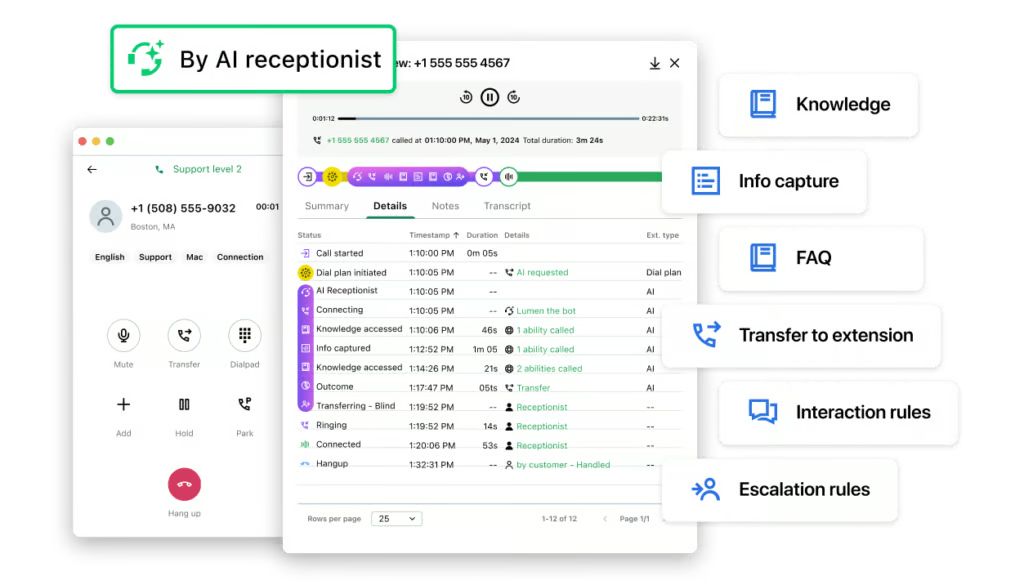
- Customizable dial plans: Create call flows with drag-and-drop tools and set different patterns for after-hours, weekends, and holidays.
- AI receptionist: An AI-powered assistant automatically provides call handling and information to customers, ensuring that each interaction receives a sufficient response.
- Intercom: Contact your colleagues wherever they are with the pager system, which connects you with individuals or an entire ring group.
Pricing
GoTo Connect offers the following packages:
- Phone System: Business calling, call routing, 250-participant video meetings, and calls to 50+ countries.*
- Phone System + AI Receptionist: Adds AI call answering, routing, FAQ responses, and 100 AIR credits.
- Customer Experience (CX): Adds shared inboxes, digital messaging, surveys, AI call summaries, and reporting.
- CX Complete: Combines phone, AI receptionist, and CX tools with advanced analytics and webinars.
- Contact Center: Adds skills-based routing, queue callbacks, auto dialing, and agent monitoring and coaching.
*International calling availability varies by region.
Contact GoTo Connect for a quote.

Zoom Phone: Best low-cost VoIP service
Pros
- Clean and intuitive interface
- Mix types of plans in an account
- Unlimited auto attendants/IVR
- Elevate calls to video meetings
- Local phone service in over 40 countries
Cons
- More advanced call analytics requires an add-on
- Virtual fax isn’t available on the Global Select plan
- Limited app integrations
Why I chose Zoom Phone over Vonage
Zoom Phone is one of the most affordable alternatives to Vonage, with monthly plans starting at just $10. With a low-cost subscription, you get essential unified communication features such as VoIP calls, virtual meetings, team chat, and integrations with third-party apps. It also lets users combine different monthly plans based on their calling needs.
Although Zoom Phone offers cost savings, it falls short in customer relationship management (CRM) integrations, providing native integrations only with Salesforce. If you’re seeking a Vonage alternative that integrates easily with your CRM software, consider Nextiva, a customer engagement platform that integrates with popular CRMs such as HubSpot, Salesforce, and Zendesk.
Gallery
Key features
- Elevate to a meeting: Easily convert an ongoing phone call into a Zoom video meeting.
- Call delegation: Assign another user to handle incoming calls on your behalf.
- Call takeover: Allow a supervisor to monitor an ongoing call and seamlessly take control.
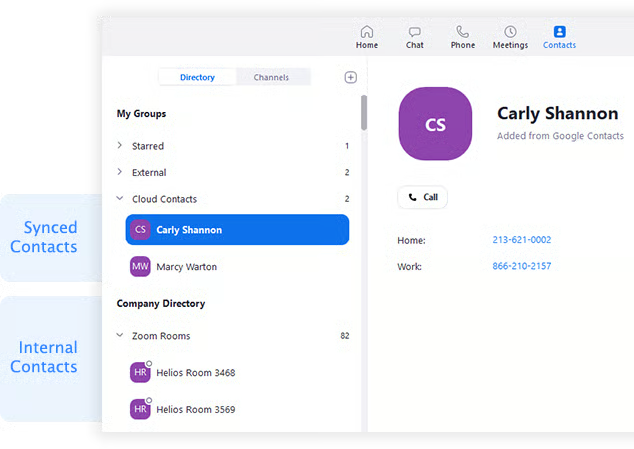
- Dial-by-name directory: Enables employees and customers to easily connect with specific individuals within the organization.
- AI companion: Zoom’s AI assistant can provide post-call summaries and extract tasks and priorities from your voicemails.
Pricing
| Zoom Phone plans | US & CA Metered | US & CA Unlimited | Pro Plus | Business Plus |
|---|---|---|---|---|
| Monthly price, billed annually | $10.50/user | $16/user | $20.50/user | $24.50/user |
| Monthly price, billed monthly | $12/user | $18/user | $24/user | $29/user |
Free trial: 7 days
Zoom Phone also offers Workplace plans that include expanded access to collaboration tools.

RingCentral: Best for unified communications
Pros
- Complete call management features
- Over 500 business apps and integrations
- Supports various communication channels
- Comprehensive analytics tools
Cons
- Pricier than other alternatives
- CRM integrations aren’t available on the base plan
- Free trial is limited to a maximum of five users
Why I chose RingCentral over Vonage
RingCentral is a comprehensive alternative to Vonage, offering VoIP, video calls, fax, and messaging all in one unified platform. The app features call control functions, including call recording, call flipping, transfers, and monitoring. You can host HD video meetings with up to 200 participants, and the team chat offers file sharing, calendar, and task management for efficient collaboration.
While RingCentral is a solid solution for large organizations and a strong alternative to Vonage, its extensive features may overwhelm small teams with simpler VoIP needs. Instead, I recommend Ooma, which is a straightforward phone solution with competitive pricing and less complexity than an advanced communication platform.
Also read: Vonage vs RingCentral: Which VoIP is Best?
Gallery
Key features
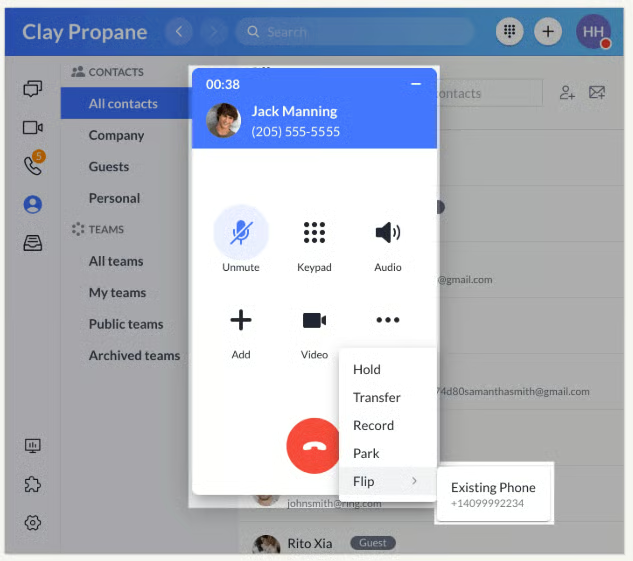
- Call flip: Transfer an ongoing call to another device (mobile phone, softphone, or desk phone) without interruption.
- Answering rules: If your team has more than one RingCentral number, this feature lets you apply unique routing rules, business hours, and greetings to different numbers.
- SMS automation: Set automatic responses to text messages received after business hours, when you’re on vacation, or for addressing general inquiries.
- AI assistant: AI in the video and phone platform allows you to transcribe calls and meetings for later review.
- Call log reports: View and manage your call history and recordings to access summaries and analytics in your workspace.
Pricing
| RingCentral Business Phone plans | Core* | Advanced* | AIR CE Bundle | AI CE Bundle |
|---|---|---|---|---|
| Monthly price, billed annually | $20/user | $25/user | Custom | Custom |
| Monthly price, billed monthly | $30/user | $35/user | Custom | Custom |
Free trial: 14 days
*Custom pricing is available for plans with more than 100 users.

Nextiva: Best for customer experience
Pros
- Generous toll-free minute allocation
- Displays all communications in one place
- Social media and review management
- Smart call routing with AI transcription
- All plans have 24/7 customer support
Cons
- Lacks vanity numbers
- CRM integrations require an add-on
Why I chose Nextiva over Vonage
Nextiva is my top choice for customer experience management (CXM) tools and is a great alternative to Vonage. The platform consolidates customer data across channels, enabling real-time engagement. Key features include call pop, contact management, sentiment analysis, and automatic surveys to enhance customer interactions.
At the same time, Nextiva’s monthly plans are too costly for budget-conscious teams, as discounts are aimed at larger organizations with longer contracts. If you’re seeking a more affordable alternative to Vonage, I suggest Zoom Phone, which offers plans starting at just $12 per user monthly.
Gallery
Key features
- Call queues: Manage incoming calls by placing them in a virtual waiting line and holding them until an agent is available.
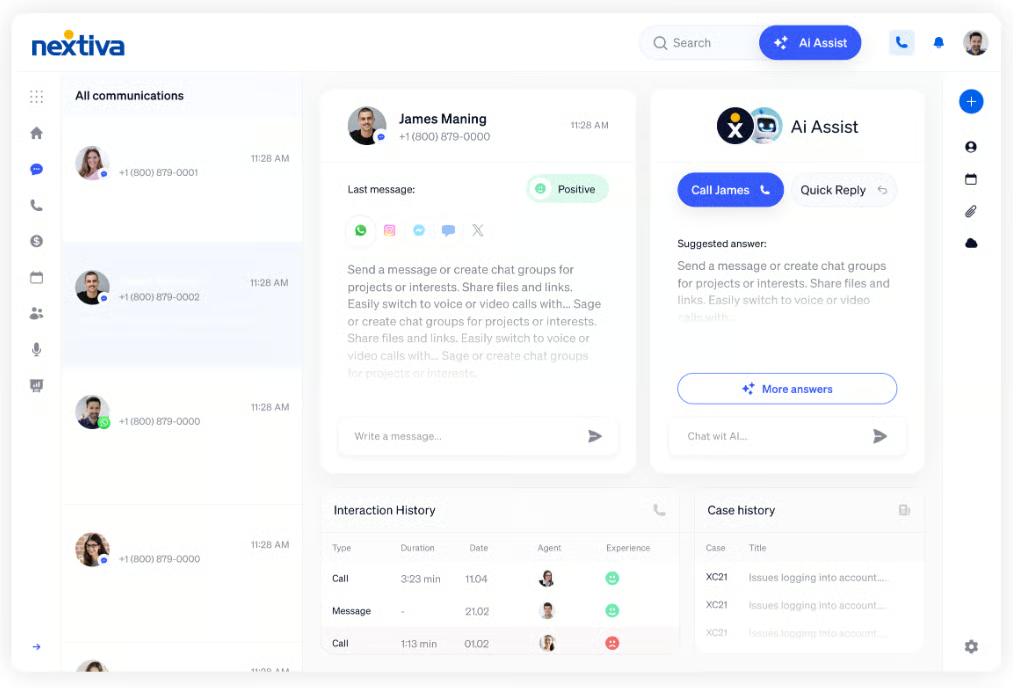
- Shared inbox: Route all conversations through a unified inbox, with channels for email, chat, messaging, and social media.
- Threaded conversations: View all customer interactions in a single stream, including voice, text, video, and email.
- Call group: This feature rings multiple team members either sequentially or simultaneously when an incoming call arrives, ensuring no call is missed.
- Call park: Put a call on hold and retrieve it from any other phone within your office.
Pricing
| Nextiva plans | NEXT Core | NEXT Engage | NEXT Scale | Enterprise |
|---|---|---|---|---|
| Monthly price, billed annually | $15/user | $25/user | $75/user | From $75/user |
| Monthly price, billed monthly | $23/user | $50/user | N/A | N/A |
Ooma: Best straightforward phone service
Pros
- Free home phone plan
- Up to 50 business phone features
- Budget-friendly international call rates
- Call mobility capabilities
- Free number porting
Cons
- Lacks international numbers
- Limited app integrations
- Conference calling is capped at 100 participants
Why I chose Ooma over Vonage
Ooma offers a user-friendly phone solution for small businesses, enabling setup in under 15 minutes without requiring technical expertise. All plans come with over 50 essential voice features. Home-based businesses can also choose the free Ooma Basic plan, which includes standard call features like call waiting and voicemail.
While Ooma Office emphasizes its simplicity, the platform doesn’t integrate with many business applications like Slack, HubSpot, and Shopify. If you need a fully integrated business phone system, try RingCentral as an Ooma alternative, which offers a large selection of third-party apps for various needs, including CRM, healthcare, marketing automation, and productivity.
Gallery
Key features
- Conference bridge: Host a virtual conference room with up to 10 participants.
- Extension monitoring: Monitor the status of all Ooma Office extensions and easily perform actions such as call transfer, speed dial, and three-way calling with a single click.
- Custom ringtone: Assign a unique ringtone to a ring group or call queue to indicate the nature of incoming calls.
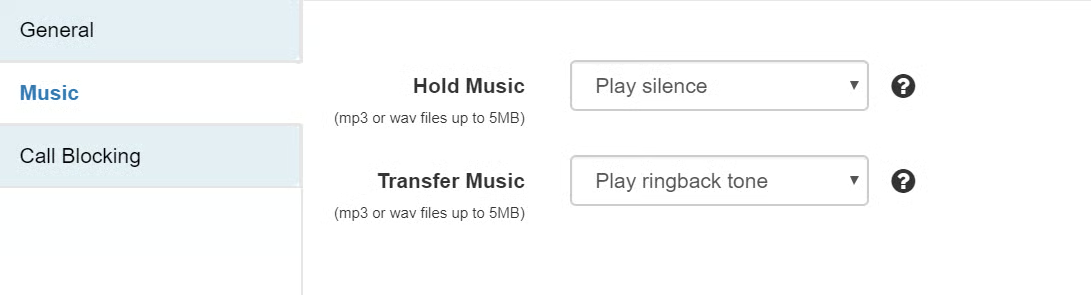
- Transfer music: Instead of standard hold music, upload an audio file to play when a caller is transferred to another extension.
- Call blocking: Keep your phone lines clear of spammers by blocking specific numbers or anonymous callers.
Pricing
- Essentials: $19.95/user billed monthly
- Pro: $24.95/user billed monthly
- Pro Plus: $29.95/user billed monthly
- Enterprise: Contact sales for pricing

Phone.com: Best for growing teams
Pros
- Unlimited calling and messaging
- Pay local call rates for up to 8 countries
- Access to live answering services
- HIPAA-compliant video conferencing
- Rich a la carte features
Cons
- No free trial
- Call recording incurs a fee on the base plans
- CRM integrations are only available on Pro plans
- Video meetings are capped at 100 participants
Why I chose Phone.com over Vonage
Phone.com is a flexible virtual phone system that offers businesses three different plans, each tailored to specific teams. While all plans provide traditional VoIP features like unlimited voice calls and text messaging, the higher-tier plans include additional features, such as AI-powered call and voicemail transcription.
But one downside of Phone.com is that it relies on the paid third-party service Zapier to expand its integration options. If you need numerous integrations and want to avoid additional costs, RingCentral may be a better choice, as it offers over 500 built-in business apps and integrations.
Gallery
Key features
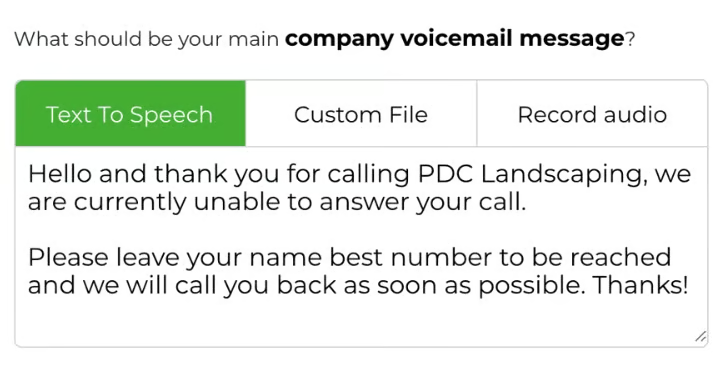
- Text-to-greeting: Create a phone greeting and choose your voice-over narrator from a selection of over 40 automated personalities.
- Live receptionist: Have a team of US-based professional live receptionists to answer your business calls and schedule client appointments. Monthly plans start at $90.
- Auto-attendant: Set up your phone menu with customized recordings that convey general information, such as business hours, company extensions, and special announcements.
- Video meetings: Host video conference calls with up to 100 participants and access meeting features like breakout rooms, screen sharing, and whiteboard.
- Fax-from-phone: Upload documents and web content from your computer or mobile device, then send them with a cover page using your Phone.com account.
Pricing
| Phone.com plans | Basic | Plus | Pro |
|---|---|---|---|
| Monthly price, billed annually | $15/user | $22.50/user | $33.33/user |
| Monthly price, billed monthly | $18/user | $27/user | $40/user |
How do you choose the best Vonage alternative?
As the voice-over-internet-protocol (VoIP) industry continues to expand, it offers several alternatives tailored to different communication needs. The leading Vonage competitors provide a comprehensive communications suite, including voice, video meetings, team chat, and collaboration tools. With a unified platform, businesses can streamline workflows, boost productivity, and ensure smooth interaction with clients and team members.
GoTo Connect ranks as the top overall Vonage alternative, thanks to its international calling and scalable monthly plans. For budget-conscious teams, Zoom Phone delivers all-in-one VoIP features for $12 per user per month. Meanwhile, Nextiva specializes in unified communications platforms that effectively track customer journeys.
Large organizations seeking value for money can benefit from RingCentral’s complete business communications software. But, if you’re managing a small team, a simple solution like Ooma might be more suitable, while Phone.com is perfect for growing teams.
Frequently asked questions (FAQs)
How do Vonage competitors compare on pricing?
Vonage alternatives typically offer competitive pricing structures. Providers like Zoom Phone and Phone.com often offer flexible, tiered plans that scale with team size, while Ooma is known for its budget-friendly packages designed specifically for startups and small businesses.
Which Vonage competitor is best for small businesses?
Ooma is often the leading competitor to Vonage for small businesses because of its affordability, ease of setup, and reliable customer service. Specifically, Ooma provides a range of essential VoIP features with cost-effective plans designed for smaller teams.
What is the most secure alternative to Vonage?
Choosing a secure alternative to Vonage varies based on your company’s specific security and compliance needs. RingCentral stands out as a strong option, offering robust data protection and features like multi-factor authentication, identity access management, and end-to-end encryption for voice, video, and messaging.