HubSpot Prospecting Agent and Apollo.io both use AI to reduce manual prospecting work, but they solve the problem from different starting points. HubSpot works from the CRM outward, using customer data and buying signals to research prospects and prepare personalized email outreach. Apollo starts with its native B2B database and adds enrichment, sequencing, calling, and workflow automation.
In this HubSpot vs Apollo comparison, I found that HubSpot Prospecting Agent is the better fit for businesses that want AI prospecting grounded in HubSpot Smart CRM. It offers strong research, review controls, and connected pipeline reporting. Apollo.io remains the stronger choice for teams that need a native B2B database and multichannel outbound execution on a single platform.
Key takeaways
- Choose HubSpot Prospecting Agent if your team already uses HubSpot and wants CRM-native research, personalized email outreach, human review controls, and pipeline attribution.
- Choose Apollo.io if you need a built-in B2B database, advanced contact search, enrichment, email sequences, calling, and deliverability tools.
- HubSpot Prospecting Agent wins overall, 4.59 to 4.54, based on its advantages in pricing and value, AI research, CRM connectivity, governance, and usability. Apollo.io leads in prospecting data and multichannel outreach.
- Prioritize prospects using CRM data, engagement history, and buying signals
- Research accounts and contacts before initiating outreach
- Draft personalized emails using defined personas and messaging rules
- Review emails before sending or automate outreach within set guardrails
Apollo vs HubSpot Prospecting Agent at a glance
| HubSpot Prospecting Agent | Apollo.io | |
|---|---|---|
| Overall score | 4.59/5 | 4.54/5 |
| Best for | CRM-native AI email prospecting | B2B prospecting and multichannel outbound |
| Starting price | $7/user/month + $1 per lead | Free or $49/user/month |
| Pricing and value | Transparent usage model; strong value for existing HubSpot users | Lower-cost entry, but credits and add-ons can complicate total cost |
| Prospecting data and targeting | Strong CRM-based targeting with enrichment options | Deeper native prospect data, enrichment, and search capabilities |
| AI research and personalization | Strong CRM-contextual research and personalized email generation | Strong AI personalization using native prospect and account data |
| Outreach and automation | Email-first automation with human review and autonomous modes | Broader multichannel outreach across email, calls, tasks, and workflows |
| CRM, integrations and reporting | Deep native CRM integration, governance, and pipeline attribution | Strong CRM integrations and reporting, with greater reliance on synchronization |
| Usability, support and expert assessment | Easier adoption for teams already using HubSpot | Flexible and approachable, but broader functionality requires more setup |
HubSpot Prospecting Agent: Best for CRM-native AI prospecting
Overall Reviewer Score:
4.59/5
Pricing and value:
4.66/5
Prospecting data and targeting:
4.44/5
AI research and personalization:
5/5
Outreach and automation:
3.99/5
CRM, integrations, and reporting:
4.93/5
Usability, support, and expert score:
4.73/5
HubSpot Prospecting Agent helps teams research prospects, personalize outreach, and automate email prospecting directly within HubSpot Smart CRM.
When I reviewed HubSpot Prospecting Agent, what stood out most was how naturally prospecting fits into the existing CRM workflow. The agent can use contact, company, engagement, and pipeline context to research prospects and create personalized emails. Teams can also choose between reviewing outreach before it is sent or allowing the agent to operate more autonomously.
Pros
- Deeply integrated with HubSpot Smart CRM and pipeline data
- CRM-grounded AI research and personalized email outreach
- Supports both human review and autonomous prospecting
Cons
- Primarily focused on email rather than multichannel outreach
- Requires an eligible HubSpot subscription plus usage-based credits
- Costs can increase with higher researched-lead volume

Apollo.io: Best for B2B prospecting and multichannel outbound
Overall Reviewer Score:
4.54/5
Pricing and value:
4.10/5
Prospecting data and targeting:
4.83/5
AI research and personalization:
4.40/5
Outreach and automation:
4.81/5
CRM, integrations, and reporting:
4.44/5
Usability, support, and expert score:
4.50/5
Apollo.io combines a large B2B prospect database with enrichment and multichannel outbound tools in one platform.
In my evaluation, I was impressed with Apollo.io’s breadth of prospecting workflow. Teams can find and enrich prospects, build targeted lists, run email and calling sequences, automate follow-up, and measure results within the same platform. That combination makes Apollo.io particularly well suited to outbound teams that want native prospect data and engagement capabilities without relying on as many separate tools.
Pros
- Large native B2B contact and company database
- Multichannel outreach across email, calls, and sales tasks
- Built-in enrichment, automation, and deliverability tools
Cons
- Contact data may require verification before high-volume outreach
- Credits, seats, and add-ons can make total costs harder to predict
- Broader functionality requires more setup and governance
Apollo vs HubSpot Prospecting Agent: A detailed comparison
I compared Apollo vs HubSpot Prospecting Agent using the same criteria from the AI prospecting software buyer’s guide: pricing and value, prospecting data and targeting, AI research and personalization, outreach and automation, CRM, integrations and reporting, and usability, support and expert assessment. Use the jump links below to go directly to each comparison:
- Pricing and value
- Prospecting data and targeting
- AI research and personalization
- Outreach and automation
- CRM, integrations and reporting
- Usability, support and expert assessment
Pricing and value
Apollo.io offers a lower-risk entry point, as teams can start with a free plan. It also consolidates native prospect data, enrichment, sequencing, calling, workflows, and analytics, which can reduce the need for separate products. However, its credit structure, add-ons, and feature limits can make the total cost harder to forecast as usage grows.
HubSpot uses a consumption model that it estimates at about $1 per researched lead. Buyers must also account for an eligible HubSpot subscription and HubSpot Credits, but the published unit estimate makes prospecting costs comparatively transparent and easier to model. That combination gave HubSpot the higher score for pricing and value in the final rubric.
| HubSpot Prospecting Agent | Apollo.io | |
|---|---|---|
| My rating | 4.66/5 | 4.10/5 |
| Free or low-risk entry | Eligible subscription + usage-based credits | Free plan available |
| Pricing transparency and predictability | Public ~$1-per-researched-lead estimate; subscription and credits also apply | Free plan is clear; paid credit costs vary |
| Scalability and usage economics | Usage-based model scales with activity, but higher volume increases cost | Seats, credits, and add-ons require more cost planning at scale |
| Included capabilities and consolidation | CRM data, signals, research, drafting, and pipeline context in one environment | Data, enrichment, sequences, dialer, automation, analytics, and deliverability |
Winner: HubSpot Prospecting Agent
In my review of HubSpot vs Apollo, HubSpot Prospecting Agent takes the lead in pricing and value with a more predictable usage model. In addition, its CRM-native setup consolidates more of the prospecting workflow. The value proposition is particularly strong for teams already using HubSpot.
Prospecting data and targeting
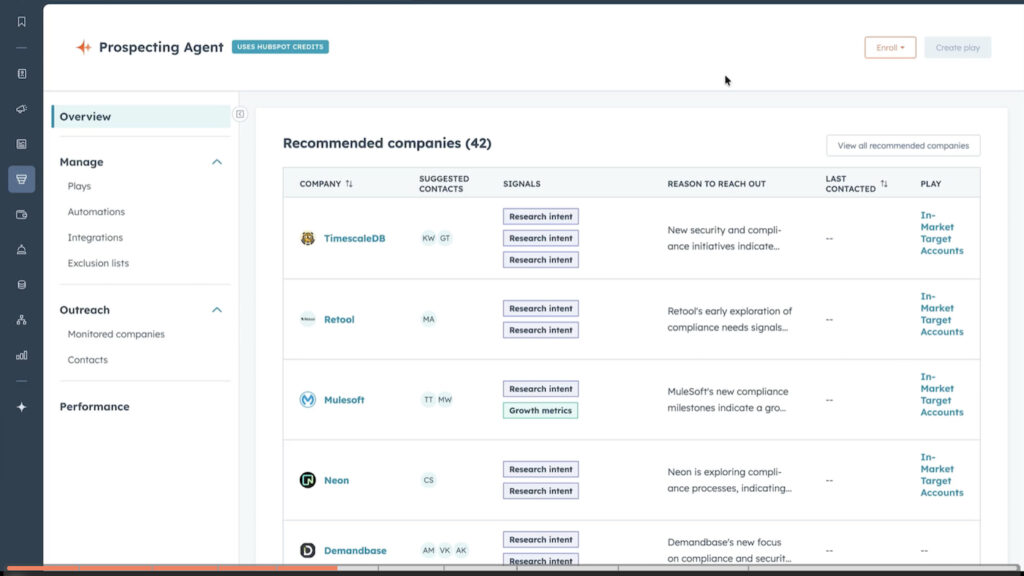
Apollo.io’s native database is its clearest advantage. Reps can search more than 240 million contacts and 30 million companies, filter them by detailed firmographic and professional criteria, enrich records, and move selected prospects into sequences.
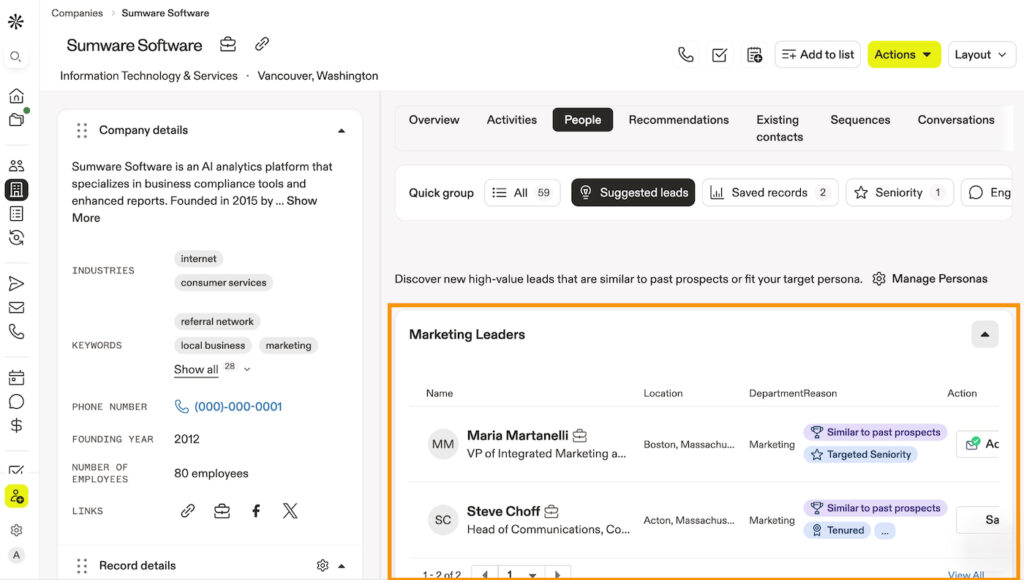
HubSpot Prospecting Agent can source and enrich prospects through HubSpot and connected data providers. It also uses CRM properties, engagement history, personas, and buying signals to find relevant contacts. This provides strong context, but the breadth of available data depends in part on the connected sources and the quality of the HubSpot portal.
| HubSpot Prospecting Agent | Apollo.io | |
|---|---|---|
| My rating | 4.44/5 | 4.83/5 |
| Native B2B database and contact sourcing | HubSpot + connected data providers | Large native B2B database |
| Data enrichment and verification | Strong connected enrichment | Native verified email, phone, and enrichment data |
| Search, segmentation, and ICP targeting | Personas, CRM properties, lists, plays, and engagement context | Advanced search and detailed ICP filtering |
| Buying signals and intent | Broad site and company signals | Strong intent, scoring, and visitor identification |
| Buying committee and contact discovery | Surfaces target personas and net-new contacts | Strong stakeholder and decision-maker search |
Winner: Apollo.io
Apollo.io leads in prospecting data and targeting with its native B2B database, built-in enrichment, and advanced search and filtering. HubSpot is stronger in certain signal-based capabilities, but Apollo.io offers a more comprehensive native foundation for finding and targeting prospects.
Also read: Best AI Lead Generation Tools
AI research and personalization
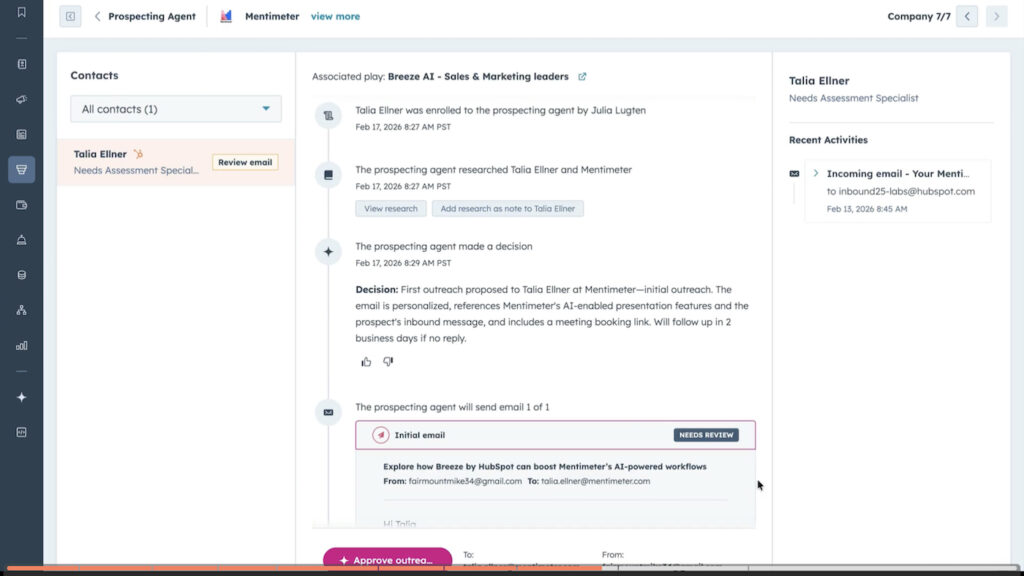
HubSpot is one of the best AI marketing tools in the market because its prospecting agent can ground its research and messages directly in HubSpot’s contact, company, engagement, and pipeline records. Teams can define personas, research criteria, messaging style, and rules, then either review drafted emails or allow autonomous sending.
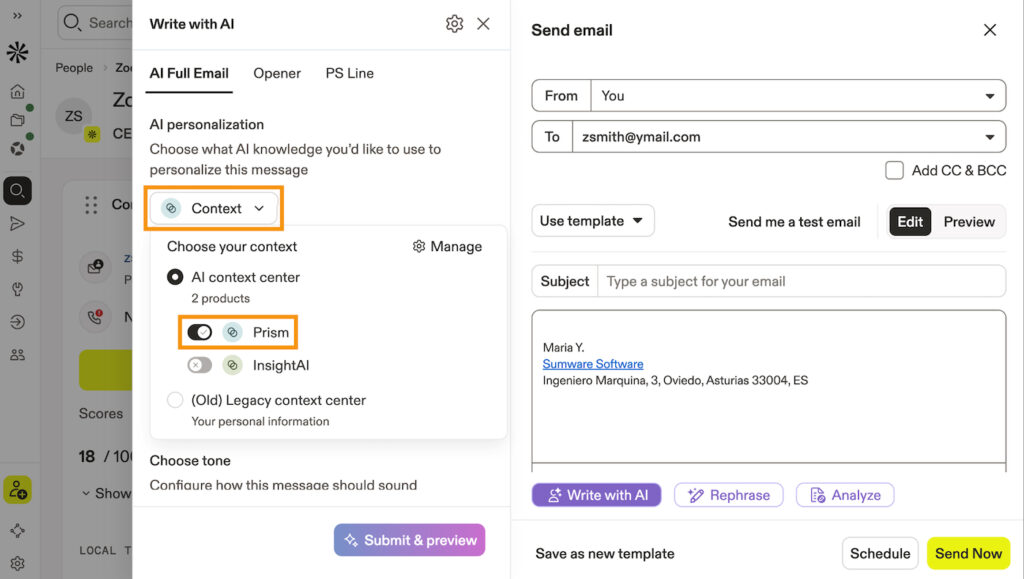
Apollo.io also offers strong AI-assisted research and personalization using its prospect database, enrichment data, and campaign context. Its output is useful for outbound workflows, but CRM-based context depends more heavily on integration quality and synchronization.
| HubSpot Prospecting Agent | Apollo.io | |
|---|---|---|
| My rating | 5/5 | 4.40/5 |
| Account and contact research | Deep research using CRM history, contacts, and signals | Strong AI research and enrichment |
| CRM and engagement-context grounding | Native HubSpot contact, company, engagement, and pipeline context | CRM context depends more on integration and sync |
| Message personalization quality | Research-based individualized email drafts | Strong personalization using prospect and account data |
| Custom instructions, personas, and voice | Advanced personas, prompts, messaging style, and play controls | Strong prompts, sequence settings, and workflow logic |
| Review controls and safeguards | Human review plus autonomous sending | Strong controls, with more reliance on sequence configuration |
Winner: HubSpot Prospecting Agent
When it comes to HubSpot vs Apollo’s AI research and personalization features, HubSpot has the advantage because it can ground prospect research and messaging directly in CRM, engagement, and pipeline context. Its customization and review controls also give teams more control over how AI-generated outreach is created and sent.
Also read: AI in Digital Marketing
Outreach and automation
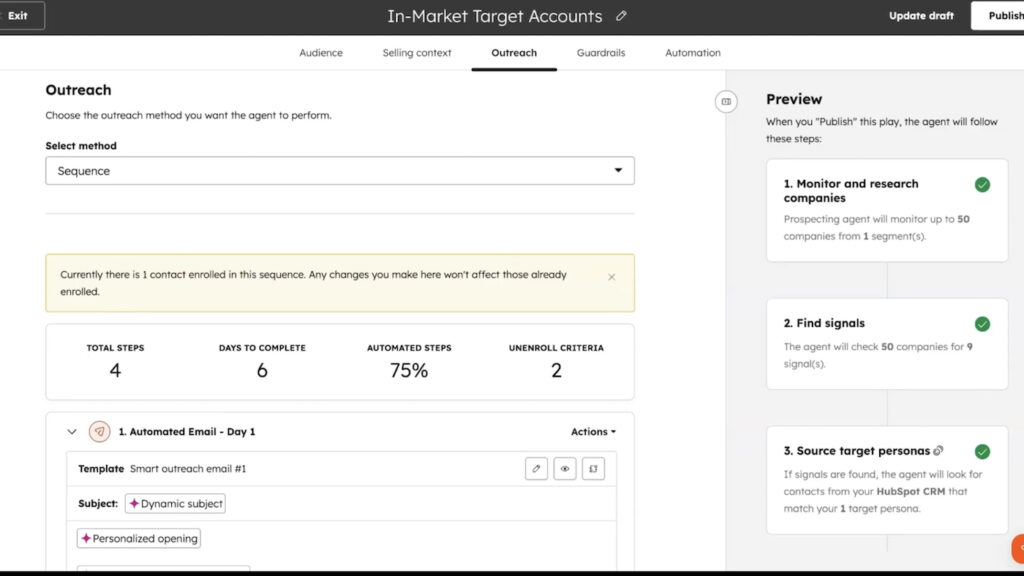
Apollo.io covers more channels natively. Its sequences can combine email, calling, and sales tasks, while its workflows support list building, routing, follow-up, and prospect management. Dedicated deliverability controls also make it better suited to teams running structured outbound programs.
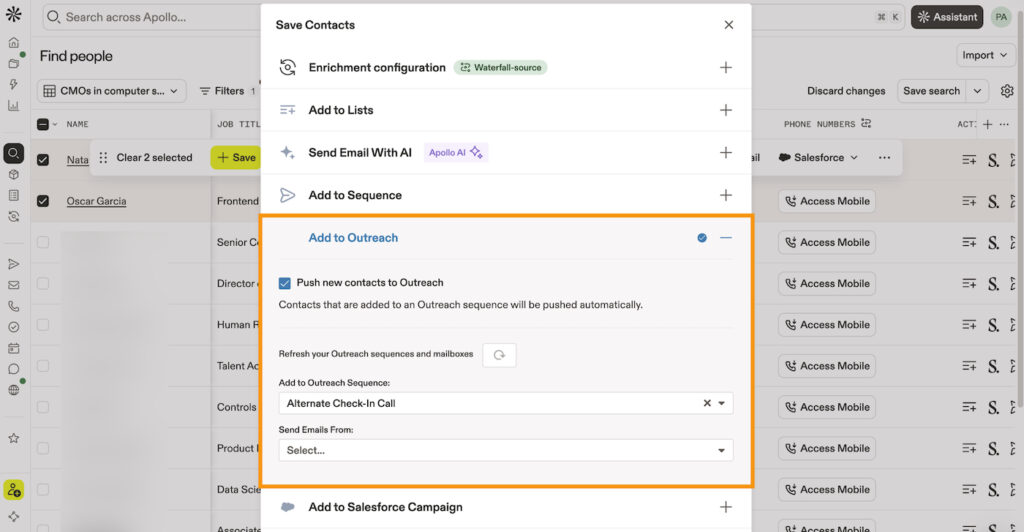
HubSpot Prospecting Agent provides strong email research, drafting, and follow-up with review and autonomous modes. It works well for email-first prospecting but is not as complete for teams that want calling and multichannel execution in the same tool.
| HubSpot Prospecting Agent | Apollo.io | |
|---|---|---|
| My rating | 3.99/5 | 4.81/5 |
| Email sequencing and follow-up | Strong automated email outreach and follow-up | Advanced native sequencing |
| Native multichannel execution | Primarily email | Email, calls, and sales tasks |
| Workflow automation | Strong plays, enrollment logic, and CRM workflows | Flexible prospecting, routing, sequence, and task automation |
| Autonomous and review modes | Human review and autonomous email sending | Configurable controls; review depends more on workflow setup |
| Reply, follow-up, and meeting handling | Strong follow-up and CRM activity capture | Strong sequencing, scheduling, tasks, and routing |
| Deliverability controls | Standard HubSpot email infrastructure and controls | Dedicated outbound deliverability safeguards |
Winner: Apollo.io
After pitting HubSpot vs Apollo in outreach and automation, I found that Apollo.io offers broader native execution across email, calls, tasks, workflows, and deliverability controls. HubSpot Prospecting Agent is well suited to AI-driven email prospecting, while Apollo.io covers more of the multichannel outbound workflow.
Also read: Best AI Sales Automation Tools
CRM, integrations, and reporting
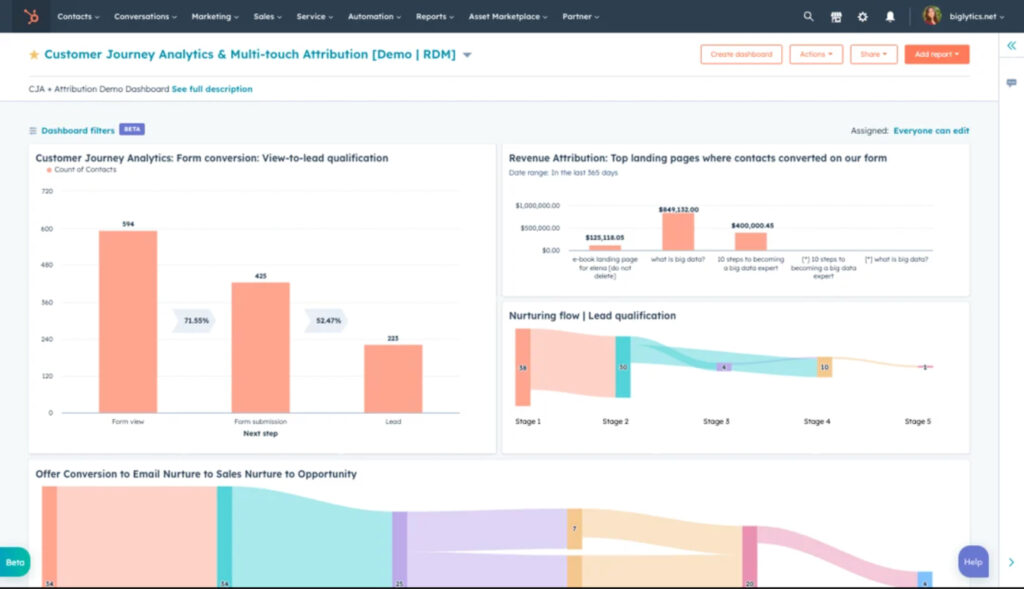
HubSpot has the advantage because Prospecting Agent operates within HubSpot Smart CRM. Research, outreach, contact activity, deal progression, and reporting share the same data model, which improves visibility and reduces synchronization risk. HubSpot also provides broad app-marketplace and API support.
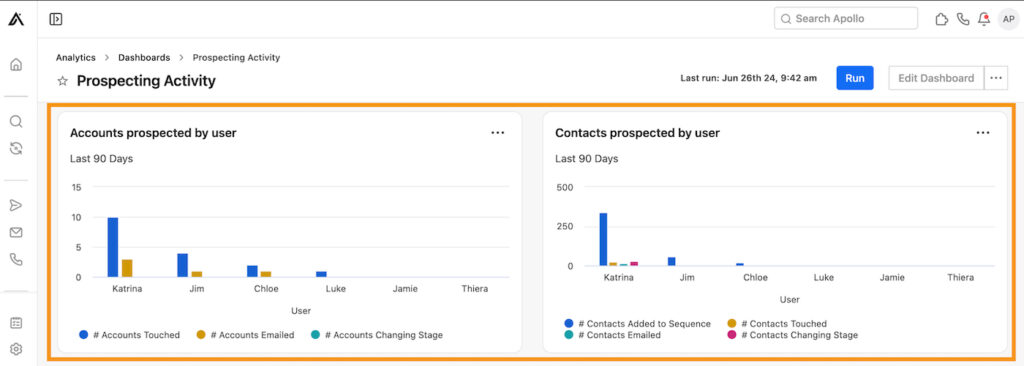
Apollo.io integrates with major CRMs and offers its own sales workspace, reporting, and APIs. Those capabilities are strong, but pipeline attribution and governance depend more on how the integration is configured and maintained.
| HubSpot Prospecting Agent | Apollo.io | |
|---|---|---|
| My rating | 4.93/5 | 4.44/5 |
| CRM depth and synchronization | Native HubSpot Smart CRM system of record | Deep CRM integrations and synchronization |
| Third-party integrations | Broad marketplace and connected data providers | Broad CRM, sales, productivity, and API integrations |
| Reporting and pipeline attribution | Prospecting activity tied directly to pipeline and revenue reporting | Strong campaign analytics; full attribution depends more on CRM sync |
| Governance and admin controls | Native permissions, logging, review controls, and CRM governance | Strong controls with more hands-on configuration |
| API and extensibility | Strong HubSpot APIs and marketplace | Strong APIs, Chrome extension, and workflow integrations |
Winner: HubSpot Prospecting Agent
HubSpot leads in CRM, integrations, and reporting because prospecting activity operates directly within HubSpot Smart CRM, supporting stronger pipeline visibility and governance. Apollo.io integrates broadly, but its CRM context and attribution depend more on synchronization with external systems.
Also read: Best CRM Software
Ease of use, support, and expert assessment
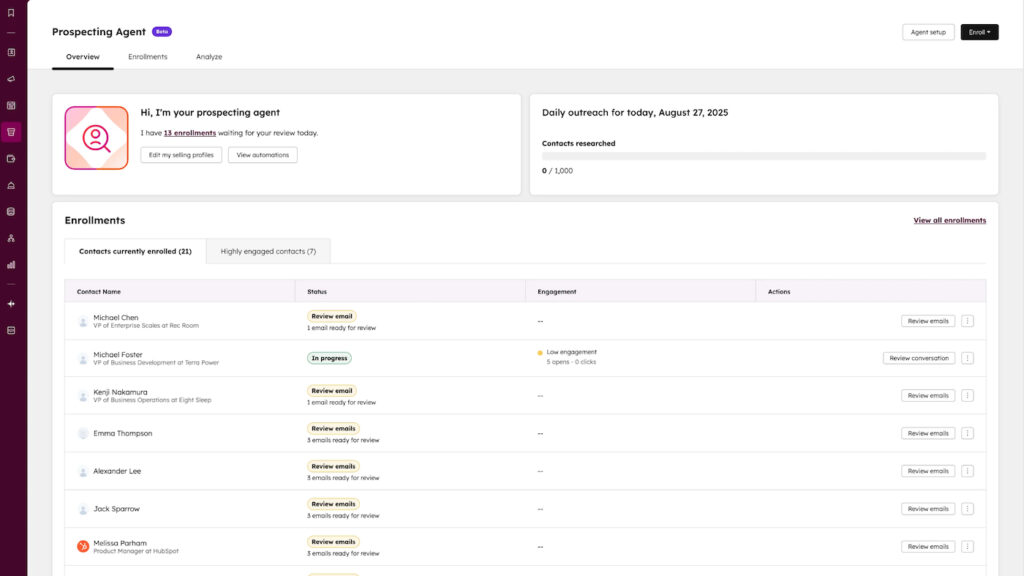
HubSpot is easier to adopt for teams already working in its CRM. Its interface, permissions, automation, activity history, Academy, help center, and support ecosystem give users a consistent environment. Human review and autonomous modes also make it easier to determine how much control the agent receives.
Apollo.io is approachable, but its wider scope means teams must configure data filters, credits, sequences, mailboxes, calling, deliverability, CRM synchronization, and workflow rules. That flexibility is valuable, though it adds operational complexity.
| HubSpot Prospecting Agent | Apollo.io | |
|---|---|---|
| My rating | 4.73/5 | 4.50/5 |
| Setup and onboarding | Straightforward for HubSpot users; requires CRM data, personas, and plays | Easy entry, but more outbound components require configuration |
| Day-to-day usability | Unified CRM workspace minimizes context switching | Strong interface; broader scope adds complexity |
| Help, onboarding, and support resources | Extensive Academy, help, community, onboarding, and support | Strong knowledge base, Academy, community, and support |
| Practical feature quality | Strong CRM-native research, personalization, and governance | Strong data, sequencing, calling, automation, and deliverability |
| Value for target buyer | Best for CRM-connected email prospecting and HubSpot users | Best for native B2B data and multichannel outbound |
| Research transparency and product maturity | Strong documentation; Prospecting Agent is newer than HubSpot’s broader platform | Mature platform with extensive public documentation |
Winner: HubSpot Prospecting Agent
In my comparison of Apollo and HubSpot Prospecting Agent, the latter has a slight edge in usability, support, and expert assessment, particularly for teams already working within its ecosystem. Its unified workspace reduces context switching, while Apollo.io’s broader outbound capabilities require somewhat more setup and ongoing configuration.
Also read: Best Easy to Use CRM Software
Which product is right for you?
Choose HubSpot Prospecting Agent if:
- Your company already uses HubSpot Smart CRM.
- You want AI research and email personalization grounded in CRM activity.
- Human review, permissions, and pipeline attribution are priorities.
- Your prospecting motion is primarily email-based.
- You prefer usage-based pricing tied to prospects recommended for outreach.
Choose Apollo.io if:
- You need a native B2B contact and company database.
- Your sales motion combines email, calling, and task-based follow-up.
- You want prospecting, enrichment, sequencing, and deliverability in one platform.
- Your team wants a free entry point before committing to paid software.
- You are prepared to manage credit usage, sending controls, and data verification.
Alternatives to HubSpot Prospecting Agent and Apollo.io
| Alternative | Best for | Starting price |
|---|---|---|
| ZoomInfo Copilot | Enterprise sales intelligence and buying signals | Contact for quote |
| Outreach | Enterprise sales execution and engagement | Contact for quote |
| Clay | Custom enrichment and go-to-market workflows | Free or $167/month |
Frequently asked questions