Employees are showing strong interest in developing AI skills, with 53% stating they actually want AI-related training. Yet only 29% of employees say their company invests enough in their AI training. That gap is getting harder to ignore as AI becomes more integrated into everyday work.
The gap between employee demand and employer training
Even as employees’ interest in AI skills grows, many feel their employers aren’t keeping up with demand. That creates an impression that employees are expected to use AI tools without the company’s guidance on how to use them effectively.
When there aren’t enough opportunities for training, employees will look for other ways to develop those skills. In fact, Salesforce’s research indicates 45% of employees already plan to pay out of pocket to upskill on their own dime.
This shows that employees are aware of how essential AI skills are to their jobs and for their overall career. Employees see these new capabilities as a way to stay competitive and open doors to new career opportunities.
But for employers, this could also mean losing some of your best talent.
Upskilling: A make-or-break for retention
As more employees see AI skills as central to staying relevant in their fields, training opportunities will play a more significant role in whether they stay with a company. Companies that invest in their employees’ development will be better positioned to retain employees who are motivated to grow and adapt with the organization.
However, developing those skills also increases an employee’s value in the labor market. Research shows roles that require AI skills have a 23% higher advertised salary than those that don’t.
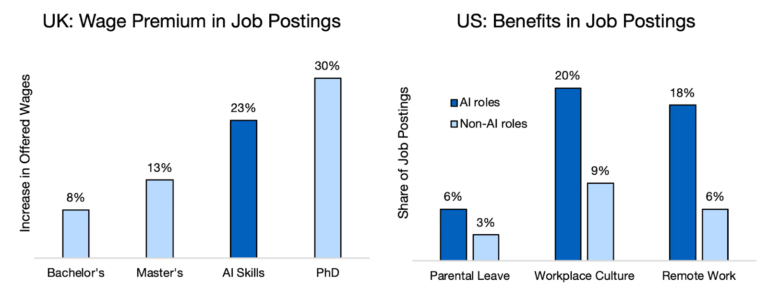
This creates a new balance for employers to manage. Upskilling employees can strengthen your company and retention, but you also have to be prepared to compensate for the growing value of those skills.
Related: Top Employee Retention Strategies
Tips for AI upskilling
Helping employees develop AI skills doesn’t have to be complicated, but it does require a thoughtful approach. Here are a few tips I recommend to help you start upskilling your teams:
1. Start with AI tools already in use
Start by reviewing the types of AI systems your organization uses. Is there a large language model, an AI agent, or an AI model embedded within your existing systems? Offer training on these systems first so employees understand how AI fits into their daily responsibilities and builds their confidence in these tools.
2. Plan training around upcoming AI tools
If your company plans to implement new AI systems, training should begin before the launch date. Identifying the skills employees will need ahead of time allows you to create a structured learning plan.
3. Don’t overlook non-technical AI skills
Knowing how to craft an effective prompt is important, but training should also include soft skills like problem framing and information literacy. These skills help employees use AI more responsibly and are transferable to non-AI settings as well.
4. Identify internal AI champions
At most companies, there are usually a few employees who catch on quickly and figure out how to use AI tools effectively. Instead of letting that knowledge stay siloed, ask those employees what the training program should include. They can also offer pro tips and provide peer support to other employees who are less comfortable with AI.
Related: How to Upskill Your Workforce
Make AI learning part of ongoing development
AI skills will continue to evolve, so training shouldn’t be treated as a one-time initiative. Employers that integrate AI education into professional development programs and ongoing learning opportunities are better positioned to keep their teams prepared in the future.
When employees understand how to work effectively with AI, the technology becomes far more useful across the organization. And for employers, that’s where real success lies. Companies that prioritize skill development today will be better positioned to adapt, compete, and retain top talent.